

The best all-round flight-control setup for X-Plane on a Mac is the Honeycomb Foxtrot Takeoff Kit. It is one of the few current HOTAS systems whose manufacturer explicitly lists both Mac and X-Plane 11/12 support.
For a single traditional stick, choose the Honeycomb Foxtrot Aviation Stick. If space matters more than a full-size stick, the Honeycomb Echo Aviation Controller is the most practical compact alternative.
X-Plane 12 remains one of the best flight simulators for Mac, but buying a joystick for a Mac needs more care than it does on a Windows PC. A controller can appear as a generic USB device without its lights, display, configuration app or every switch being properly supported in macOS.
That is why this is deliberately a shorter 2026 list. We have prioritised controls whose makers currently state Mac and X-Plane 11/12 compatibility, rather than repeating popular Windows-first sticks as if they are guaranteed Mac purchases.
Important: Microsoft Flight Simulator is not a native Mac app. This guide is for X-Plane 12 on macOS. Do not buy a controller on the assumption that Microsoft Flight Simulator will run locally on your Mac just because its manufacturer also lists MSFS support. For more, check our guide on how to play Microsoft Flight Sim on a Mac.
The Best Joysticks for Mac & X-Plane Compared
| Flight controller | Best for | Mac and X-Plane status | Typical price band |
|---|---|---|---|
| Honeycomb Foxtrot Takeoff Kit | Best overall HOTAS for Mac | Manufacturer lists Mac and X-Plane 11/12; stick and compact throttle box | Mid-range |
| Honeycomb Foxtrot Aviation Stick | Best standalone flight stick | Manufacturer lists Mac and X-Plane 11/12; 16-bit Hall-effect sensors and twist rudder | Mid-range |
| Honeycomb Echo Aviation Controller | Best compact controller for a MacBook or small desk | Manufacturer lists Mac and X-Plane 11/12; wired USB-C or supplied wireless dongle | Mid-range |
| Logitech G X52 Pro HOTAS | Best legacy/discount HOTAS if you accept limitations | Basic Mac HID support, but its Mac support information is old and Windows-only software limits features | Varies widely |
Prices and UK stock change frequently. In October 2026, the Foxtrot stick is commonly around $130/£130, the Takeoff Kit around $150-$180 / £150–£180 when available, and the X52 Pro varies particularly widely between new, discounted and used listings. Check the final delivered price, VAT and returns policy before ordering from an EU retailer.
How We Chose
For a controller to be a main recommendation here, the manufacturer must currently list Mac compatibility and support for X-Plane 11 or 12. We make one clearly labelled legacy exception for the Logitech X52 Pro because Logitech still documents basic Mac HID operation, but it is not a like-for-like alternative to the Honeycomb options.
This excludes a number of very familiar flight sticks. They may work as generic USB hardware for some owners, but that is not the same as being a current, supported Mac recommendation.
1. Honeycomb Foxtrot Takeoff Kit — Best Overall Joystick Setup for Mac
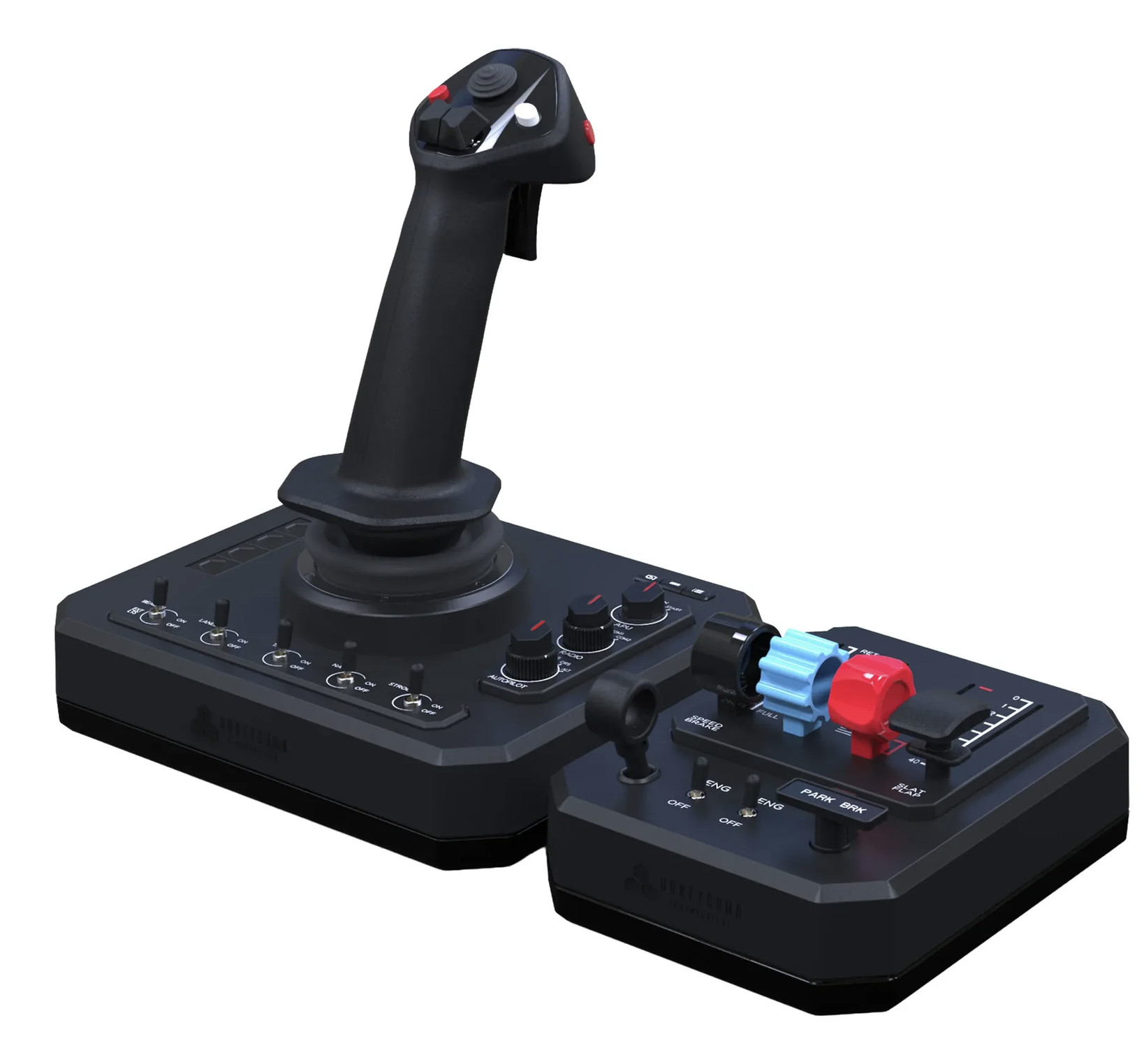
The Honeycomb Foxtrot Takeoff Kit is the best starting point for most Mac pilots because it combines a proper flight stick and throttle box in one compact HOTAS setup. Honeycomb explicitly lists it for PC and Mac, plus X-Plane 11 and 12, and publishes Mac X-Plane downloads for its current range.
The Foxtrot stick handles pitch, roll and yaw through a twist-rudder axis, so you do not need to buy pedals on day one. It uses 16-bit Hall-effect sensors, has adjustable resistance and avoids a pronounced centre detent. The accompanying throttle box adds four levers, flap, thrust, parking-brake and landing-gear controls, with interchangeable caps for general-aviation and airliner-style flying.
It is a much safer Mac purchase than mixing a popular PC stick with a separate Windows-only throttle. You can begin with a capable HOTAS, then add dedicated pedals later if you find yourself flying regularly.
Why we recommend it
- Manufacturer-listed Mac and X-Plane 11/12 compatibility
- Stick and throttle in a relatively compact, coherent package
- Hall-effect sensors, adjustable tension and twist rudder
- Four-lever throttle that suits both light aircraft and multi-engine airliners
- Better value and less desk clutter than assembling a cockpit one device at a time
Watch out for
- Availability can be inconsistent and may not even be available on Amazon in the USA. Honeycomb’s European shop has warned that UK deliveries may take longer and could attract additional duties, so use a retailer with clear UK pricing and returns.
- Twist rudder is convenient, but it is not as natural as separate pedals for taxiing, crosswind landings or differential braking.
- As with any new control set, assign every axis yourself in X-Plane rather than assuming an MSFS profile will translate correctly.
Best for: Anyone who wants a genuine throttle-and-stick setup for X-Plane on a Mac without building a permanent cockpit.
2. Honeycomb Foxtrot Aviation Stick — Best Standalone Joystick for Mac
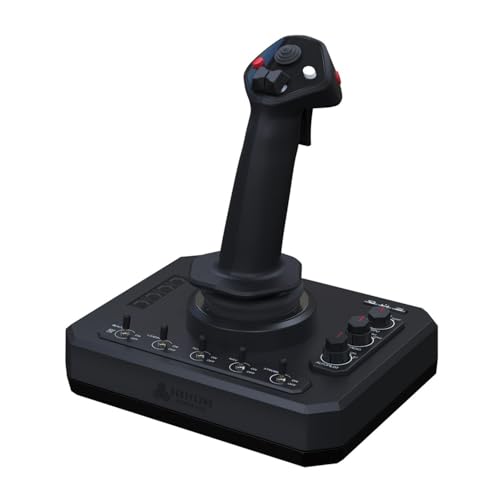
If you want a traditional stick rather than a full HOTAS, the Honeycomb Foxtrot Aviation Stick is the clearest 2026 choice for a Mac. Honeycomb explicitly lists Mac and X-Plane 11/12 compatibility, which is still unusually reassuring in this category.
It is especially well suited to sidestick-controlled aircraft, aerobatic flying and users who want smooth, precise control without a large yoke on the desk. The stick is ambidextrous and uses 16-bit Hall-effect sensors with adjustable X- and Y-axis tension. It also has a twist-rudder axis, a hat switch, trigger, buttons, rocker switches and an integrated switch panel, so you can keep essential functions off the keyboard.
Honeycomb supplies a USB-C-to-USB-A cable. If your Mac only has USB-C ports, you will need a reliable USB-C hub or adapter with a data-capable USB-A port.
Why we recommend it
- Explicit Mac and X-Plane 11/12 support
- Smooth Hall-effect stick with adjustable resistance
- Ambidextrous grip and twist rudder work well on a small desk
- Useful buttons, switches and rotary controls for common X-Plane commands
- More modern and supportable than the old entry-level sticks commonly recommended for Macs
Watch out for
- It is a stick only: there is no separate throttle quadrant in the box.
- It uses a smooth, detent-free action. That is excellent for fine control, but some people prefer the stronger self-centring feel of older spring-based sticks.
- Buy a proper throttle later if you want more realistic engine management than a small slider can provide.
Best for: Beginners and regular X-Plane pilots who want the strongest standalone Mac-compatible stick, with room to upgrade later.
3. Honeycomb Echo Aviation Controller — Best Compact Flight Controller for MacBooks
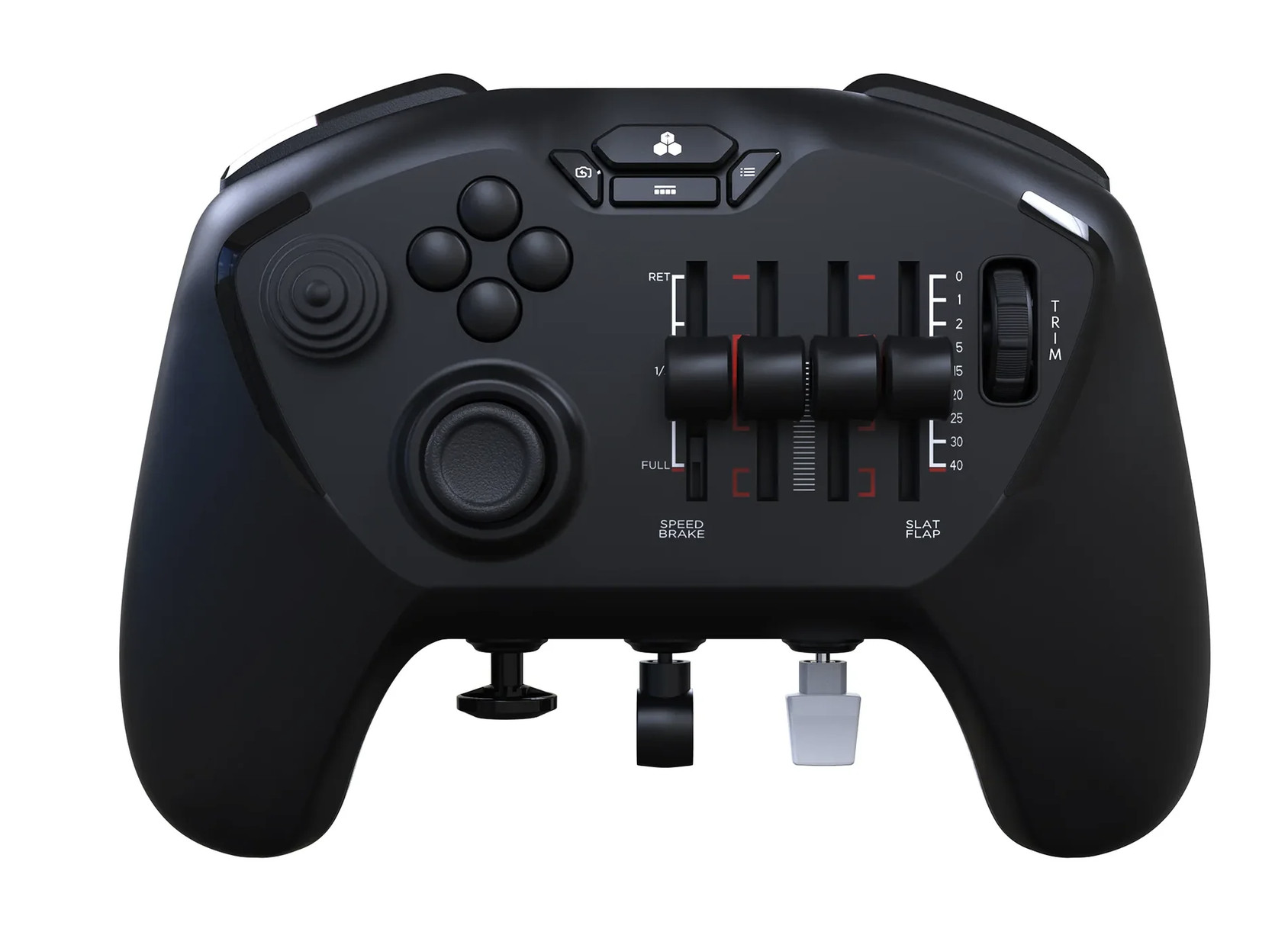
The Honeycomb Echo Aviation Controller is not a conventional desktop joystick, but it is the most useful answer if you fly from a MacBook, a sofa or a very small desk. It puts pitch, roll, yaw, throttle, trim, flaps, gear and parking-brake controls into a handheld unit with a travel case.
Honeycomb lists both Mac and X-Plane 11/12 compatibility. Its 16-bit Hall-effect thumbstick controls pitch and roll, while mechanically linked rear paddles act as rudder pedals. Four sliders with interchangeable caps cover engines and secondary controls. It can connect by USB-C or with the supplied 2.4 GHz wireless dongle.
This is not the first choice for someone seeking the feel of a real centre stick or sidestick. But it is much more capable than an ordinary gamepad and is genuinely practical for a portable Mac setup.
Why we recommend it
- Explicit Mac and X-Plane 11/12 support
- Very small footprint, with a protective travel case
- Hall-effect primary controls, physical trim wheel and dedicated flight controls
- Includes both USB-C wired and wireless-dongle connection options
- Makes a much better first purchase than a large desktop rig you may rarely have space to use
Watch out for
- It is a compact all-in-one controller, not a replacement for the fine hand position and throw of a full-size stick, throttle and pedals.
- Connect it by cable for the first X-Plane setup. Once every axis and button works, try the wireless dongle if you prefer it.
- Avoid the separate Echo XPC model for a Mac purchase: Honeycomb describes that version as Xbox and PC focused.
- Availability can be limited and may not even be stocked by Amazon.
Best for: MacBook users, casual pilots and anyone who needs to pack their controls away between flights.
4. Logitech G X52 Pro HOTAS — Best Legacy Alternative, With Mac Caveats
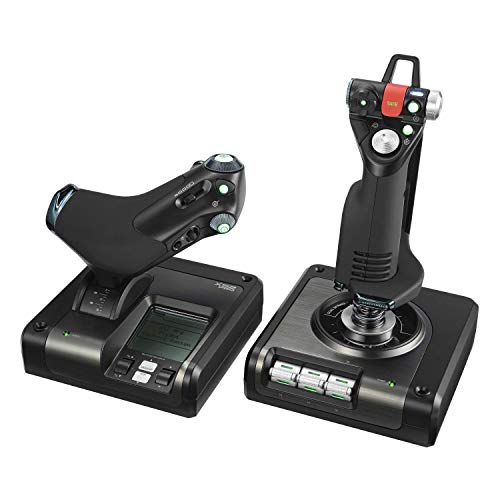
The Logitech G X52 Pro remains a tempting option because it is widely available, includes a separate throttle and can be cheaper than newer hardware. It is still capable of being used with X-Plane on a Mac, but it needs a more qualified recommendation in 2026 than it received in older versions of this guide.
Logitech states that, apart from its Pro Flight Panels, the older Saitek/Logitech flight range can work on Mac as basic plug-and-play HID devices. That lets you map axes and buttons in the simulator. However, Logitech’s Mac support table is old, names X-Plane 10 rather than X-Plane 12, and makes clear that Mac users do not get its Windows driver, plug-in and programming software.
In practical terms: do not buy the X52 Pro expecting every LCD, radio-stack feature, lighting option, dead-zone setting or profile tool to work on a current Mac. Buy it only when the price is compelling and the retailer offers an easy return, then test every axis and button promptly in X-Plane.
The X52 Pro’s throttle connects to the stick unit, with the stick providing the USB connection to the Mac. It does not normally require two Mac USB ports, as the old version of this article suggested.
Why it can still make sense
- Separate throttle and stick, with adjustable throttle resistance
- Twist rudder means you can start without pedals
- Dual-spring centring and non-contact X/Y sensors
- Usually easy to find new, discounted or second-hand
Mac limitations to understand first
- Treat it as basic HID hardware that you configure in X-Plane, not as a fully supported modern Mac ecosystem.
- Logitech’s software, custom profiles and some LCD/lighting/plug-in functions are Windows-first.
- The X52 Pro does not have current, explicit manufacturer-listed X-Plane 12 Mac support in the way the Honeycomb controls do.
Best for: Existing owners, or buyers finding one significantly cheaper than a Foxtrot Takeoff Kit from a retailer that accepts returns.
Popular Joysticks We No Longer Recommend as Mac Picks
The following controls are popular for PC flight simulation, but should not be described as fully Mac-compatible recommendations in 2026:
| Product | Why it is not a main Mac recommendation |
|---|---|
| Thrustmaster T.16000M FCS / T.16000M FCS HOTAS | Thrustmaster’s current product pages list the hardware and X-Plane 11/12 support for PC/Windows, not Mac. It may be recognised as a generic USB device in some setups, but that is not enough for a Mac-specific buying recommendation. |
| Logitech Extreme 3D Pro | It is an ageing, Windows-focused stick. Logitech’s current support pages provide Windows support, not a current Mac/X-Plane 12 promise. Do not present it as “fully macOS compatible.” |
| Saitek/Logitech Attack 3 | This is an obsolete, basic PC stick and no longer a worthwhile new purchase for a Mac flight-sim guide. |
| Turtle Beach VelocityOne Flightstick | Turtle Beach markets it for Xbox and Windows PC, and its support team has stated that the Flightstick does not support macOS. |
If you already own one of these, plug it in and see whether X-Plane detects each axis. That can be a perfectly reasonable no-cost experiment. It is simply not the same as buying one new because an old article says it is Mac-compatible.
What to Look for in a Mac Flight Joystick
1. Explicit macOS support, not just a USB connector
Most flight hardware connects over USB, but that alone proves very little. Look for a current manufacturer page that names Mac and, ideally, your simulator. It is the difference between a controller X-Plane can map successfully and a product whose key features depend on a Windows driver or plugin.
2. X-Plane 12 support
For a full flight-control setup, X-Plane 12 is the sensible Mac target. Laminar Research supports macOS 12 Monterey or later and recommends Apple silicon for the strongest experience. X-Plane has its own controller calibration and button-assignment tools, so it can work well with hardware that does not require a separate desktop app.
3. Stick only or HOTAS
A single stick is the easiest way to begin. A HOTAS gives you a separate throttle and makes longer flights, jets and complex aircraft much more enjoyable. Neither is automatically “better”: a stick is an excellent, compact choice for beginners, Airbus-style sidesticks, aerobatics and helicopters.
4. Twist rudder or pedals
A twist-rudder stick is enough to start. Dedicated pedals are the later upgrade that improves taxiing, coordinated turns, crosswind landings and differential braking. Do not feel you need to buy the whole cockpit at once.
5. USB-A, USB-C and hubs
Many controls still end in USB-A, even when the device itself has a USB-C socket. Check the cable supplied and the ports on your Mac before ordering. For your first setup, connect the controller directly to the Mac or through one good-quality adapter. A powered hub becomes worthwhile once you have several devices, but it will not fix a Windows-only driver or a controller that X-Plane cannot see.
How to Set Up a Joystick in X-Plane on macOS
X-Plane lets you configure axes and buttons itself, so do this even if a controller claims to include a profile.
- Connect one main controller first. Start with the stick or HOTAS before adding pedals, a gamepad or extra panels.
- Open X-Plane 12 and go to
Settings > Joystick & Equipment. Select the Axis tab. - Move every axis through its full range. X-Plane will show the active bar. Assign the stick forward/back axis to pitch, left/right to roll, twist to yaw and the throttle to throttle.
- Calibrate before flying. Move each control through its full travel, then use X-Plane’s centre option if the stick does not return precisely to neutral.
- Set unused inputs to
none. This avoids a second controller or slider fighting your main pitch, roll or throttle setting. - Assign a few essential buttons. Brakes, trim, flaps, landing gear, parking brake and views are a good start. Add complex commands only after the basics work.
- Test in a default aircraft. A simple Cessna makes it easier to spot a reversed axis or duplicate assignment before you load a complex add-on aircraft.
Laminar Research’s official X-Plane flight-controls guide explains the same process in more detail.
FAQ
Do joysticks work on Apple Silicon Macs?
Yes, but Apple silicon is not a blanket compatibility guarantee. X-Plane 12 runs on Apple silicon and can map connected controllers, but a flight stick’s configuration software, display, lights or special buttons may still be Windows-only. Choose hardware that explicitly names Mac support where possible.
Is a joystick better than a yoke for X-Plane on Mac?
Not universally. A joystick is more compact and is the natural choice for sidestick aircraft, aerobatics and helicopters. A yoke feels more authentic for many light aircraft and airliners. Start with the aircraft you most enjoy flying and the space you actually have; see our guide to the best flight simulator controls for Mac for yokes, throttles and pedals.
Does the Logitech X52 Pro work on a Mac?
It can work as a basic USB HID controller that you map in X-Plane, but it is not a fully supported modern Mac experience. Logitech’s Mac guidance is aimed at basic operation and older X-Plane support; its driver, profile and some display/lighting features are Windows-only. Buy it with a return option and test it immediately.
Can I use the Thrustmaster T.16000M FCS on a Mac?
You may find reports of it appearing as a generic USB controller, but Thrustmaster currently lists the T.16000M and its X-Plane support for PC/Windows. We would not buy it new as a Mac-specific recommendation.
Do I need a powered USB hub?
Not for one flight stick. It becomes useful when you add several controls, illuminated panels, pedals and external storage to a Mac with limited ports. Start with a direct connection when troubleshooting, then add a reputable powered hub if you need more ports.
Final Verdict
For most Mac users flying X-Plane 12, buy the Honeycomb Foxtrot Takeoff Kit. It combines the right controls in one space-efficient package and, crucially, is explicitly sold for Mac and X-Plane 11/12.
If you only want a stick, the Honeycomb Foxtrot Aviation Stick is the strongest standalone choice. For a MacBook or a tiny desk, the Honeycomb Echo Aviation Controller is the practical compact alternative. The Logitech X52 Pro is only worth considering as a well-priced legacy option, with its Mac limitations understood upfront.
For more ways to expand your setup, see our complete guide to the best flight simulator controls for Mac.