

Tracing your family history is much easier on a Mac than it used to be, but the right choice depends on what you want your software to do.
If you want the most polished, genuinely Mac-native experience, MacFamilyTree 11 is the best overall choice. If you already keep your main tree on Ancestry and want it to stay synchronised with a desktop database, Family Tree Maker 2024 is the stronger option. For serious research across several genealogy services, RootsMagic 11 offers excellent value and a local copy of your work.
The important distinction is between a family-tree application, which can keep your master data on your Mac, and an online genealogy service, which is better for finding records, DNA matches and distant relatives. Most committed researchers use both: a desktop app to organise and preserve their work, plus Ancestry, FamilySearch, MyHeritage or Findmypast to discover new evidence.
If you need to map family relationships for clinical, social-work or therapeutic purposes rather than trace genealogy, see our guide to genogram software for Mac. Genograms and family trees can look similar, but they are designed for different jobs.
Below are the best family tree makers for Mac in 2026, including free options. We have prioritised current development, Mac compatibility, data ownership, GEDCOM portability, source handling, research integrations, family sharing and the quality of charts and reports.
Important for macOS Golden Gate: Family Tree Maker 2024 explicitly lists macOS Golden Gate (27) in its current system requirements. Several other developers still list formal support only through macOS Tahoe (26), or do not yet make a Golden Gate claim. That does not mean their apps will not work, but download the demo or free trial before moving a large family file to a new Mac or macOS release.
Quick Picks
| Best for | Software | Why choose it | Cost model |
|---|---|---|---|
| Best overall native Mac app | MacFamilyTree 11 | Beautiful Mac interface, excellent charts, iPhone/iPad companion and easy iCloud-based sharing | US$69.99 list price; promotions are common |
| Best for Ancestry users | Family Tree Maker 2024 | One-click Ancestry sync, FamilySearch hints, strong reporting and recovery tools | Paid licence; regional pricing varies; optional TreeVault services |
| Best value for serious research | RootsMagic 11 | Local database, Ancestry/FamilySearch/Findmypast/MyHeritage connections and more than 100 report/chart options | US$39.95 one-time purchase |
| Best for a long-term local archive | Reunion 14 | Mature Mac software with powerful searching, source records, books and printable wall charts | About US$99; upgrade and iOS companion costs are separate |
| Best for European research | Heredis 2027 | Native macOS app with strong source, map, chart and document tools | US$69.99 Mac list price |
| Best free all-rounder | Gramps | Free, open source and exceptionally detailed | Free |
| Best free GEDCOM-first option | Ancestris | Keeps your work in a standard GEDCOM file and gives you deep data-management tools | Free |
| Best web service for global research and DNA matches | MyHeritage | Strong international record matching, family sharing and photo tools | Free account; records, enhanced features and DNA cost extra |
Prices were checked in September 2026 and can vary by country, promotion and exchange rate.
How We Chose These Apps
We gave the most weight to whether an app is still actively maintained, handles a local family file well, imports and exports GEDCOM, records sources and media properly, and offers a sensible Mac workflow. We also considered current Apple Silicon and macOS support, research integrations, sharing, reporting and the ease of creating a reliable backup.
We did not rank an app highly merely because an online service claims billions of records. Record databases are valuable, but they are separate from the quality of the software you use to document, cite and preserve what you find. We also checked long-term Mac-user feedback alongside the developer documentation; that is why MacFamilyTree and Reunion rank highly for dedicated Mac users, while Family Tree Maker and RootsMagic lead for Ancestry-connected research.
The Best Family Tree Software for Mac
1. MacFamilyTree 11 — Best Overall Family Tree Software for Mac
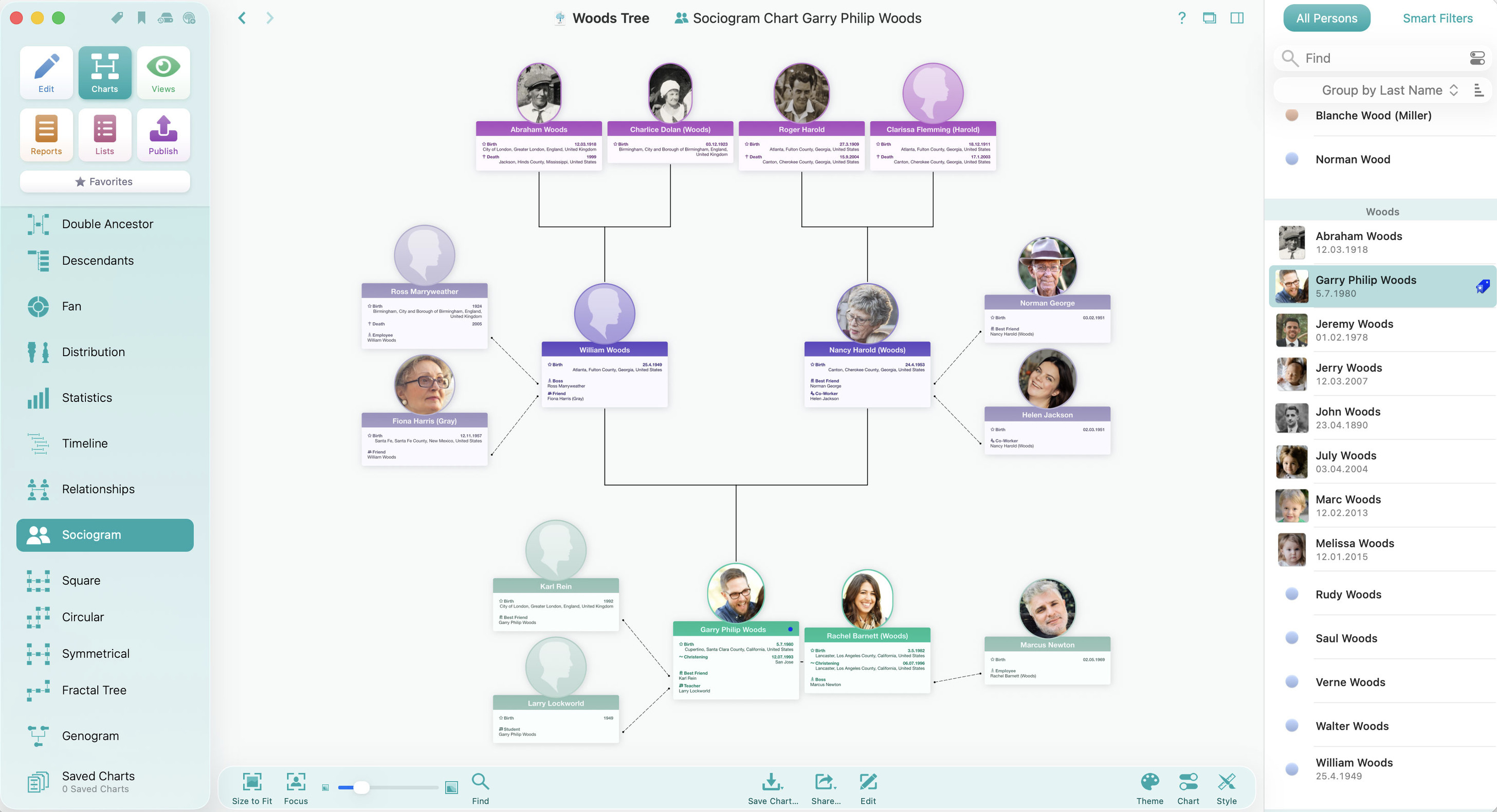
MacFamilyTree is our top pick for most Mac owners because it feels like it belongs on macOS rather than being a Windows genealogy program adapted for the Mac. It is quick to navigate, makes even large trees easy to explore, and presents names, events, places, sources and media in a much clearer way than more database-like alternatives.
The standout feature is its presentation quality. You can turn the same family data into fan charts, hourglass charts, kinship reports, descendant trees, books, slideshows, maps and an interactive 3D tree. That makes it especially good if you want to give a printed family history to relatives rather than simply maintain a research database.
MacFamilyTree also has unusually good Apple-device support. Its separate MobileFamilyTree app lets you work with the same tree on an iPhone or iPad, while CloudTree Sync & Share uses iCloud to let invited relatives contribute in real time. This is far more natural for a Mac-and-iPhone household than emailing GEDCOM files back and forth.
For research, MacFamilyTree can search the free FamilySearch archive and import GEDCOM files. It does not advertise the same direct, continuous Ancestry tree sync as Family Tree Maker, so it is not the best fit if Ancestry is where your master tree already lives. Use its demo before committing, particularly if you have moved to macOS Golden Gate, because Synium’s current published compatibility information is through macOS Tahoe.
Best for: Mac users who value a polished interface, beautiful charts, iPhone/iPad access and easy family collaboration.
Pricing: US$69.99 list price, with regular direct-sale discounts. Also available on the Mac App Store. MobileFamilyTree is a separate purchase.
2. Family Tree Maker 2024 — Best for Ancestry Syncing on a Mac
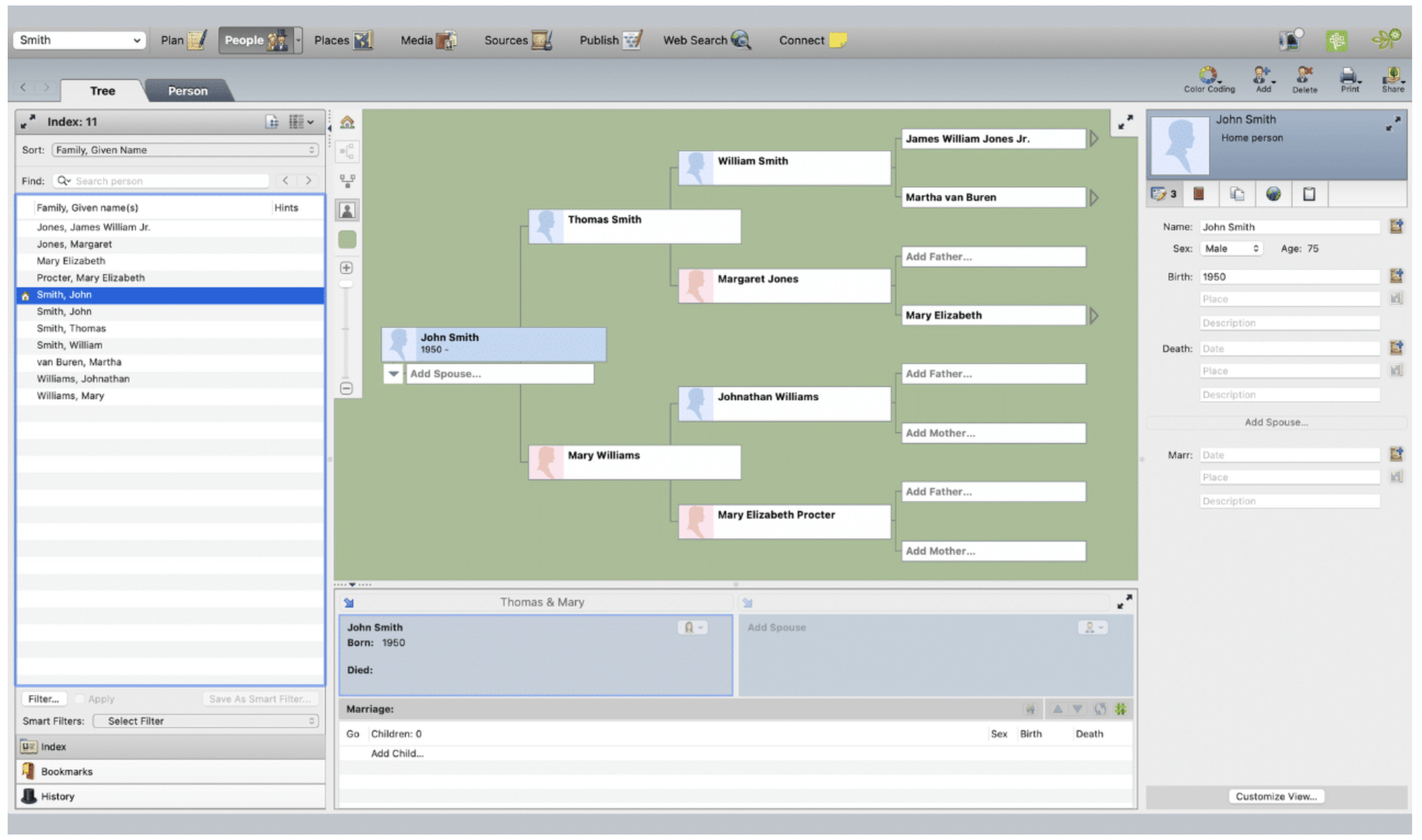
Family Tree Maker (FTM) 2024 is the current version for Mac, replacing the outdated FTM 2019. It is the best choice if you want a desktop copy of an Ancestry tree that can stay in step with the version online. MacKiev describes its Ancestry integration as one-click synchronisation, and FTM also surfaces FamilySearch hints within the app.
That matters because Ancestry is excellent for finding records but is not an ideal sole archive for years of detailed work. FTM gives you local charts, reports, maps, source records and media tools alongside your online tree. The 2024 release adds Turn Back Time 5000, which can roll back up to 5,000 recorded changes, richer photo-restoration tools and a Connect workspace that lets relatives comment or help fact-check via the free FTM Connect mobile app.
It is comprehensive rather than minimal. The interface contains a great deal of information, and it is less elegant than MacFamilyTree or Reunion, but it repays the learning curve if your research revolves around Ancestry. It is also the most straightforward recommendation for people already using Ancestry on both a laptop and desktop Mac.
Treat any sync as a convenience, not a backup. Before a large download, merge or sync, create a fresh local backup and check a representative sample of sources, notes and media. Online trees and desktop databases do not always preserve every field in exactly the same way.
Best for: Ancestry subscribers who want a serious Mac desktop database, cloud backup options and a simple way to keep their online and local trees aligned.
Pricing: A paid perpetual licence, sold through MacKiev’s regional stores. Optional TreeVault services add cloud backup, sharing and legacy-planning features. FTM 2024 officially supports macOS 11 Big Sur and later, including macOS Golden Gate 27.
3. RootsMagic 11 — Best Value for Research-Heavy Family Trees
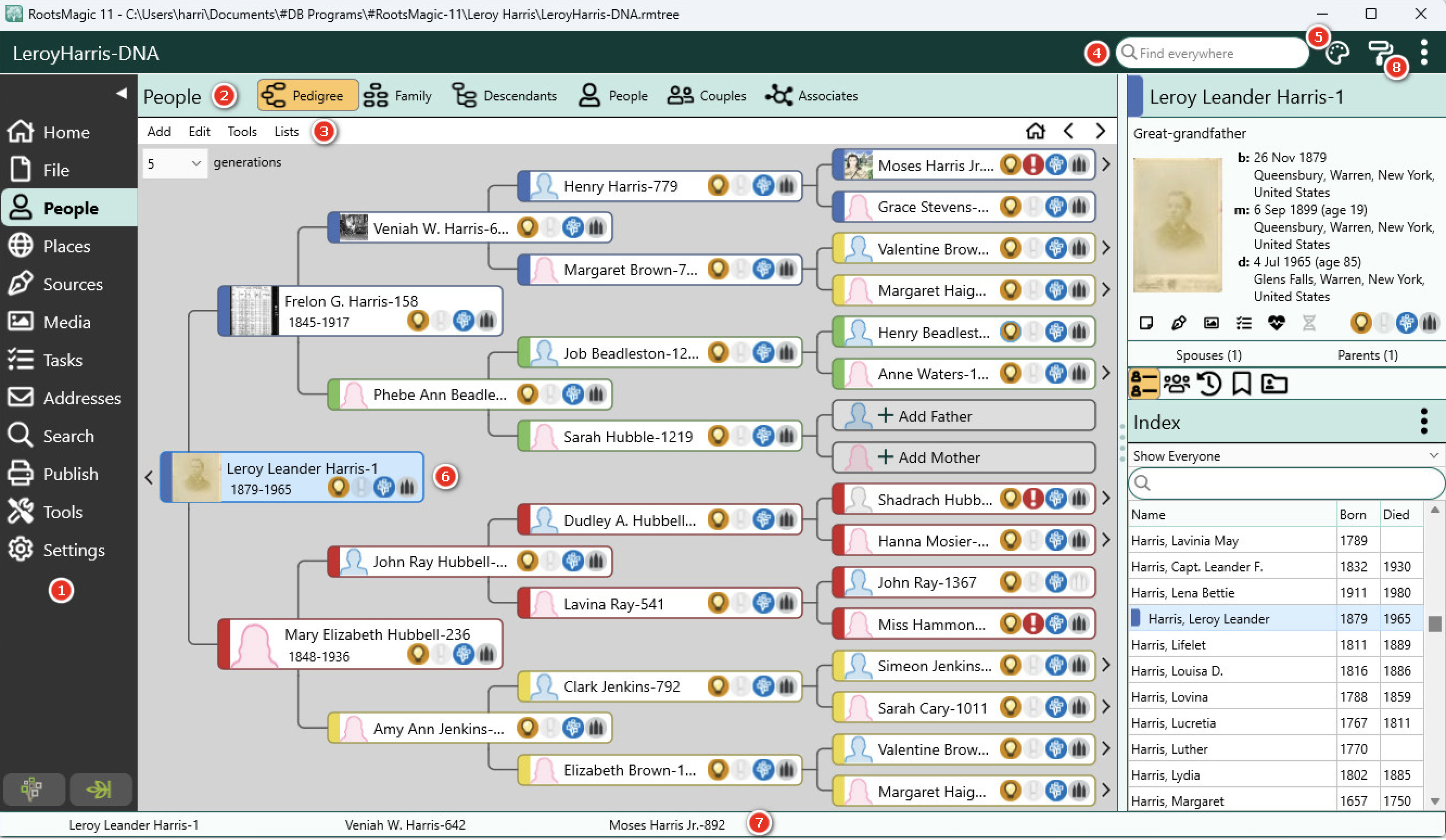
RootsMagic is the best option if you care more about research depth and flexibility than a particularly Mac-like interface. It is available for Mac and Windows, stores your working tree locally, and costs much less than most commercial alternatives without locking you into a subscription.
The current RootsMagic 11 connects to FamilySearch and Ancestry and can surface hints and records from Ancestry, FamilySearch, MyHeritage and Findmypast. It also has a very capable set of clean-up tools for duplicates and inconsistencies, plus more than 100 reports and charts, book publishing, website publishing and portable copies for a USB drive.
Its Ancestry TreeShare workflow is useful if you want to decide which changes move between your local and Ancestry trees instead of allowing everything to happen automatically. That extra control is valuable for careful researchers, although it is more hands-on than Family Tree Maker’s direct sync. Keep a backup before any bulk transfer, particularly if your database contains many media files or detailed citation fields.
RootsMagic is not as visually polished as MacFamilyTree, and some Mac users may prefer a more traditional macOS interface. However, it is one of the strongest choices for someone who needs research tools, long-term local control and broad connections to major genealogy sites at a sensible price.
Best for: Serious researchers who use several genealogy databases and want a capable local master tree without paying a subscription for the software itself.
Pricing: US$39.95 for a one-time licence, with a free trial available. Check the current trial on your own Mac before moving a large file, especially if you use macOS Golden Gate.
4. Reunion 14 — Best for Long-Term Mac Users and Printed Family Histories
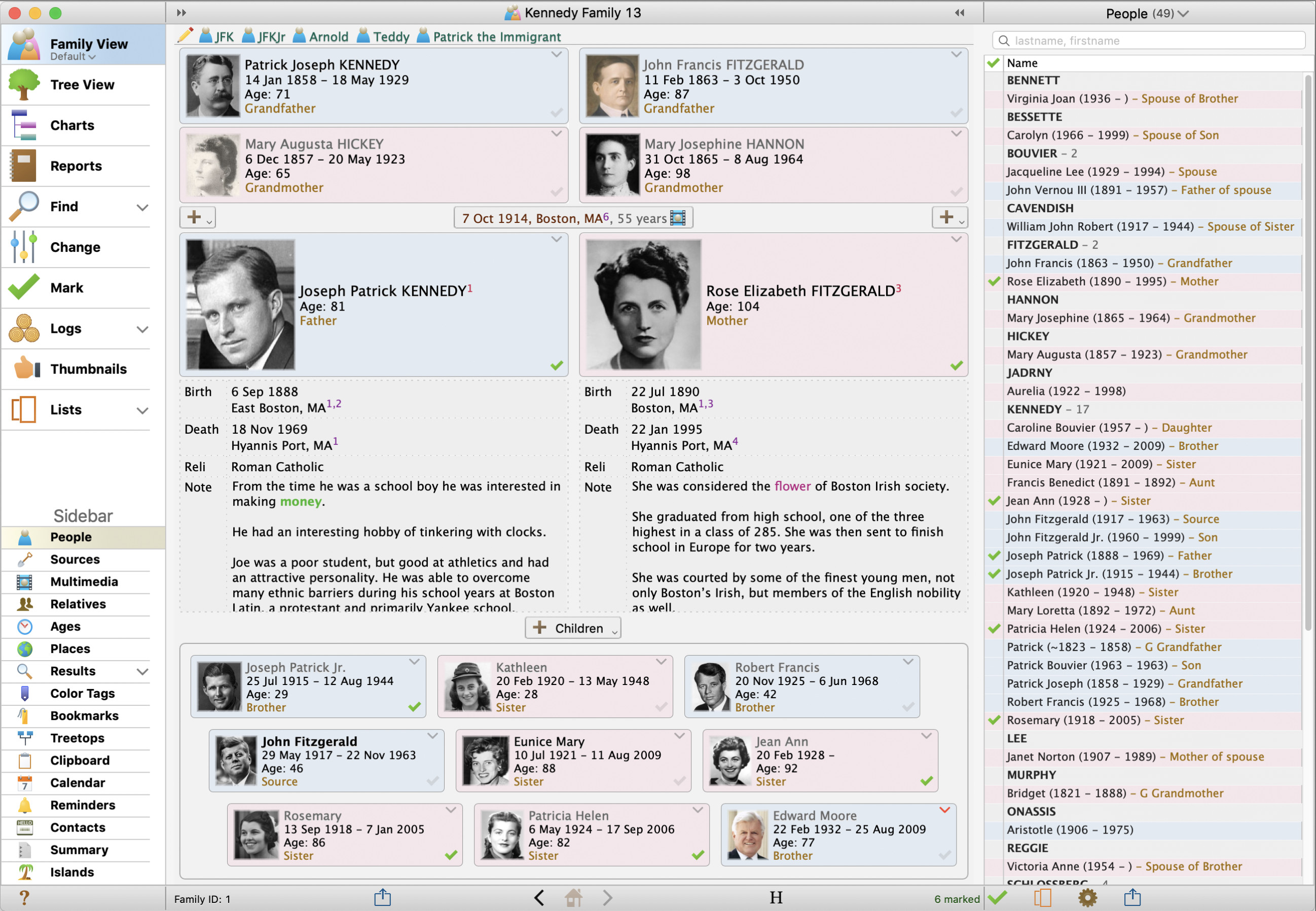
Reunion has been a dedicated Mac genealogy application for decades, and that maturity shows. It is a strong choice if your priority is a reliable local family archive with excellent searches, flexible source records, detailed notes and professionally presented charts, books and websites.
The current Reunion 14 adds GEDCOM 7 and GEDZIP support, dark mode, a new hourglass chart, an “Everybody” chart, better media linking and much stronger note-searching tools. You can attach photographs, scans, sound recordings and video to people, families, events and sources, then turn the results into family books, websites, questionnaires or large editable wall charts.
Reunion is particularly appealing if your work has grown beyond a simple ancestry tree. Its advanced searching, custom report sections and source documentation suit a researcher who wants to preserve the why behind each conclusion, not just names and dates. The companion ReunionTouch app lets you carry and edit a family file on an iPhone or iPad, although the sharing and syncing model requires more deliberate setup than MacFamilyTree’s CloudTree collaboration.
Reunion is not the right choice if direct Ancestry synchronisation is essential. It can help you search web resources, but it is best thought of as your local, carefully maintained archive. Its developer currently lists compatibility through macOS Tahoe, so Golden Gate users should test the demo first.
Best for: People building a permanent family archive, creating books or wall charts, and preferring a mature Mac-first database over a cloud-first service.
Pricing: About US$99 for Reunion 14, with discounted upgrades for earlier versions. ReunionTouch is sold separately through the App Store.
5. Heredis 2027 — Best for European and Document-Led Research
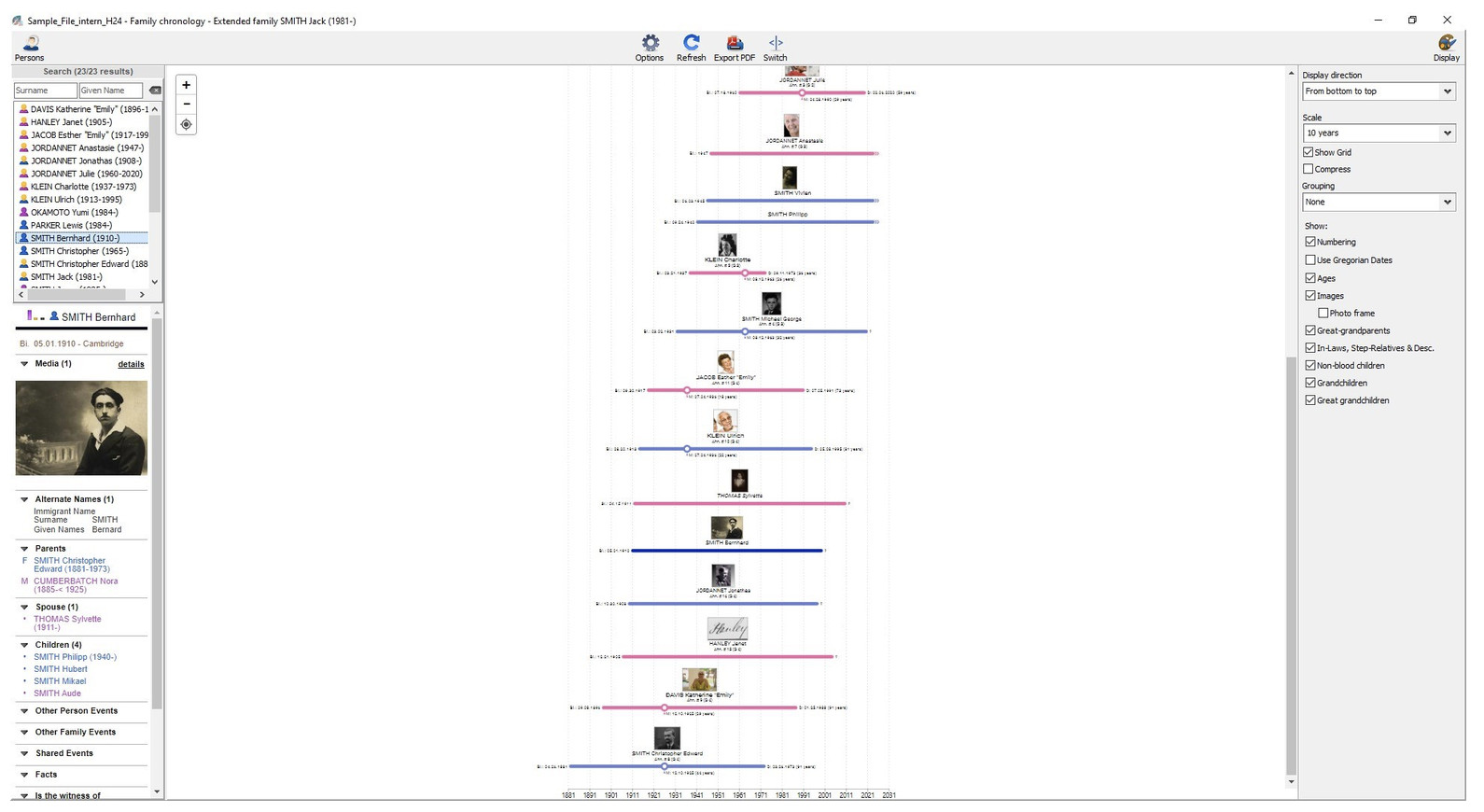
Heredis is a native macOS genealogy app with a particularly broad set of tools for people who work from original records, places, documents and sources. Although its interface is denser than MacFamilyTree’s, it offers more than 200 features for data entry, research, charting, statistics, consistency checks, document handling and publishing.
The current product is Heredis 2027 — despite its name, this is the current version being sold during 2026. It can import GEDCOM files, work with photos and sources, create many styles of ancestor, descendant and hourglass chart, and communicate with FamilySearch. It also has companion apps for iPhone, iPad and Android, along with an online service for publishing and sharing selected work.
Heredis is especially worth considering if your research is European, French or archive-led, where its place, source and document-management tools shine. It is less attractive if your chief requirement is simple Ancestry synchronisation, since that is not its main strength. The free demo is limited to 50 people, but that is enough to test an import and see whether its way of handling your data suits you.
As with the other products whose published compatibility page has not yet caught up with macOS Golden Gate, download the demo and test your own files before paying for an upgrade.
Best for: Researchers who want a feature-rich native Mac app with strong source, document, map and reporting tools, especially for European family history.
Pricing: US$69.99 list price for the Mac edition; upgrades start from US$29.99. The demo is free but limited to 50 people.
6. Gramps — Best Free Family Tree Software for Mac
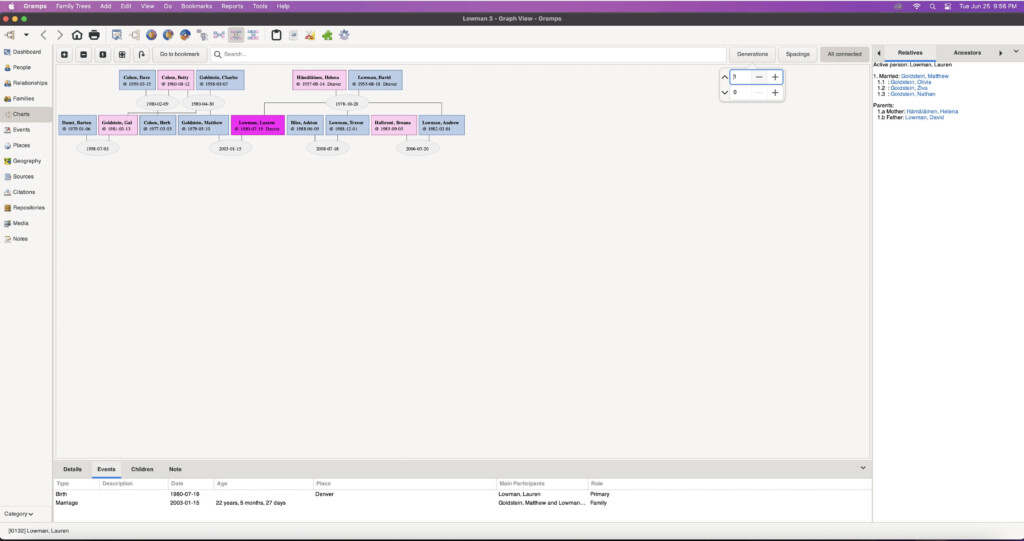
Gramps is the best free option for people prepared to trade some design polish for deep, flexible genealogy features. It is open source, cross-platform and maintained by a community of genealogists rather than a subscription service.
The current Gramps 6 release is much more than a basic family-tree drawing tool. It can record people, relationships, events, places, repositories, citations, media and detailed research notes, with separate views and “Gramplets” to analyse your data. You can produce reports and charts, export GEDCOM files and keep your database independent of commercial genealogy platforms.
The drawback is that Gramps has a steeper learning curve and a more utilitarian interface than the commercial Mac apps above. It is also not the simplest route to automated Ancestry or MyHeritage research. If you are beginning a family tree for a gift or want family members to contribute from iPhones, MacFamilyTree will be easier. If you are building a carefully cited research database at no cost, Gramps is hard to beat.
Best for: Budget-conscious hobbyists and experienced genealogists who want a free, detailed, independent local database.
Pricing: Free and open source.
7. Ancestris — Best Free GEDCOM-First Option

Ancestris is another genuinely free Mac-compatible genealogy program, but it approaches family history from a different angle. Its central promise is that your work remains in a standard GEDCOM file rather than a proprietary database, giving you maximum control over where your data lives and making it easier to move on in the future.
The stable Ancestris 13 release is available for macOS, while the project also offers a daily-updated version 14 for users who want the latest changes. It supports unlimited people and family files, dynamic tree views, map and chronology tools, source and media management, duplicate detection, statistics and web-book publishing.
It is a powerful program rather than a beginner-friendly one. The interface will not appeal to everyone and its commercial-service integrations are limited compared with Family Tree Maker or RootsMagic. But if data portability matters more than a glossy design, Ancestris is one of the most sensible free choices available.
Best for: Researchers who want a free, offline, standards-focused genealogy program and are comfortable learning a more technical interface.
Pricing: Free.
8. MyHeritage — Best for Online Research, Family Matches and DNA
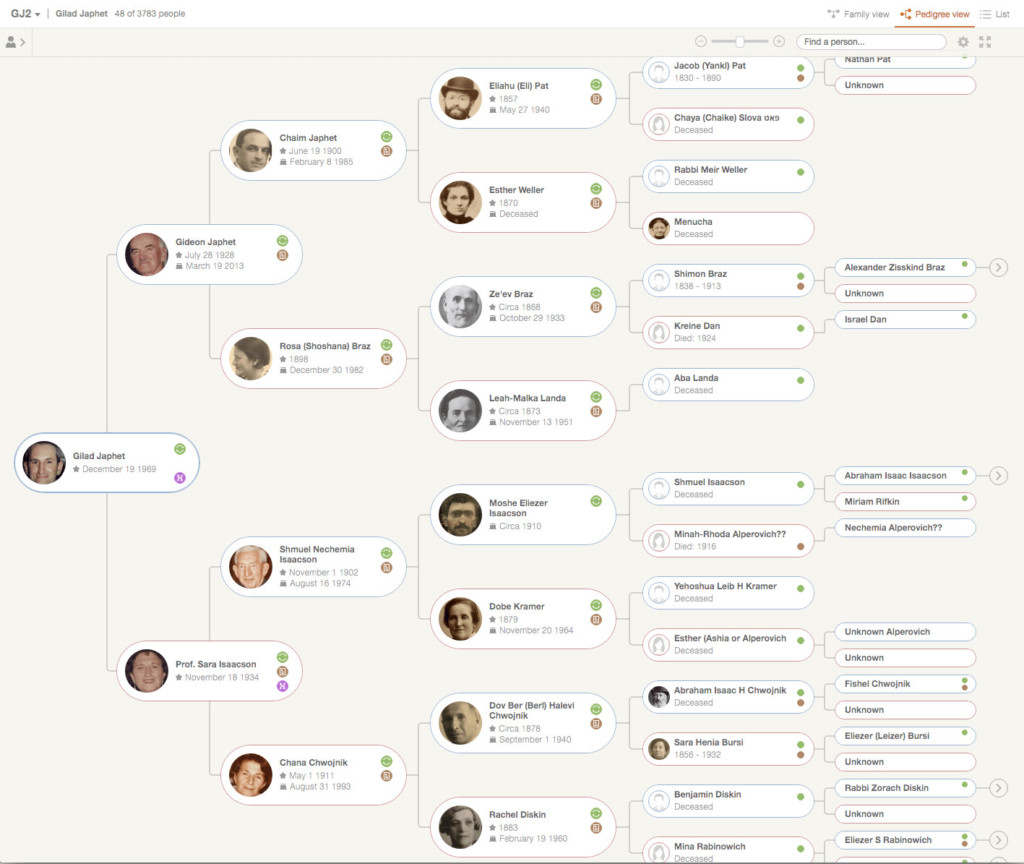
MyHeritage works well in any modern Mac browser and is one of the best online services for turning a small tree into new research leads. It is particularly strong for international family history, automatic Smart Matches and Record Matches, shared family sites, photo enhancement tools and DNA matching.
Its strength is discovery, not local data ownership. You can build a tree, search records, upload a GEDCOM and invite relatives to collaborate, but a paid membership is usually required for meaningful access to historical records and many of its more advanced features. DNA testing is a separate purchase and should be treated as a separate privacy decision.
For that reason, we recommend MyHeritage as a companion to a local Mac app rather than the only place you keep years of work. Keep a current GEDCOM export and copies of key documents on your Mac, and verify every suggested relationship against an original record or a properly cited source before accepting it.
Best for: International research, automated matching, photo tools, DNA matches and family members who prefer to collaborate in a browser.
Pricing: You can create an account and start a tree for free. Full record access, enhanced features and DNA kits are paid separately, so check the current plan and renewal price before subscribing. All plans 10% off with Discount Code “NJM10”.
Online Genealogy Services Worth Pairing With a Mac App
Even the best family tree software cannot replace the records held by online services. These are the three worth considering alongside a local Mac database:
| Service | Best use | What to know |
|---|---|---|
| FamilySearch | Free historical records and a very large shared family tree | It is free and invaluable for research, but its global tree is collaborative. Keep your own sourced master file rather than assuming every online entry is correct. |
| Ancestry | Subscription research, records, DNA matches and shared online trees | Best paired with Family Tree Maker if you want a direct desktop sync. A subscription gives you access to records, not automatic proof that a hint is correct. |
| Findmypast | UK and Irish research, especially for British records | It is a research subscription, not Mac desktop software. RootsMagic can surface Findmypast hints, but the value depends on the regions and record collections you need. |
If you only need to create a visually attractive chart for a school project, presentation or family gift, rather than maintain a researched genealogy database, SmartDraw’s family tree templates are a quick alternative.
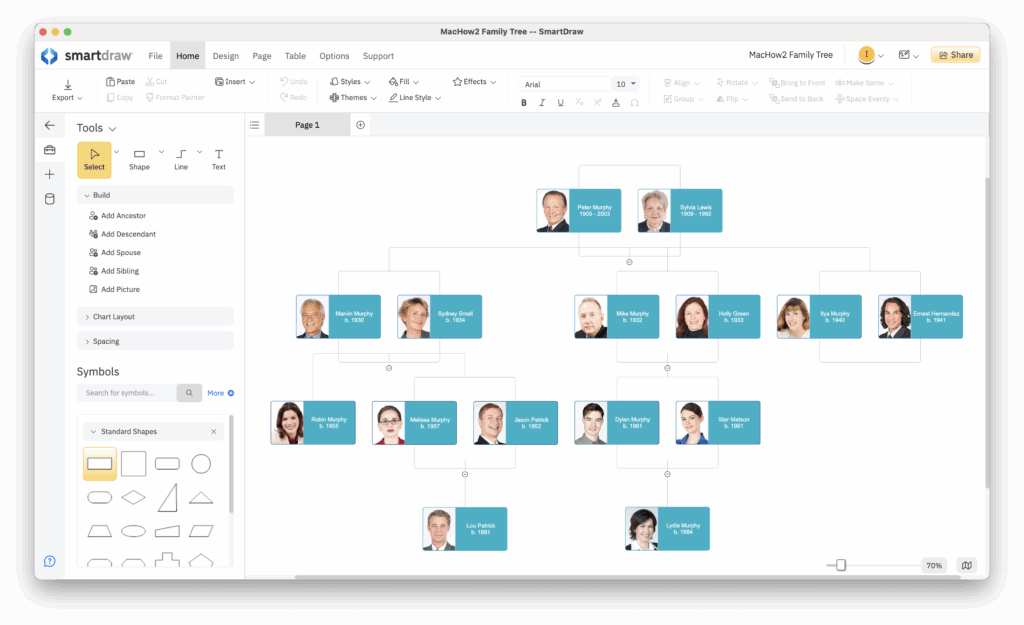
It is not a replacement for the apps above: it does not give you the source management, GEDCOM workflow, research tools or long-term family-history archive that a true genealogy app provides.
What to Look for Before Choosing Family Tree Software for Mac
Decide where your master tree will live
This is the most important decision. A local Mac app such as MacFamilyTree, Reunion, RootsMagic, Family Tree Maker, Heredis, Gramps or Ancestris gives you a working copy you control. An online tree is useful for sharing and discovery, but a service can change its pricing, interface, exports and record licences over time.
Whichever app you choose, export a GEDCOM copy periodically and keep a normal Mac backup as well.
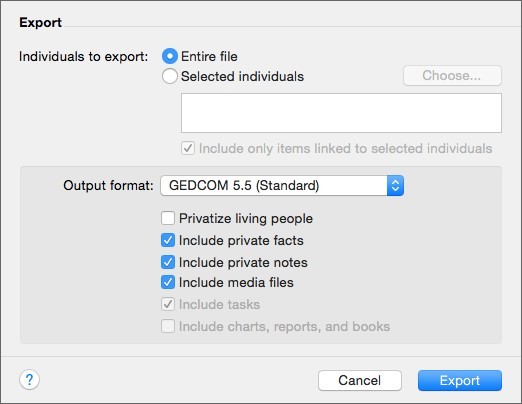
GEDCOM is the closest thing genealogy has to a universal transfer format, but not every app stores media, source templates, custom fields and relationship details identically. Before switching programs, import a copy of a small but representative branch and check the result before moving your full tree.
Do not choose an app only because it has a huge database
Historical records come from online providers, not from the desktop app itself. Choose the app for its data entry, source handling, reporting, backup and sharing; choose the research service for the countries, archives and record collections it covers.
For example, MacFamilyTree is excellent for FamilySearch and Apple-device sharing, while Family Tree Maker is the obvious choice for a closely synchronised Ancestry workflow. RootsMagic is more flexible if you use several services. No software can turn a hint or a shared online tree into proof without you checking the underlying evidence.
Test family relationships and imports before committing
If your tree includes adoption, stepfamilies, multiple marriages, same-sex couples, name changes, donor conception or other complex relationships, test the exact views and reports you plan to use. Most current genealogy apps can record far more than the old nuclear-family model, but their charts, GEDCOM imports and exports can present the same information differently.
Also test a few linked photos, certificates, research notes and citations. A clean-looking tree is not enough if an export later loses the evidence behind it.
Think about sharing, privacy and DNA separately
Decide who should be able to see living people before publishing a tree online or inviting relatives. Use the privacy controls in the chosen service, but avoid treating them as a substitute for judgement: do not publicly post sensitive details about living relatives without their permission.
DNA testing can be enormously useful for identifying close and distant relatives, but it also has implications for family members who have not tested. Read the provider’s current privacy, matching and sample-retention policies before ordering a kit, and do not assume an ethnicity estimate or a DNA match explains a family relationship on its own.
Do You Need Windows Family Tree Software on a Mac?
Usually, no. There are now enough good Mac-compatible choices that it makes little sense to run a virtual copy of Windows merely for a family-tree program. Family Tree Maker, MacFamilyTree, RootsMagic, Reunion, Heredis, Gramps and Ancestris cover the main needs of most Mac users.
If you already have years of work in a Windows-only product such as Legacy Family Tree or Family Historian, exporting a GEDCOM and testing it in one of the apps above is generally the best first step. Running Windows in a virtual machine can be a temporary bridge, but a Mac-compatible application will be easier to maintain and back up in the long term.
FAQ
What is the best family tree software for a Mac?
For most people, MacFamilyTree 11 is the best overall family tree software for Mac because it is built for macOS, has excellent charts and reports, and works well with iPhone and iPad through MobileFamilyTree. Choose Family Tree Maker 2024 instead if direct Ancestry synchronisation is your priority.
Does Family Tree Maker work on a Mac?
Yes. Family Tree Maker 2024 has a Mac edition and currently supports macOS 11 Big Sur and later, including macOS Golden Gate 27. It is the strongest option for keeping a desktop tree synchronised with an Ancestry tree.
What is the best free family tree software for Mac?
Gramps is the best free all-rounder for most people because it is mature, detailed and actively maintained. Ancestris is the better free option if keeping your data in a standard GEDCOM file is your main priority. FamilySearch is also free, but it is an online collaborative research service rather than a private Mac desktop database.
Which Mac family tree software works with Ancestry?
Family Tree Maker 2024 offers the clearest direct Ancestry synchronisation workflow. RootsMagic 11 can also connect and share data with Ancestry through its TreeShare tools, but it gives you more manual control. MacFamilyTree and Reunion are excellent Mac apps, but neither is the right choice if a continuously synchronised Ancestry tree is non-negotiable.
Can I use MyHeritage on a Mac?
Yes. MyHeritage works in a web browser on any current Mac, and its mobile apps make it easy for relatives to contribute. It is especially useful for international records, automatic matches and DNA research, but keep a local export and a backup if it is your main tree.
Which app is best for printing a family tree?
MacFamilyTree is excellent for attractive visual charts and family books. Reunion 14 is particularly strong for highly customised wall charts, books, forms and websites. Family Tree Maker and Heredis also have powerful report and printing options for research-led family histories.
What Happened to iFamily for Mac?
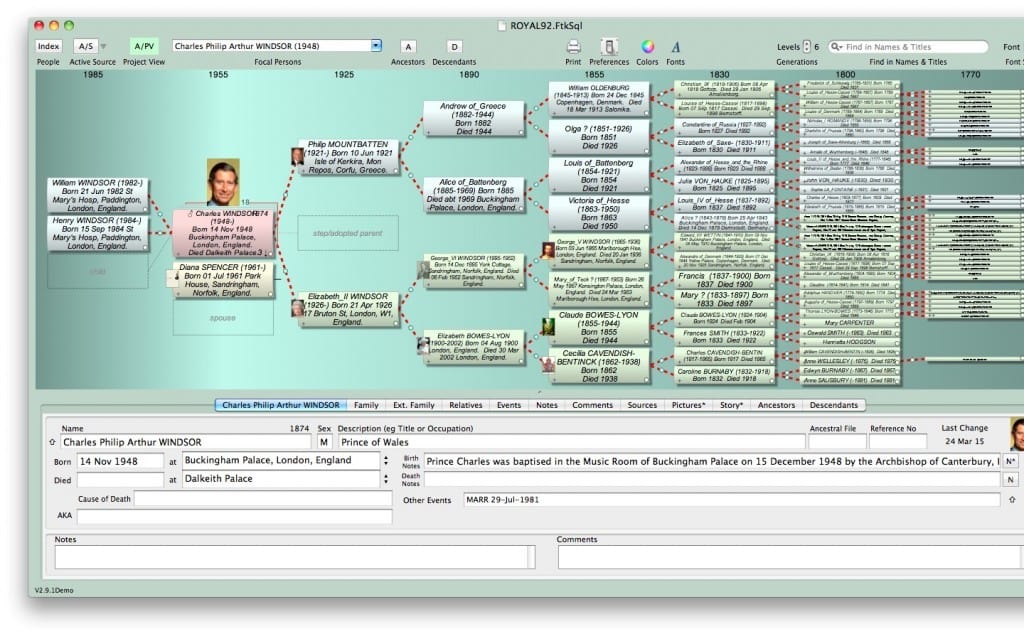
iFamily for Mac was discontinued in 2025 and is no longer available. It was a very dated app anyway and all of the above are excellent alternatives to iFamily for Mac.
Final Verdict
For most Mac owners, MacFamilyTree 11 is the best balance of usability, design, family sharing and visual output. It is the app to choose if you want genealogy software that feels at home on a Mac.
Choose Family Tree Maker 2024 if your family history already revolves around Ancestry and you want a desktop copy that can stay synchronised. Choose RootsMagic 11 if you want wide research-site connections and a powerful local database at a low one-time cost. Reunion 14 remains a superb long-term Mac archive for people who care about source documentation, books and charts, while Gramps and Ancestris are the best free choices for researchers who want control over their data.
Whichever you choose, keep your own backups, export a GEDCOM regularly and treat online hints as leads to investigate rather than facts to accept automatically.