

Although there are now several ways to play Windows games on a Mac, including cloud gaming and virtual machines, I still consider CrossOver the best Wine-based solution for most Mac users.
Unlike virtualization software, CrossOver doesn’t require a Windows license or a complete installation of Windows. This makes it considerably lighter than a virtual machine and, with supported games, it can deliver better graphics performance.
However, CrossOver isn’t a complete replacement for Windows. Compatibility varies from one application or game to another, anti-cheat software remains a major obstacle, and some titles require experimentation with graphics settings.
After testing CrossOver 26 on both Intel and Apple Silicon Macs, including the latest CrossOver 26.3 update, here’s how it performs in 2026.
What Is Crossover?
Crossover for Mac is a compatibility layer developed by CodeWeavers that allows Windows applications and games to run on macOS without installing Windows itself.
It is based on the open-source Wine project, which translates Windows API calls into macOS equivalents.
In simple terms, Crossover acts as a translator between Windows software and macOS.
Unlike virtual machines such as Parallels, VMware Fusion or UTM, Crossover doesn’t need a full Windows installation. This makes it far lighter, faster and less demanding on your Mac’s hardware.
Although many people use Crossover primarily for gaming, it can also run productivity software, business applications and other Windows-only programs.
Modern versions of Crossover also incorporate technologies derived from Apple’s Game Porting Toolkit, allowing many DirectX 12 games to run on macOS.
CrossOver 26.3: What’s New?
The current stable release is CrossOver 26.3, released on July 21, 2026.
The original CrossOver 26 release introduced several significant underlying updates:
- Wine 11.0, incorporating more than 6,000 changes.
- D3DMetal 3.0 for improved DirectX 11 and DirectX 12 support.
- DXMT 0.72 for translating DirectX 11 graphics directly to Metal.
- Wine Mono 10.4.1.
- VKD3D 1.18.
- Interface changes for macOS Tahoe.
- Fixes for Steam closing and reopening unexpectedly.
It also added or improved support for games including Helldivers 2, Kingdom Come: Deliverance II, Clair Obscur: Expedition 33, Age of Empires IV, God of War Ragnarök, Starfield, Final Fantasy VII Rebirth and The Outer Worlds 2.
The subsequent CrossOver 26.1 update fixed mouse input in many Unity games, Battle.net installation problems, Quicken display issues and Death Stranding 2 on macOS.
When combined with macOS Tahoe 26.5 or later, CrossOver 26.1 also restored support for Diablo IV and Overwatch. Both the CrossOver and macOS updates are required for these games.
CrossOver 26.2 fixed another Helldivers 2 launcher problem and added warnings about the forthcoming end of 32-bit bottle support.
Finally, CrossOver 26.3 fixed Diablo IV after another game update, repaired Epic Games Launcher downloads on Mac and fixed GOG Galaxy failing to load.
This illustrates both the strength and weakness of CrossOver: CodeWeavers responds quickly when games and launchers break, but a routine update to Steam, Battle.net, Epic or the game itself can temporarily stop something working.
You can see every change in the official CrossOver changelog.
System Requirements
CrossOver supports both Intel and Apple Silicon Macs. You need at least 1GB of free space for CrossOver itself, plus enough storage for any Windows applications or games you install.
Apple Silicon support requires an M1 or later Mac. Stable CrossOver 26 still uses Intel Wine components through Rosetta 2, so Rosetta must also be installed.
CodeWeavers maintains a macOS compatibility table showing which CrossOver versions work with Catalina, Big Sur, Monterey, Ventura, Sonoma, Sequoia and Tahoe. macOS Tahoe requires CrossOver 25.1.1 or later.
Beta versions of macOS are not officially supported. I recommend using the latest CrossOver 26 point release with a fully updated stable version of macOS.
Installation and Setup
Installing Crossover is extremely straightforward.
After downloading the application, drag it into your Applications folder and launch it.
Crossover immediately presents a searchable list of supported applications and games. Each title includes a compatibility rating such as:
- Runs Great
- Runs Well
- Limited Functionality
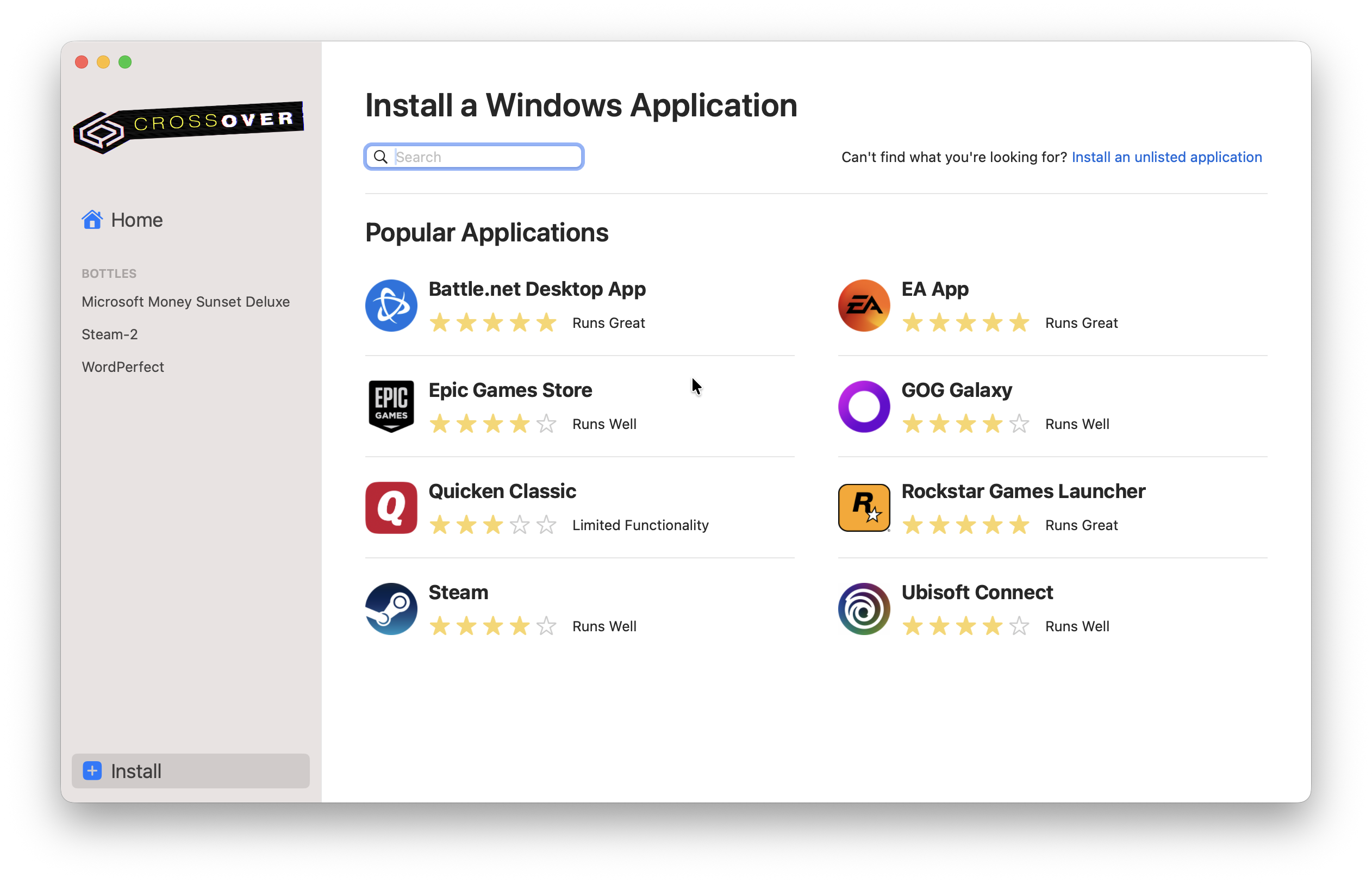
You can also search the CodeWeavers compatibility database to check how well specific applications perform before purchasing.
For testing, I installed the Windows version of Steam.
Crossover automatically creates what it calls a “Bottle” – an isolated Windows environment that contains your applications and settings.
If a bottle becomes corrupted or stops working, you can simply delete it and create a new one without affecting macOS.
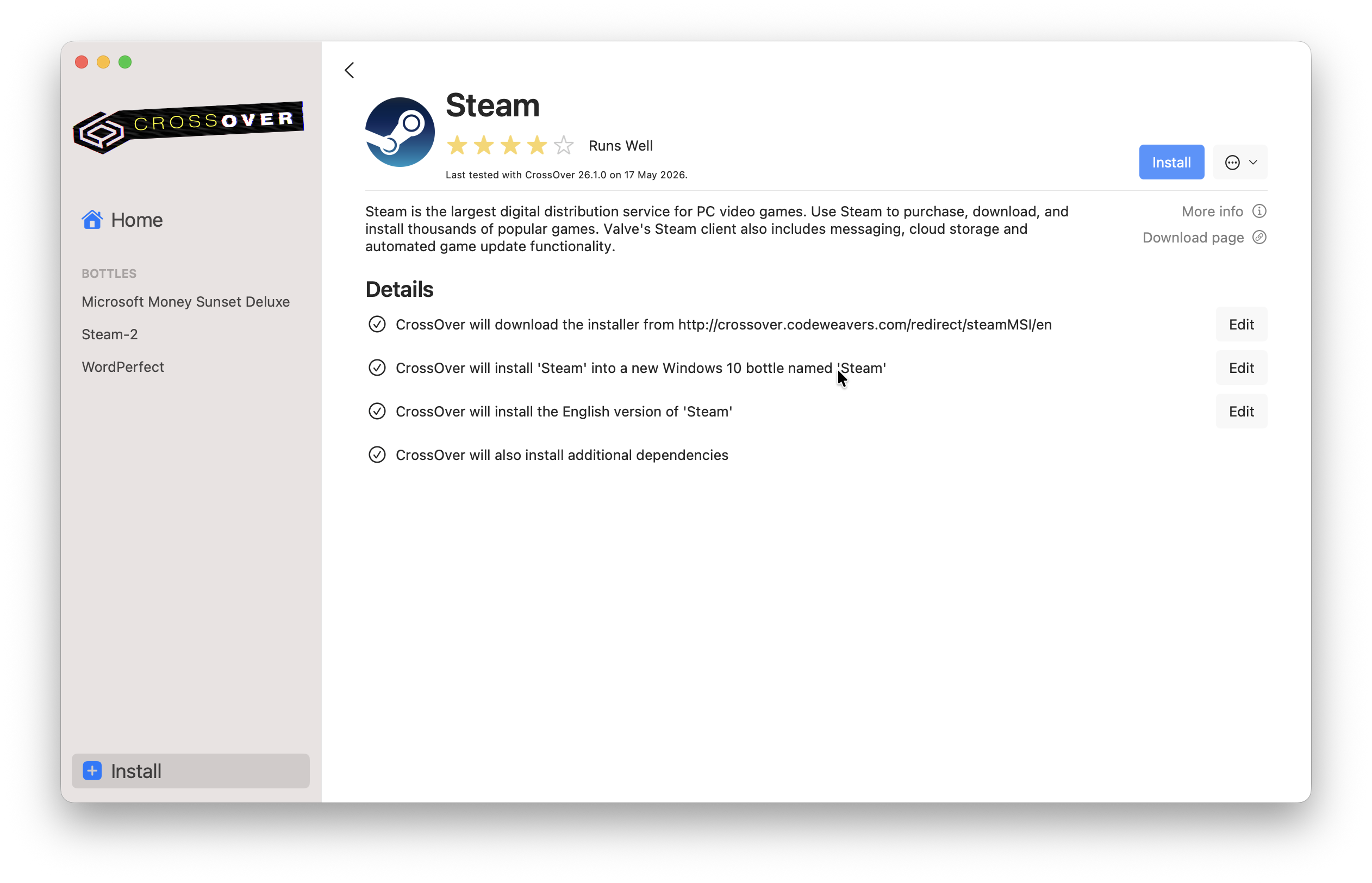
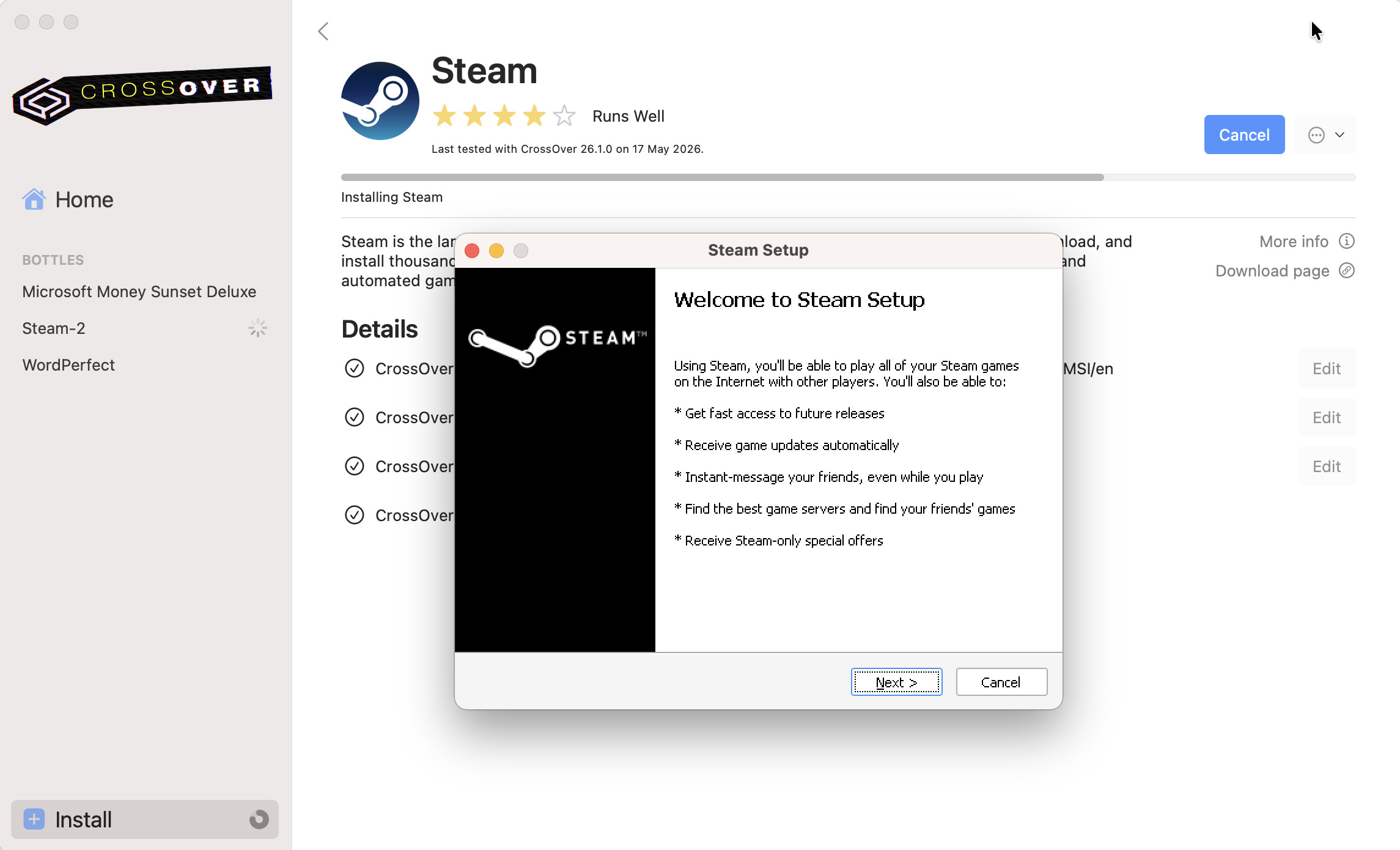
Click on Install to install the Windows version of Steam in Crossover on your Mac. Crossover will take a few minutes to download Steam and launch the Windows installer.
Running Steam Games
Once Steam is installed, simply log into your account and install your games as normal.
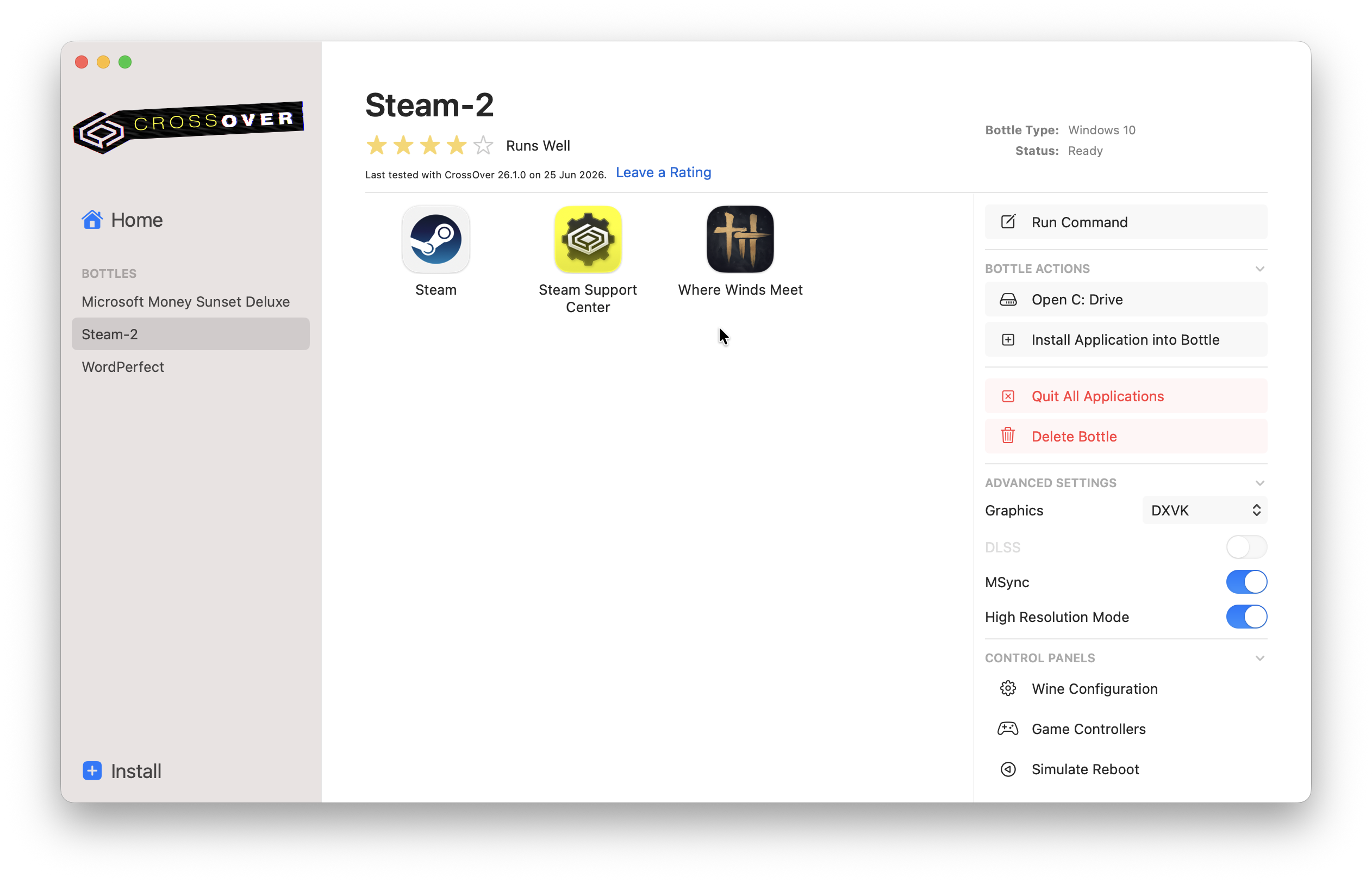
I recommend leaving the Graphics setting on Auto when you first install a game. CrossOver can then select the graphics backend recorded for that game in its compatibility database.
The available options are:
- Auto: Uses CrossOver’s recommended backend for recognized games.
- DXMT: A Metal-based DirectX 11 implementation that can perform particularly well on less powerful Macs.
- D3DMetal: Apple’s translation layer for DirectX 11 and DirectX 12 games.
- DXVK: Translates DirectX 10 and DirectX 11 to Vulkan.
- Wine: Uses Wine’s own WineD3D implementation as a fallback.
You can also experiment with MSync, which improves synchronization and performance in some games but makes little difference in others.
High Resolution Mode shouldn’t be enabled automatically for every game. It improves detail by disabling pixel doubling and reporting a high-resolution display to the Windows application, but some applications render incorrectly and the higher resolution may reduce gaming performance.
CrossOver 26 also offers DLSS through MetalFX when using D3DMetal or DXMT. This requires the game itself to support DLSS, and results still vary between titles.
Therefore, I would start with Auto and only change the graphics backend, MSync or High Resolution Mode if you experience poor performance or display problems.
Storage space is also important.
While smaller games may require less than 1GB, modern AAA titles can easily consume 50GB to 100GB or more.
Double click on the Steam logo to open the Windows version of Steam on your Mac and log into your Steam account. You may notice that Steam is a bit laggy when it starts compared to using the native version of Steam on a Mac.
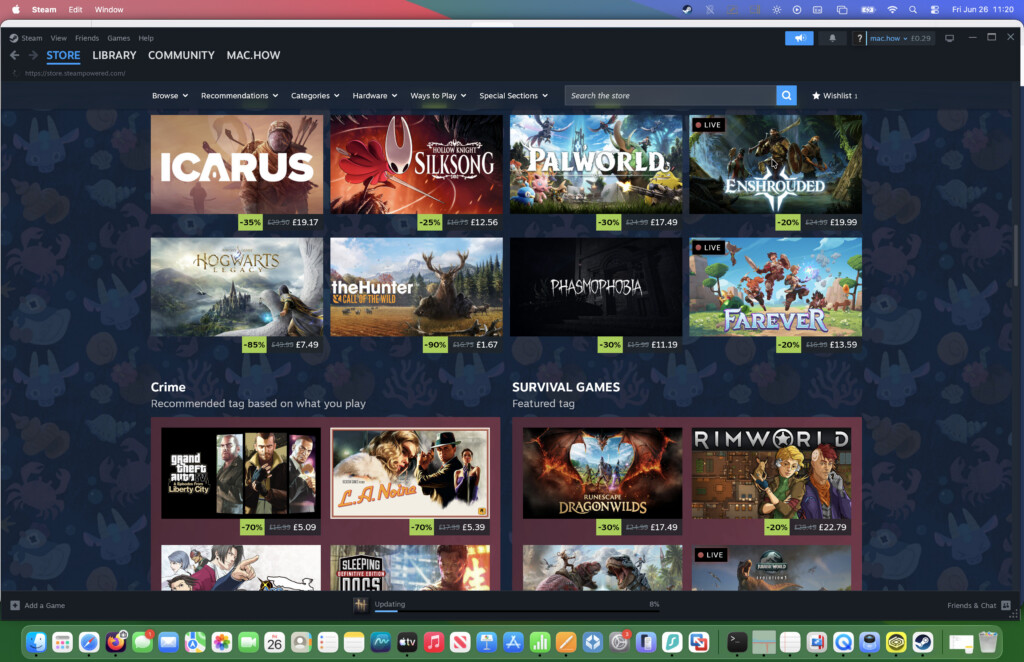
Choose a game that you want to install in Steam. I chose Stumble Guys which is normally only available on Windows. One thing to bear in mind is that you need a lot of free disk space on your Mac if you intend on installing many games. In this case, Stumble Guys only requires 576MB but high end games may require 50-120GB of space. I recommend recovering disk space on your Mac before installing games with Crossover.
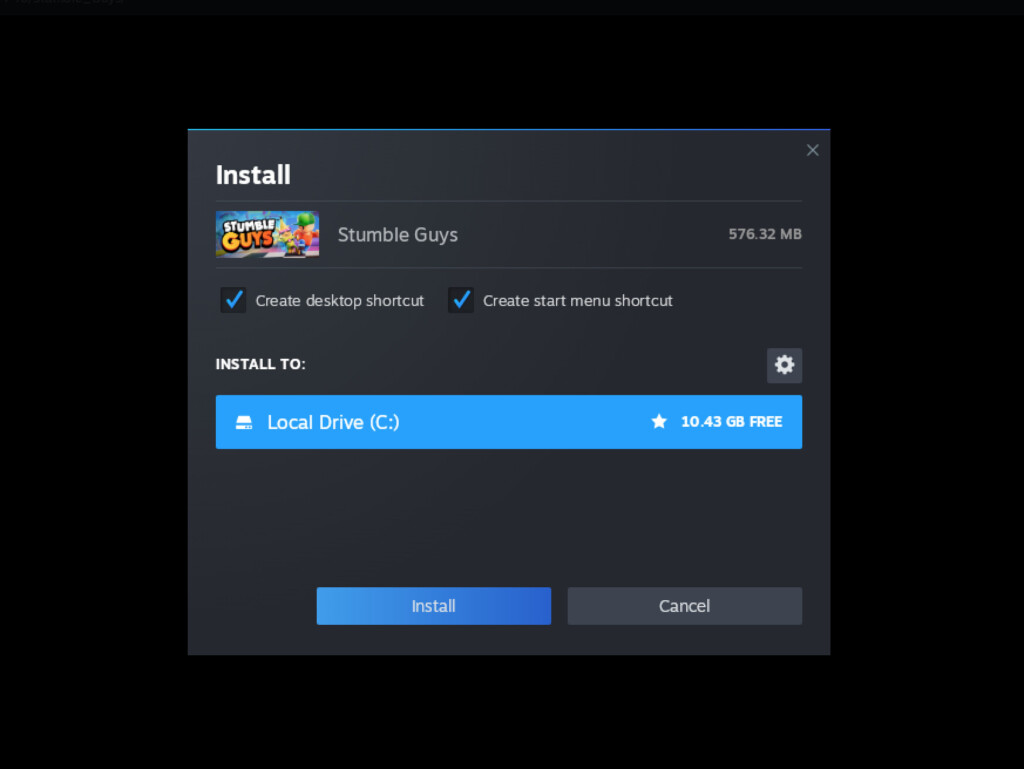
Click on “Install” and the game will install in the Windows version of Steam on your Mac. When done, either go to your Steam games Library or click on the completed game download to play it.
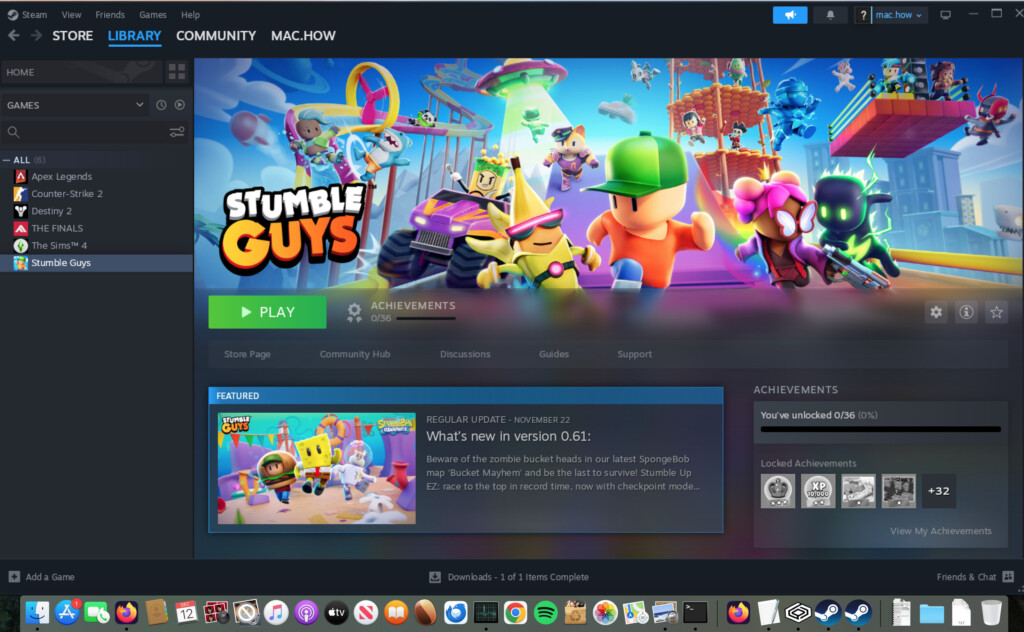
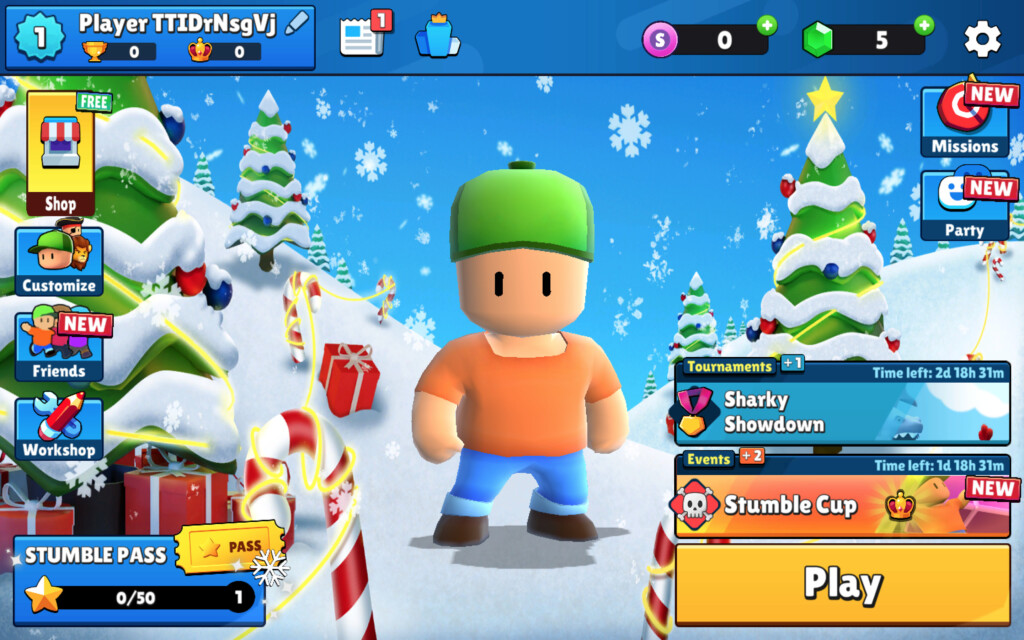
The game will then launch in Crossover on your Mac. Crossover opens the game in full screen mode and runs surprisingly well although I did experience a certain amount of lag at times.
I also tried to push things a little more by installing Where Winds Meet on a Mac.
As you can see in the video below, performance was superb – you can’t tell the difference between playing it natively on Windows to be honest.
Performance on Intel Macs
CrossOver 26 still supports Intel Macs and doesn’t require Rosetta on them.
Older Intel Macs with dedicated graphics can run many Windows games surprisingly well, although performance depends heavily on the GPU. Compared with modern Apple Silicon Macs, I experienced more fan noise, heat, power consumption and instability when running demanding games.
CrossOver 26 will be the last major version to support Intel Macs. Existing users will be able to continue using it, but they won’t be able to upgrade to CrossOver 27.
This makes CrossOver 26 a useful way of extending the life of an Intel Mac, although future game and launcher updates could eventually break compatibility with a version that is no longer receiving updates.
Performance on Apple Silicon Macs
CrossOver generally performs far better on Apple Silicon than it did on most older Intel Macs, especially on Pro, Max and Ultra chips.
However, CrossOver 26 isn’t yet fully native. Its stable Wine components still use Rosetta 2 to run on Apple Silicon. Despite this additional translation layer, performance can be excellent when a game is well supported.
In my testing, Apple Silicon offered:
- Lower temperatures and fan noise.
- Faster loading.
- Better battery efficiency.
- Greater stability.
- Less stuttering in supported games.
The exact M-series processor still makes a substantial difference. An entry-level M1 or M2 Mac won’t deliver the same frame rates as a Pro, Max or Ultra model, even though both are technically compatible.
Unified memory is shared between macOS, CrossOver and the game, so 16GB is a more practical starting point for recent games. Demanding AAA titles benefit from even more.
DirectX 11 and DirectX 12 Performance
One of CrossOver’s biggest advantages over virtual machines is its support for both DirectX 11 and DirectX 12 games.
CrossOver doesn’t use all of its graphics technologies simultaneously. Instead, it selects a graphics backend depending on the game:
- D3DMetal supports DirectX 11 and DirectX 12 through Metal.
- DXMT handles DirectX 11 directly through Metal.
- DXVK handles DirectX 10 and DirectX 11 using Vulkan.
- MoltenVK translates Vulkan calls to Apple’s Metal graphics API.
- VKD3D provides another route for translating DirectX 12.
CrossOver 26 includes D3DMetal 3.0, DXMT 0.72 and VKD3D 1.18, giving it much broader game compatibility than earlier releases.
That doesn’t mean every DirectX 12 game works well. Translation introduces overhead and you may still experience:
- Lower frame rates than on equivalent Windows hardware.
- Shader-compilation stutter.
- Texture or lighting glitches.
- Launcher failures.
- Problems after game updates.
- Incorrect mouse, window or external-display behavior.
Where Winds Meet performed superbly in my testing, but Diablo IV and Counter-Strike 2 were more demanding. This is why I strongly recommend testing the specific game you want during CrossOver’s 14-day trial.
Windows Games Supported by Recent CrossOver Releases
Recent CrossOver releases have added or improved support for games including:
- Red Dead Redemption 2
- Helldivers 2
- Diablo IV
- Overwatch
- Path of Exile 2
- Street Fighter 6
- Tekken 8
- Kingdom Come: Deliverance II
- Clair Obscur: Expedition 33
- God of War Ragnarök
- Starfield
- Final Fantasy VII Rebirth
- The Last of Us Part I
- The Outer Worlds 2
This doesn’t guarantee perfect performance on every Mac. Compatibility can depend on your CrossOver version, macOS version, M-series chip, graphics settings, launcher and even the latest game update.
Check the CodeWeavers compatibility database and recent user reports before buying CrossOver for one particular game.
How To Run An EXE File In Crossover
Unlike a virtual machine, CrossOver doesn’t give you a complete Windows desktop. Instead, each application is installed inside a bottle and appears more like an individual Mac application.
This works particularly well for older or relatively self-contained programs. Applications that depend heavily on specific Windows services, system components or hardware integrations are less likely to work correctly.
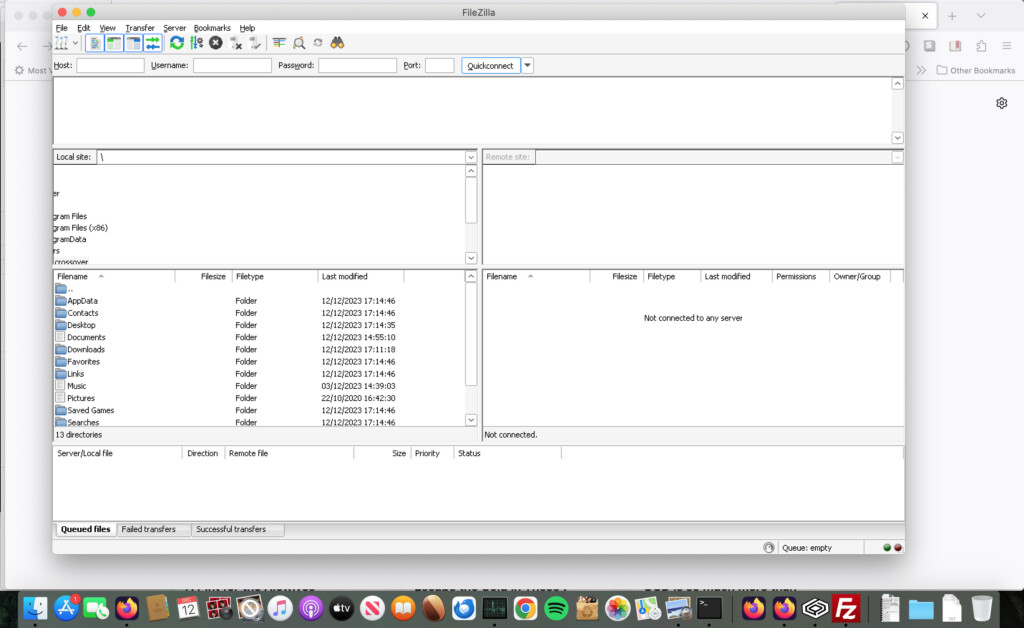
I used the Windows version of FileZilla to demonstrate how CrossOver can run an EXE on a Mac (see video above or instructions below).
Since FileZilla already offers a native Mac version, it isn’t itself a compelling reason to buy CrossOver, but it provides a useful example of how straightforward manual installation can be.
For an essential business application, I would always test every important feature during the free trial. If you need guaranteed access to a complete Windows environment, a virtual machine such as Parallels or VMware Fusion remains the safer option.
Crossover improved this in the release of Crossover 24 so that you can simply drag-and-drop an EXE file into it to run it:
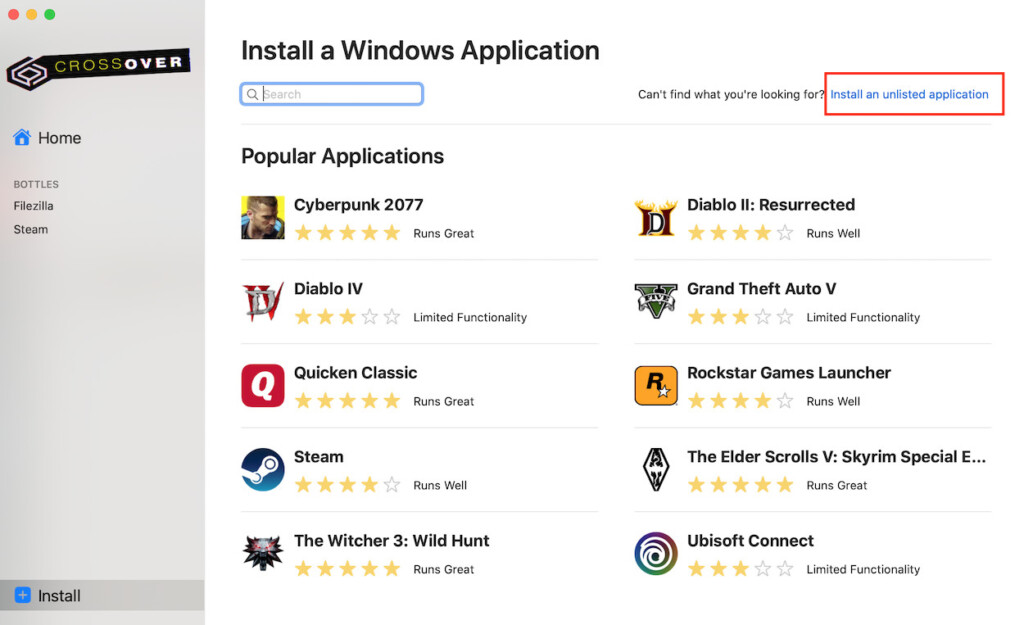
You can also run an EXE file by using the “install an unlisted application” feature on the Install screen:
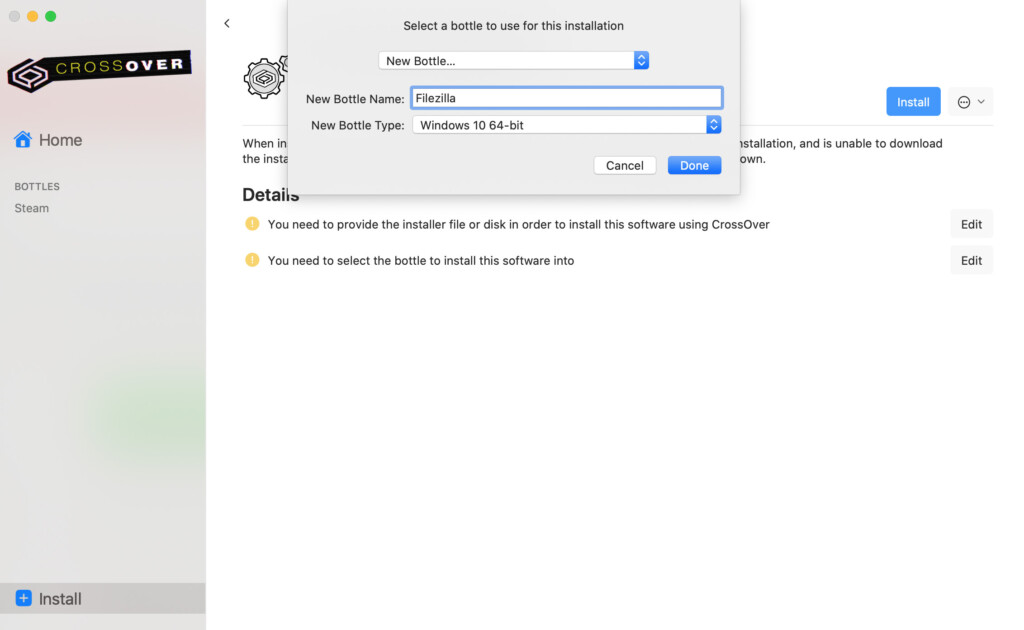
You then need to create a bottle for the Windows EXE file you want to run on your Mac:
Then simply browse to the EXE file you want to run on your Mac:
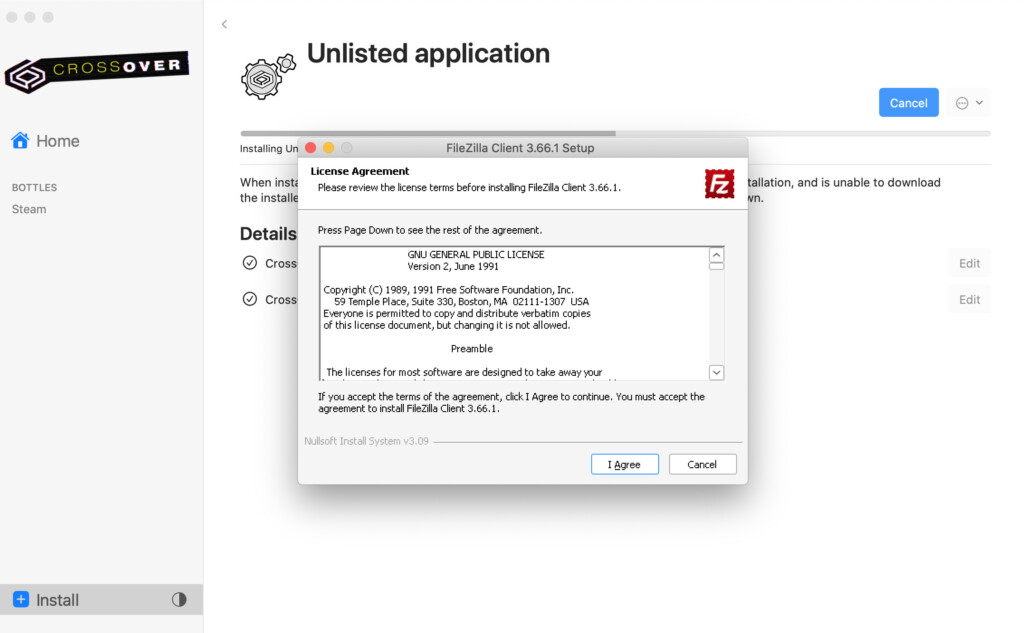
You can then run the Windows installer as if you were installing it on Windows:
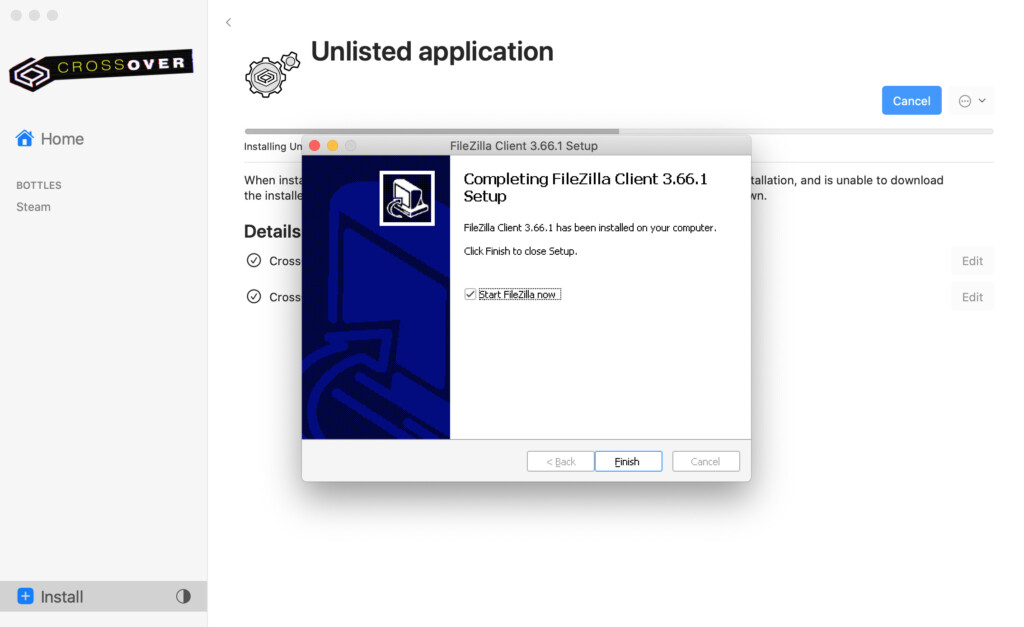
Once the installation is complete, you can run the Windows application on your Mac using Crossover. In this case, you can see I installed Filezilla for Windows successfully.
Is Crossover Better Than Whisky?
With Whisky no longer actively developed, Crossover has become the leading Wine-based solution for Mac users.
While Whisky offered a free alternative, Crossover provides:
- Commercial support.
- Frequent updates.
- Improved compatibility.
- Game-specific fixes.
- Preview releases.
- Better long-term reliability.
For users who regularly play Windows games, the subscription cost is usually worthwhile.
Crossover vs Pixel Port
More recently, Pixel Port has come along as an easy way to play Windows only Steam games on a Mac.
While its currently only suitable for Steam games, in our review we found it was incredibly easy to use with virtually no configuration like you have to do with Wine, Whisky and even Crossover.
At the moment its in Beta but its free to use and one to watch for the future. Read more about it in our full Pixel Port review.
Crossover Downsides
Despite being the best Windows gaming solution for many Mac users, Crossover still has some limitations.
The biggest drawbacks are:
- Some games simply don’t work.
- Anti-cheat software often prevents online play.
- Battery life suffers during gaming.
- Performance varies considerably between games.
- Certain applications still require troubleshooting.
Games that rely on kernel-level anti-cheat systems such as Vanguard generally remain incompatible.
Support
CodeWeavers provides good customer support, particularly for popular applications and major game releases.
The company actively releases compatibility fixes and engages with its community forums.
Support tends to be strongest for widely used games and applications.
What’s Coming in CrossOver 27?
CrossOver 27 is expected in early 2027 and will be one of the most significant releases in years.
The biggest change is native ARM64 support. Stable CrossOver 26 still relies on Rosetta 2 on Apple Silicon, but CrossOver 27 will use native ARM64 Wine components and FEX to handle Intel Windows applications.
This is important because Apple plans to retain Rosetta as a general-purpose compatibility tool only through macOS 27. CodeWeavers expects it to be largely discontinued with macOS 28 in late 2027.
There are some important consequences:
- CrossOver 27 will only support Apple Silicon Macs.
- Intel Macs will have to remain on CrossOver 26 or earlier.
- It will require macOS Sonoma or later.
- Existing 32-bit bottles will no longer work.
- Users will need to create new 64-bit bottles before upgrading.
Most 32-bit Windows applications can still run inside a 64-bit bottle, but old 32-bit bottles themselves cannot be carried forward.
CodeWeavers released its first native ARM64 CrossOver Preview build in July 2026. However, this is currently intended for testing rather than everyday use.
The ARM64 Preview requires macOS 26.5 for native operation, doesn’t yet support D3DMetal or DirectX 12, has problems with many game launchers and cannot convert existing bottles. For now, most users should remain on stable CrossOver 26.3.
Crossover Pricing
Crossover offers both annual and lifetime licensing options. The latest pricing for Crossover 26 annual licensing is $74.00 (£60.00) for the Crossover+ plan (although you can 15% off with this link).
Crossover+ includes:
- The full version of CrossOver.
- 12 months of updates and bug fixes.
- 12 months of email and phone support.
- Access to CrossOver Preview builds.
- Special pricing if you later renew support.
Importantly, CrossOver+ isn’t a conventional annual subscription. When the 12-month support period ends, the version you purchased continues working. You only need to renew if you want further upgrades, Preview builds or technical support.
CodeWeavers explicitly advises Intel Mac users who intend to remain on CrossOver 26 that there is no reason to keep renewing once CrossOver 27 becomes Apple Silicon-only.
CrossOver Life costs $494 and includes lifetime upgrades, bug fixes and technical support. This is difficult to justify for most home users, but it may appeal to businesses or long-term users who want to support continued Wine development.
The 14-day trial is completely functional and doesn’t require a credit card. If you purchase CrossOver after the trial expires, you can unlock it and continue using your existing bottles without reinstalling your Windows applications.
The annual subscription version isn’t bad when you consider virtual machines like Parallels charge $99.99 per year although for that, you do get a fully functional version of Windows which offers more flexibility.
Both Crossover+ and Crossover Life give you access to the bleeding-edge Preview version of Crossover too.
The Preview version adds new features that will be eventually rolled-out into the full version which usually includes support for games that previously didn’t work with Crossover.
Compared to virtual machines that require both a Windows license and annual subscriptions, Crossover remains relatively affordable.
A fully functional 14-day free trial is available.
Alternatives to Crossover
If Crossover doesn’t support the game or application you need, alternatives include:
- GeForce Now
- Xbox Cloud Gaming
- Parallels Desktop (see our Parallels vs Crossover comparison for more)
- VMware Fusion
- UTM
- Pixel Port
Cloud gaming services are often the easiest option for demanding AAA titles.
For a full roundup, check our guide to the best way to play Windows PC only games on a Mac.