

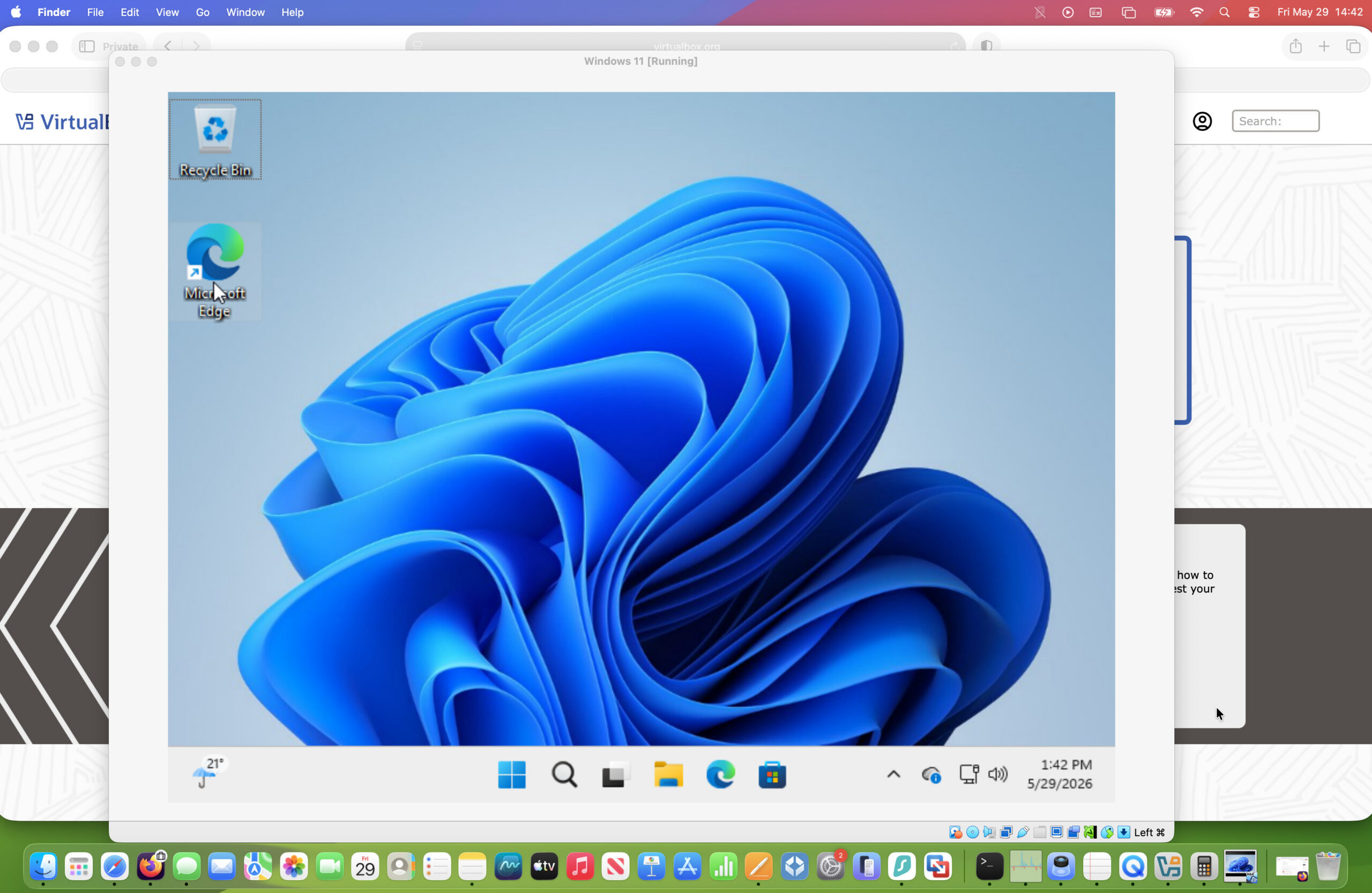
Yes – you can now run Windows on Apple Silicon Macs using VirtualBox, although there are still some important limitations you need to be aware of.
When Apple first released M1 Macs, VirtualBox did not support Apple Silicon hardware at all. However, newer versions of Oracle’s VirtualBox now include experimental ARM support for Apple Silicon Macs including M1-M5 Macs.
The important word there is experimental.
While it’s now technically possible to install Windows 11 ARM on an Apple Silicon Mac using VirtualBox, the overall experience is still far behind the best virtual machines for Mac such as VMware Fusion and Parallels Desktop.
In this guide, we’ll explain what currently works, what doesn’t, and whether VirtualBox is actually worth using on Apple Silicon Macs in 2026.
Can You Run Windows On M-series Macs With VirtualBox?
Yes – but only Windows ARM.
Apple Silicon Macs use ARM-based processors, which means they cannot run the standard Intel/x86 version of Windows directly.
Instead, you must install:
- Windows 11 ARM
Windows ARM is Microsoft’s ARM-compatible version of Windows designed for processors like Apple’s M-series chips.
Unlike in the early days of Apple Silicon, Windows ARM has improved dramatically and now includes built-in x86 and x64 emulation which allows many traditional Windows applications to run surprisingly well.
This means that many popular Windows apps now work on Apple Silicon Macs including:
- Microsoft Office
- Chrome
- Steam
- Photoshop
- many older Windows apps
However, compatibility still isn’t perfect and some software, games and drivers may not work correctly.
What Works In VirtualBox On Apple Silicon Macs
In my testing, I was able to:
- install Windows 11 ARM
- boot Windows successfully
- browse the web
- install standard Windows apps
- run basic productivity software
Performance was acceptable on an M3 Mac with sufficient RAM and CPU cores allocated to the VM.
For lighter Windows usage such as:
- office work
- browser testing
- development tools
- business applications
VirtualBox is now usable on Apple Silicon Macs.
What Still Doesn’t Work Well
This is where the limitations become much more obvious.
Although VirtualBox now supports Apple Silicon Macs, many features still feel unfinished compared to other virtual machines.
Guest Additions Problems
One of the biggest issues is that VirtualBox Guest Additions support remains unreliable on Apple Silicon Macs.
Guest Additions are supposed to enable features such as:
- clipboard sharing
- drag and drop
- dynamic screen resizing
- mouse integration
- shared folders
However, during testing on an M3 Mac, I couldn’t get Guest Additions working properly at all.
For example:
- drag and drop failed
- clipboard sharing didn’t work reliably
- Windows and macOS integration was limited
This means VirtualBox on Apple Silicon still lacks the seamless experience offered by Parallels Desktop or VMware Fusion.
Graphics Performance Is Limited
VirtualBox still has fairly weak graphics acceleration support on Apple Silicon.
You should not expect:
- modern Windows gaming
- heavy 3D workloads
- advanced GPU acceleration
Most modern AAA Windows games will either:
- run poorly
- not launch
- or be incompatible entirely
VirtualBox is far better suited to productivity tasks than gaming.
USB Support Can Be Unreliable
USB passthrough on Apple Silicon Macs can also be inconsistent.
Some devices work correctly while others:
- disconnect randomly
- fail to appear in Windows
- or are not detected at all
Installing the VirtualBox Extension Pack can improve compatibility somewhat, but it’s still less reliable than competing virtual machines.
How To Download VirtualBox For Apple Silicon Macs
The good news is that you no longer need unstable beta or development snapshots.
Modern versions of VirtualBox now include official Apple Silicon support directly from Oracle.
To install it:
- Go to the official VirtualBox website
- Download the macOS version for Apple Silicon
- Run the installer
- Approve Oracle system extensions in macOS if prompted
- Restart your Mac if required
After installation, you can create a Windows 11 ARM virtual machine using a Windows ARM ISO downloaded directly from Microsoft.
Check the installation video below for more help.
Important: You Must Use Windows ARM
This is one of the biggest points of confusion for many Mac users.
On Apple Silicon Macs:
- standard Windows ISOs will NOT work
- only Windows 11 ARM is supported
If you attempt to install the normal x86 version of Windows, the virtual machine will fail to boot properly.
Make sure you specifically download:
- Windows 11 ARM64
from Microsoft.
Is VirtualBox Worth Using On Apple Silicon Macs?
It depends on what you need.
VirtualBox Is Good For:
- free Windows virtualization
- testing Windows software
- basic office apps
- web browsing
- development environments
- learning virtualization
VirtualBox Is NOT Ideal For:
- gaming
- heavy graphics work
- seamless macOS integration
- high-performance Windows workloads
- beginners wanting easy setup
If you simply need occasional Windows access without paying for virtualization software, VirtualBox is now a viable option on Apple Silicon Macs.
However, it still requires more manual setup and troubleshooting than alternatives.
Better Alternatives To VirtualBox On Apple Silicon Macs
Parallels Desktop
Parallels Desktop remains the best overall Windows virtualization solution for Apple Silicon Macs.
It offers:
- dramatically better performance
- excellent macOS integration
- automatic Windows ARM installation
- reliable clipboard and drag-and-drop support
- far better graphics acceleration
The downside is that it’s paid software.
VMware Fusion
VMware Fusion is another excellent option and is now free for personal use.
Compared to VirtualBox, VMware Fusion generally offers:
- smoother Windows ARM support
- better compatibility
- more polished performance
- easier setup
In my experience, VMware Fusion currently feels much more stable on Apple Silicon Macs than VirtualBox.
UTM
UTM is another popular free virtualization solution for Apple Silicon Macs.
It’s especially useful for:
- Linux VMs
- retro operating systems
- ARM virtualization
- advanced emulation setups
UTM can sometimes provide better compatibility than VirtualBox on M-series Macs depending on the workload.
Summary
VirtualBox has improved significantly on Apple Silicon Macs compared to the early days of the M1.
You can now successfully run Windows 11 ARM on M-series Macs using VirtualBox, which simply wasn’t possible when Apple Silicon first launched.
However, support still feels unfinished in several areas.
Features such as Guest Additions, graphics acceleration and USB passthrough remain inconsistent, particularly compared to Parallels Desktop and VMware Fusion.
For casual Windows use, testing and experimentation, VirtualBox is now a viable free option on Apple Silicon Macs.
But if you want the smoothest and most reliable Windows experience on an M-series Mac, VMware Fusion or Parallels Desktop are still the better choices.