

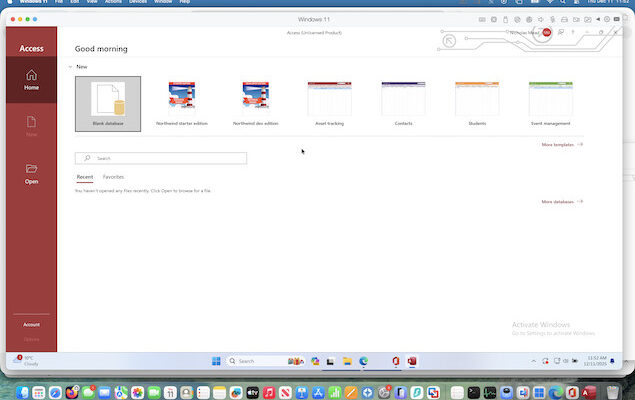
Although there are now some excellent Microsoft Access alternatives for Mac, there are still many situations where you need to open, view, or even edit real MS Access .mdb or .accdb files on macOS.
Some Mac apps can read Access databases and export the data, while others offer limited editing.
However, none of these Mac-native tools can open password-protected Access databases or run complex Access functionality such as forms, reports, and VBA.
If you need full compatibility, the only complete solution is to run Windows on your Mac and use the real Microsoft Access.
Below are the best options, ranked from most powerful to simplest.
| Tool / Method | Best For | Pricing |
|---|---|---|
| Parallels Desktop + Windows + Microsoft Access | Full Access compatibility (forms, reports, VBA, password-protected databases); users who need to use or develop Access databases on a Mac | Parallels Desktop: $99/yr; Windows license: varies; Microsoft 365 with Access: from $69/yr |
| Access Database Manager | Users who want a Mac-native app that allows viewing and optional editing of MDB files | $14.99 + optional in-app purchases for editing features |
| MDB ACCDB Viewer | Fast viewing and exporting of large .mdb and .accdb files; users who need reliable read-only access | $18.99 |
| MDB Tool – For Microsoft Access | Simple, low-cost viewing/exporting of older Access 2007-and-earlier databases | $5.99 |
| MDB Explorer (Google Workspace) | Free access for viewing MDB/MDE files and exporting data via Google Workspace | Free |
| Actual ODBC Driver for Access | Users who need to query Access data directly from Excel, FileMaker, LibreOffice, or OpenOffice on Mac | $39.95 |
1. Run Microsoft Access Using Parallels Desktop
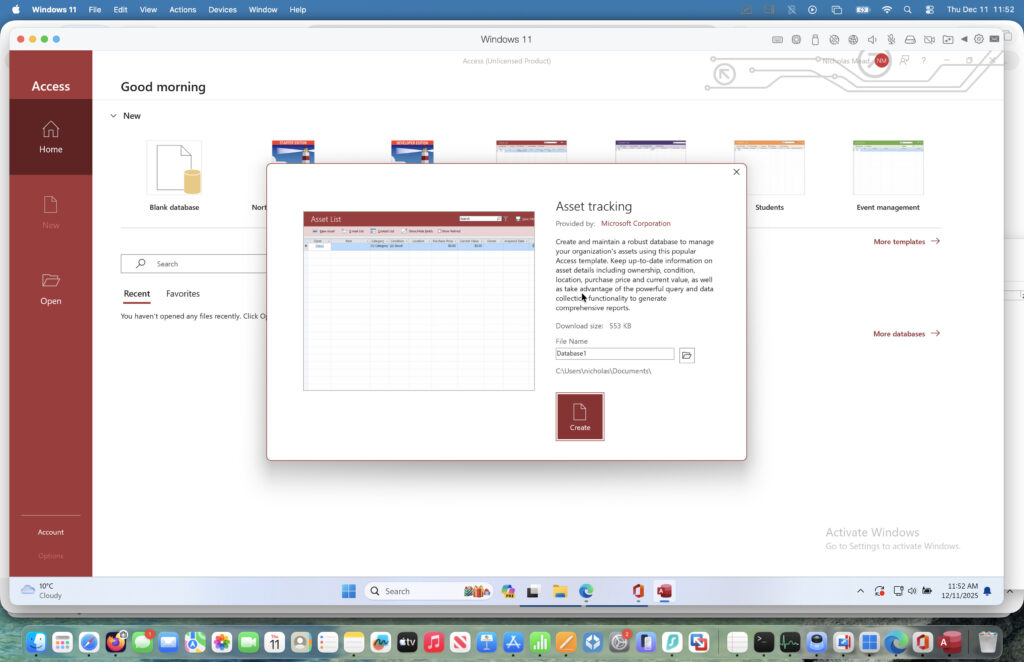
The most reliable and fully compatible way to open, edit, and use Microsoft Access on a Mac is to install Windows ARM using Parallels Desktop, and then run Microsoft Access on your Mac inside Windows.
Why this is number 1:
- Works on all Apple Silicon Macs (M1–M5)
- Full compatibility with .mdb and .accdb files
- Supports password-protected databases
- Works with forms, reports, macros, queries, and VBA
- Seamless integration with macOS (Coherence mode, copy/paste, shared folders)
Microsoft now distributes Windows ARM directly through Parallels, and Access runs perfectly under ARM using Microsoft’s built-in x86 emulation.
If you need real Microsoft Access – especially for editing, development, or complex databases – this is the best method.
For more on this, check our full guide on how to run Access on a Mac.
2. Access Database Manager

Access Database Manager allows you to open, view, and (with in-app purchase) edit MDB files directly on your Mac.
Highlights:
- Supports Access 2000+
- Can filter, sort, and export data
- Optional paid upgrade enables editing features:
- Update row data
- Add tables
- Import CSV
- Create databases
- Build simple interface elements
Limitations:
- Editing requires in-app purchases
- Cannot open password-protected files
- Does not support forms, queries, reports, or VBA
Still, it’s the most capable Mac-native editor available.
3. MDB ACCDB Viewer
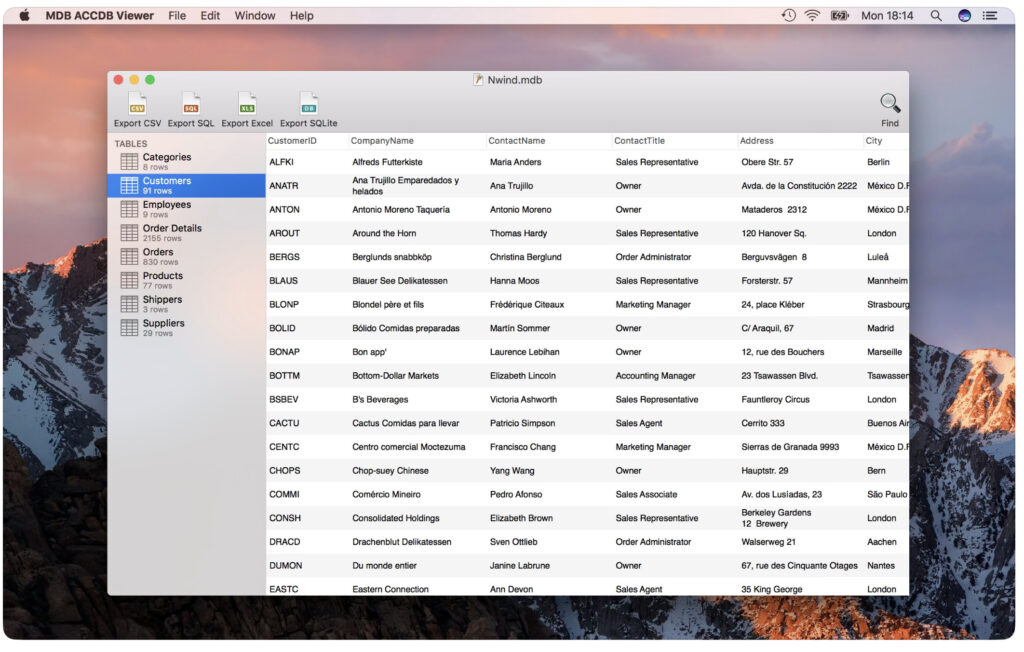
MDB ACCDB Viewer is fast, polished, and opens both .mdb and .accdb formats without extra steps.
Pros:
- Excellent performance with large databases
- Opens both legacy and modern Access formats
- Strong export options (CSV, SQL, Numbers, LibreOffice, etc.)
- Very stable and well supported
Limitations:
- Read-only: you can’t edit data
- SQL export can be messy with complex schemas
- No support for passwords, forms, or queries
Best for users who simply need to view data and export it cleanly.
4. MDB Tool – For Microsoft Access
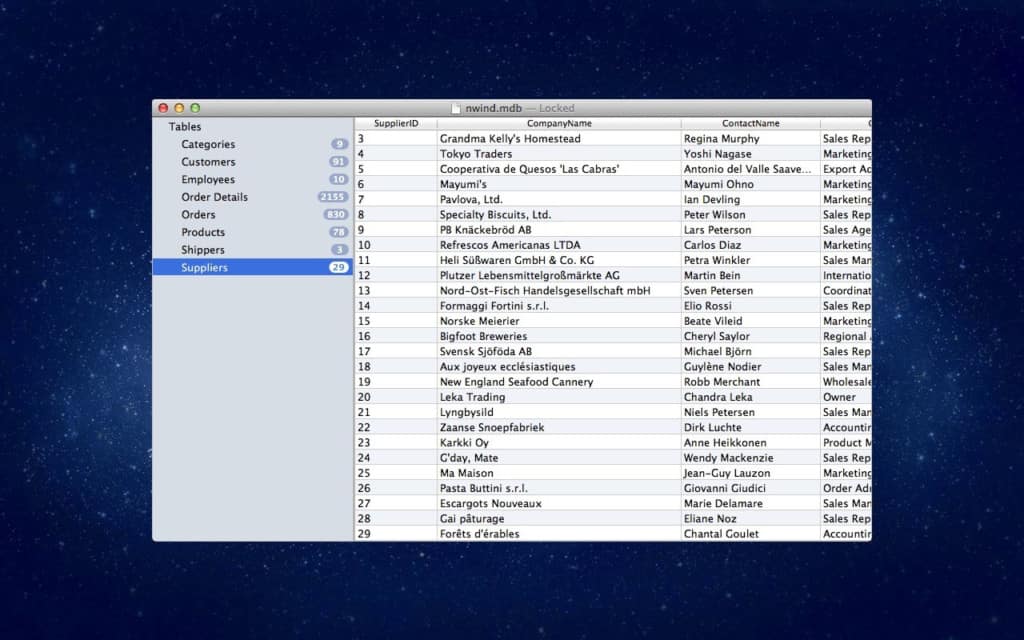
MDB Tool is a simple utility for viewing and exporting Access files.
Pros:
- Export to SQL or CSV
- Very easy to use
- Works well for small datasets
Limitations:
- Only supports Access 2007 and earlier
- Cannot open newer .accdb files reliably
- Very slow with large databases
- Does not support queries, forms, or reports
- View-only with no editing
This is a budget tool best suited for opening small, older databases.
5. MDB Explorer
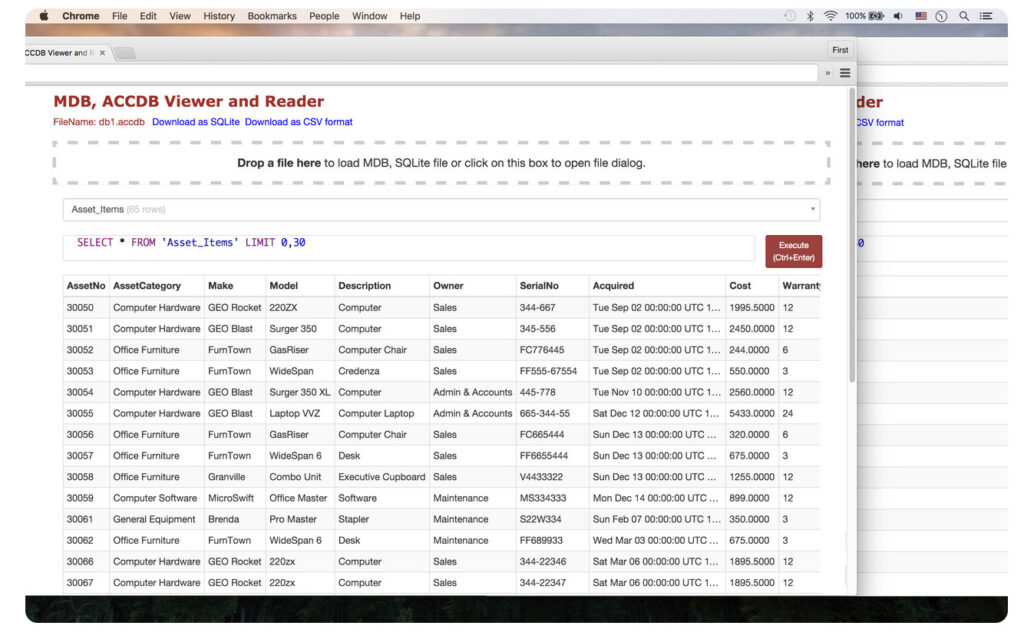
MDB Explorer is a free Google Workspace add-on that can open MDB and MDE files via the web-based interface.
Pros:
- Completely free
- Opens MDB/MDE files
- Exports to CSV, TXT, XML, SQLite, XLS, and XLSX
Limitations:
- No editing
- No query or form support
- Export-only workflow
- Requires Google Workspace
Useful for quick data extraction when you’re already working in Google Drive.
6. Actual ODBC Driver for Access
This tool lets you connect Microsoft Access database files to Mac apps such as:
- Excel
- FileMaker Pro
- LibreOffice
- OpenOffice
Pros:
- Good for integrating Access data into other Mac applications
- Works with Access 97 and newer
- Handles SELECT and JOIN queries
Limitations:
- Read-only: INSERT and UPDATE are not supported
- Cannot open password-protected databases
- Setup can be fiddly depending on your workflow
It’s basically a good choice if you already use Excel or FileMaker and just need data connectivity, not editing.
FAQ: Opening & Using Microsoft Access Files on a Mac
Can I run the real Microsoft Access on a Mac?
Yes. The only way to run the full Windows version of Microsoft Access on a Mac is by installing Windows in Parallels Desktop and then installing Access through Microsoft 365 or Office 2019/2021. This provides full compatibility with VBA, forms, reports, and password-protected databases.
Can Mac apps open password-protected Access databases?
No. None of the Mac-native database viewers or converters can open password-protected Access files. You must use real Microsoft Access in Windows to open them.
Do any Mac apps allow editing Access files?
Yes – Access Database Manager allows limited editing of MDB files with an in-app purchase.
However, it cannot edit ACCDB files or access forms, queries, or reports.
For full editing, use Microsoft Access via Parallels.
Can a Mac open ACCDB files?
Yes. Tools like MDB ACCDB Viewer can open ACCDB files and export their contents.
But editing ACCDB files (or using forms/reports) still requires the full version of Microsoft Access.
Is there a free way to open Access files on a Mac?
Yes. MDB Explorer (via Google Workspace) lets you open and export data from MDB/MDE files for free. However, it’s view-only and lacks support for ACCDB.
Can I convert Access files to another database format on Mac?
Yes. Many tools allow exporting or conversion:
- MDB ACCDB Viewer supports CSV, SQL, Numbers, LibreOffice
- MDB Tool supports CSV, SQL
- MDB Explorer supports CSV, TXT, XML, SQLite, XLS, XLSX
For more complex conversions, running Access in Parallels gives the most accurate results.
Is running Parallels Desktop safe for my Mac?
Yes. Parallels Desktop is fully optimized for Apple Silicon and works safely alongside macOS. It installs Windows in a virtual machine without modifying macOS.
Does Microsoft Access work on M1, M2, M3, M4 and M5 Macs?
Yes – via Parallels Desktop. Access runs normally because Windows ARM includes built-in x86 emulation, allowing Access to run just like on an Intel PC. There are also other virtual machines you could try other than Parallels.
Is Boot Camp an option for running Access on a Mac?
Not anymore. Boot Camp only works on older Intel Macs.
Apple Silicon Macs (M1–M5) do not support Boot Camp, so Parallels is the preferred method.
Which option should I choose?
- Best full Access experience: Parallels + Windows + Access
- Best Mac-native viewer/editor: Access Database Manager
- Fastest viewer/exporter: MDB ACCDB Viewer
- Free viewer: MDB Explorer
- For Excel/FileMaker integration: Actual ODBC Driver