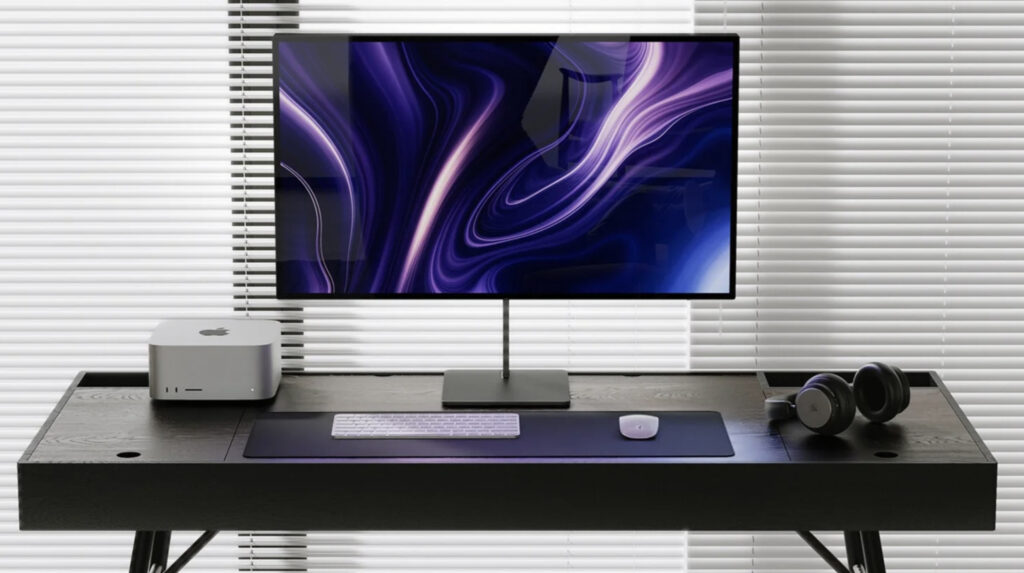

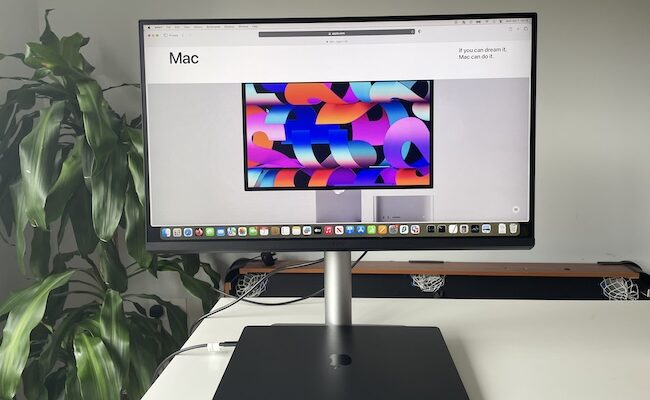
If you like the look of the Apple Studio Display but are put off by the hefty price tag, we’ve tested the best replacements for it in 2025.
July 8th-11th 2025 Update: Amazon Prime Day deals for both 4K and 5K monitors are now live!
Starting at $1,599 (although often much cheaper refurbished) and going up to $2,299 with customization (fancy a height adjustable stand for $400?), the Studio Display its aimed at those that want a more “affordable” version of Apple’s Pro XDR Display which costs a whopping $4,999.
There’s no denying the Studio Display is a difficult monitor to rival with ultra high-spec features such as 5K resolution, 218 pixels per inch, a 12MP face tracking camera and A13 chip to process images that you simply won’t find in any other non-Apple display.
However, when you consider that the Studio Display costs more than a new 24-inch M3 iMac, then you get an idea of just how expensive it really is.
Table of Contents
- Pros & Cons Of The Apple Studio Display
- 1. 4K BenQ 27 inch MA270U Monitor
- 2. 5K Samsung ViewFinity S9 (59% off!)
- 3. 5K BenQ PD2730S
- 4. 4K BenQ PD3225U 32 inch Monitor
- 5. 5K Asus ProArt PA27JCV
- 6. 5K LG Monitor 27MD5KL-B Ultrafine
- 7. 4K Asus ProArt Display PA279CV
- Are There 120Hz Studio Display Alternatives?
- 👀 Should You Just Get the Apple Studio Display?
- 🧭 Coming Soon in 2025
Pros & Cons Of The Apple Studio Display
There are many things we looked at when comparing these displays to Apple’s monitor.
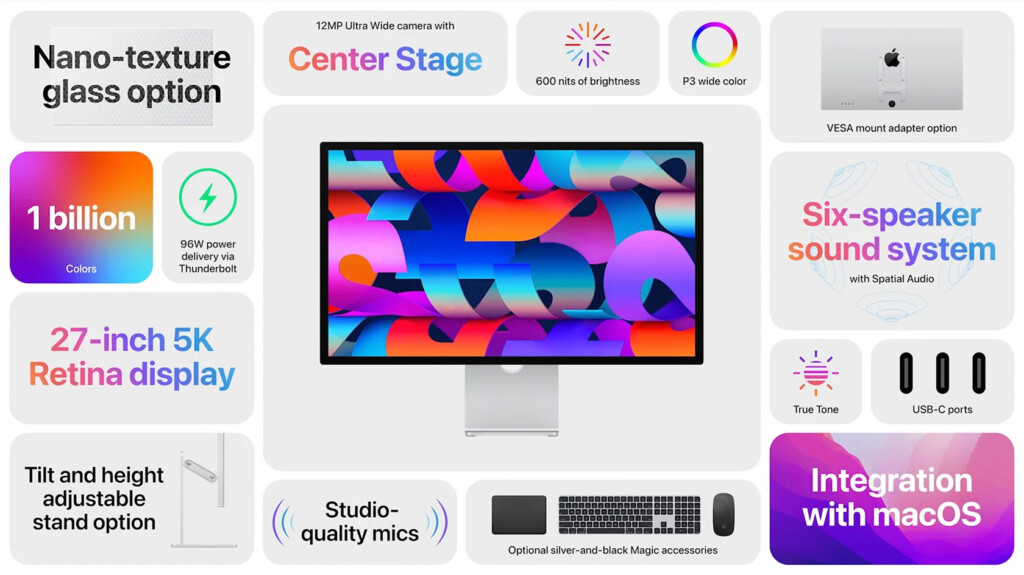
Some of the outstanding features of it include:
- Stunning build quality: The attention to detail and quality of materials make head and shoulders above any other monitor.
- Unbelievable specifications: 218 PPI, 5K, 27 inches, 14.7 million pixels, 600 nits of brightness and P3 wide color support to name just a few of the impressive specs.
- Speakers & Webcam: Six speaker sound system with spatial audio and an incredible 12 megapixel webcam with support for Center Stage.
However, there are some drawbacks to consider:
- It’s powered by the older A13 chip used in the iPhone 11. Considering the A16 chip is already available, this was a bit of a dated choice.
- It’s got a non removable power cable that can only be detached by “a professional”.
- There’s only one Thunderbolt port, three USB-C ports but no HDMI or DisplayPort.
- It doesn’t support High Dynamic Range (HDR) which is important for those that do video editing. However, it’s rumored that Apple will update the Studio Display with HDR later this year.
- There’s no LED backlighting although again, it’s thought Apple will add mini-LED backlighting which will improve brightness and contrast.
- It only supports Thunderbolt 3 whereas the latest Macs support up to Thunderbolt 5.
And of course, not to mention that cost still remains out of reach for many.
The good news there are some very competitive and cheaper alternatives that are comparable in terms of specs and performance.
Some of the main things we looked for in these alternatives were:
- Color Accuracy
- Resolution
- Support for HDR 600
Here then are the best Apple Studio Display replacements for all budgets in order of ranking.




1. 4K BenQ 27 inch MA270U Monitor
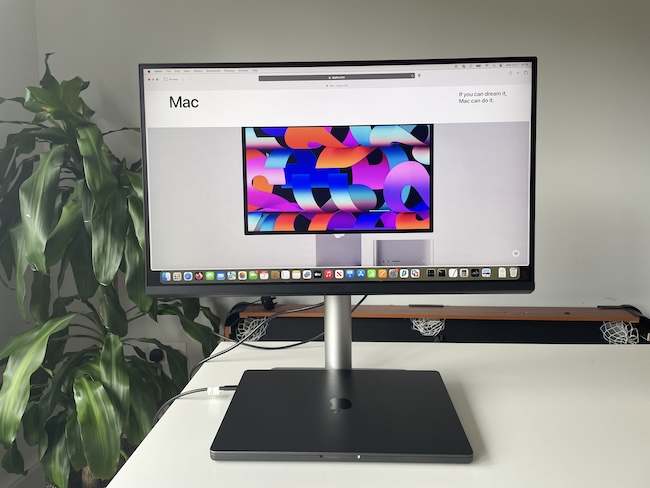
If you’re happy to settle for a 4K display, then the superb BenQ 27 inch MA270U may just be for you.
At less than $500 for the 27 inch version and under $600 for the 32 inch model, the MA270U is our favorite budget alternative to the Apple Studio Display.
BenQ’s MA series of monitors feature an “M-Book” mode which instantly calibrates the color to match your MacBook’s liquid Retina display.
In our review, we were really impressed by how accurate this was compared to other displays.
Not only this but the MA series allow you to control brightness and volume on the display with your Mac keyboard.
It even supports using Siri to control Focus Modes in macOS if you use that.
In fact, we really couldn’t find much difference between it and BenQ’s far more expensive Design Monitor apart from the lack of Thunderbolt port and Hotkey puck.
If you’re looking for excellent value and Mac compatibility, it’s a superb replacement for the Apple Studio Display.
Check out our full BenQ MA270U review for more.
You can also read our in-depth comparison of the MA270U vs Studio Display to see how they match-up head-to-head.
Pricing: $459.99 for the 27 inch MA270U / $549.99 for the 32 inch MA320U
Pros:
- M-Book mode calibrates color instantly with Macs
- Excellent value
- Control brightness and volume from your Mac keyboard
- Excellent Display Pilot software
- Available in 27 and 32 inch models
Cons:
- Internal speaker quality is poor
- No Thunderbolt port
- No webcam
- Maximum 4K resolution
2. 5K Samsung ViewFinity S9 (59% off!)

The 5K Samsung ViewFinity S9 has almost the same specifications as Apple’s monitor and is an amazing alternative to it.
Originally, this display retails for $1,599 from Samsung but refurbished models are currently an absolute steal at up to 59% off for just $654.44 which is an unbelievable deal for a 5K monitor with these specs.
💡 Tip: You can only get this model for less by scrolling down to the “Save with Used – Like New” section on Amazon on the right-hand side of the Amazon product page. Note that the offer is subject to availability.

In fact, we ranked it the best 5K display for Macs as a much better value alternative to the Studio Display.
Even in terms of looks, the Samsung ViewFinity S9 has a close resemblance to Apple’s display.
In terms of specifications, the Viewfinity S9 has a 5K 5120 x 2880 display with a wide 10-bit color gamut that covers 99% of the DCI-P3 spectrum.
The ViewFinity S9 also supports 218 PPI which is provides the best compatibility with the Retina displays of MacBooks.
It also has HDR600 support to improve shadows and highlights, support for 600 nits of brightness, a 4K webcam, one Thunderbolt 4 port, three USB-C ports and a mini Display port.
One other advantage is that the ViewFinity S9 also features its own remote control with a control joystick to navigate the on screen display settings.
You can also adjust the height of the stand on the ViewFinity S9 – if you want that privilege with Apple’s product you have to shell out an extra $400!
However, at full price, it’s the most expensive replacement for the Apple Studio Display that we’ve seen with a price tag that’s almost the same as Apple’s product.
You can check out our look at the Samsung ViewFinity S9 vs Apple Studio Display for more.
Pricing: Full retail price $1,599 but often well over 50% off refurbished.
Pros:
- Same specifications as Apple’s display
- Refurbished models are insanely good value
- 218 PPI
- 5K resolution
- HDR600 support
- Remote control and Smart TV functionality
Cons:
- Big external power supply
3. 5K BenQ PD2730S
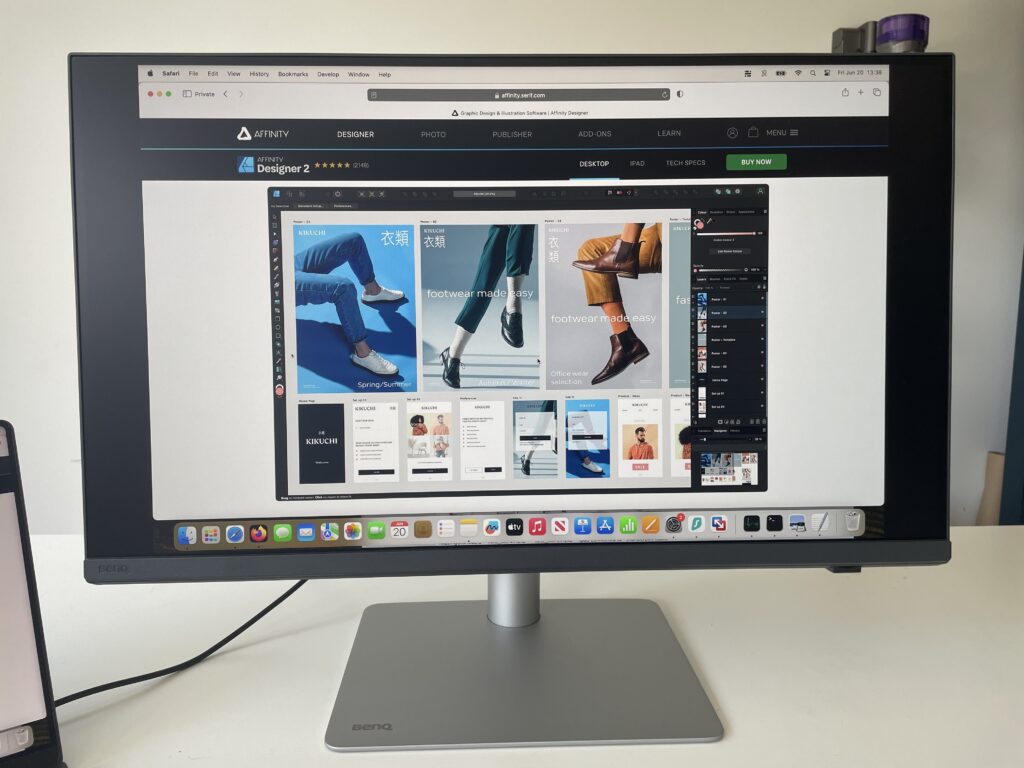
If only 5K will do and you demand the highest color accuracy with Thunderbolt connectivity, then BenQ’s stunning PD2730S released in March 2025 is for you.
At $1,399, it’s not cheap, but it delivers 5K2K resolution, Thunderbolt 4 support, and full DCI-P3 color accuracy in a package that’s built specifically with creatives and Mac users in mind.
Unlike cheaper monitors, the PD2730S includes a Thunderbolt 4 port with 90W power delivery, so you can charge your MacBook and connect high-speed peripherals with a single cable.
It also features a dedicated “M-Book” mode which instantly adjusts the color profile to match your Mac’s Retina display—ideal for graphic design, photo and video editing.
We were particularly impressed by the clarity of the 5K2K resolution, which gives you even more horizontal screen real estate than 4K for timelines, side-by-side windows, and design tools.
Another bonus is BenQ’s wireless Hotkey Puck, which lets you switch between color modes, inputs, and brightness presets without having to open menus—something even Apple’s Studio Display doesn’t offer.
And unlike the standard version of the Studio Display, the stand is fully adjustable, and the anti-glare coating works well in brightly lit spaces.
If you’re looking for a display that competes with Apple on quality, resolution, and Mac-first features—but gives you more flexibility and ports—the PD2730S is a fantastic high-end choice.
Check out our full BenQ PD2730S review for more.
You can also read our head-to-head comparison of the PD2730S vs Studio Display to see how they stack up.
Pricing: $1,399
Pros:
- 5K2K resolution is sharper than 4K
- Thunderbolt 4 with 90W charging
- M-Book mode matches Mac Retina displays
- Hotkey Puck for quick adjustments
- DCI-P3 and DisplayHDR 600 certified
- Fully adjustable stand
Cons:
- More expensive than other BenQ models
- No built-in webcam
- Speakers are basic compared to Studio Display
4. 4K BenQ PD3225U 32 inch Monitor
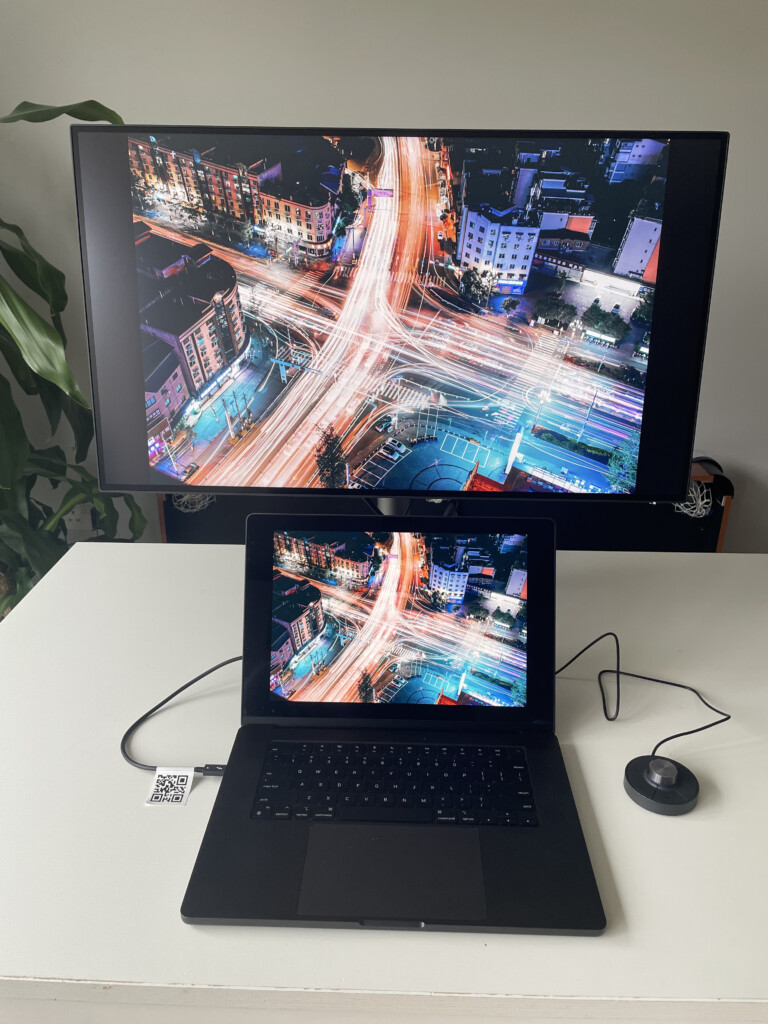
If you’re happy to use a slightly bigger 32 inch 4K replacement for the Studio Display with incredibly high color quality, then the BenQ PD3225U “Design Monitor” is an amazing alternative.
Aimed at graphic designers, the Design Monitor has the same “M-Book mode” as the MA270U meaning it instantly matches the colors of MacBook Retina displays.
The BenQ PD3225U supports 4K at a resolution of 3840 x 2160 pixels but is also an In-Plane Switching monitor (IPS) which uses liquid crystals in parallel to produce richer colors than most displays.
It also utilizes BenQ’s ColorTone software to automatically fine tune calibration for Macs with a bit of manual input to help it get the color representation just right.
There are no calibration issues when you use the Design Monitor either as it comes with it’s own calibration certificate out-of-the-box.
Like the MA series, it also allows you to use the brightness controls on your Mac keyboard to adjust the brightness of the monitor itself which most external displays don’t do.
There’s a lot more we could say about this excellent display and you can check out our full BenQ PD3225U review for more.
You can also see our head-to-head PD3225U vs Studio Display for more.
Pricing: Approx $1,099
Pros:
- Mac mode designed for connecting seamlessly to Macs
- Amazing color depth and blacks thanks to wide P3 color gamut
- Thunderbolt 3 ports for daisy chaining other monitors
- Control brightness from your Mac keyboard
- Excellent ColorTone and DisplayPilot software
Cons:
- Internal speaker quality is poor
- No integrated webcam
- Only 4K resolution
5. 5K Asus ProArt PA27JCV
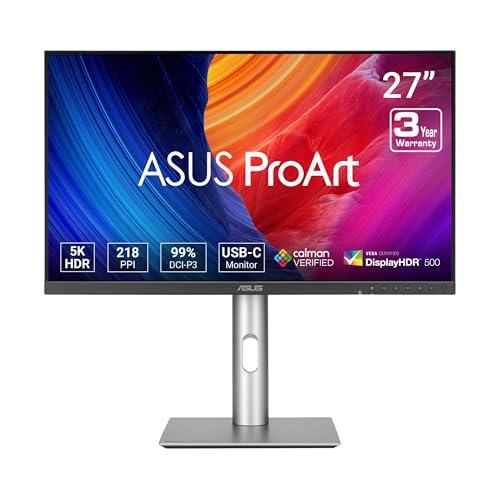
Released in November 2024, the excellent Asus Pro Art PA27JCV is up there with the Samsung Viewfinity S9 as the best budget alternative to the Apple Studio Display.
With support for 218 ppi it does an amazing job of reproducing the Retina displays of MacBooks.
It’s designed for creative professionals with a sharp 5120 x 2880 resolution, extremely accurate color reproduction and factory calibrated for Delta E<2 color accuracy.
Connectivity options include DisplayPort over USB-C with 96-watt Power Delivery, DisplayPort 1.4, USB hub with USB 3.2 Gen 1 Type-C and 3x USB 3.2 Gen 1 Type-A ports.
However, there’s only one HDMI port although we’d only recommend using USB-C with a Mac anyway.
The monitor is priced at around $799 although high demand has meant that availability is limited.
Check out our full comparison of the Asus Pro Art PA27JCV vs Apple Studio Display for more.
Pros:
- 5K resolution with 218 ppi
- USB-C, 96W power delivery
- Supports HDR
- Price
Cons:
- 27 inch only
- Availability
- One HDMI port
6. 5K LG Monitor 27MD5KL-B Ultrafine
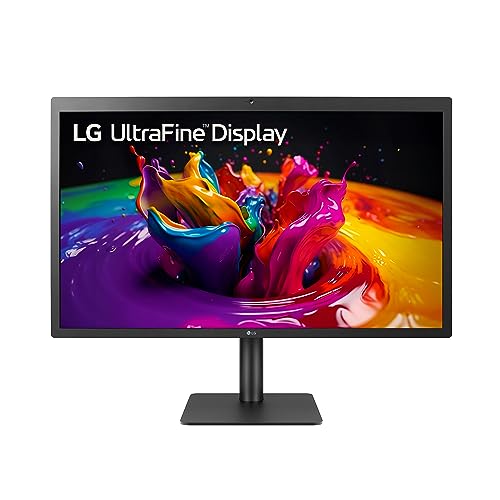
With a very similar spec to the Apple Studio Display, the 5K LG 27MD5KL-B UltraFine 27 inch monitor is a very close match to it.
In fact, Apple helped LG develop the UltraFine display as it contains a very similar panel to the 27 inch 5K iMac display.
Apple even used to sell the LG 5K 27MD5KL-B UltraFine 27 inch monitor on its website until the release of the Studio Display.
The 27 inch UktraFine is a 5K Ultra High Definition (UHD) monitor with 5120 x 2880 resolution with a 16:9 aspect ratio which is exactly the same as the Studio Display.
Crucially, the 27 inch LG UltraFine 5K display supports up to 218 pixels per inch (PPI) which is also the same as Apple’s Retina quality screen.
This means that when you use it at its maximum 5K resolution the images are Retina quality which is just as good.
This avoids many of the resolution scaling issues that many Mac users experience when connecting external monitors to MacBooks.
One big downside is the availability of this display, especially outside of the USA.
Although LG still stock it, they are frequently out of stock and Amazon is one of the few places you can get it.
The great thing however is that you can pick-up refurbished models for around $850 which is an absolute steal for a monitor with these specs.
New ones are limited in availability but cost around $1,559 – and if you’re going to pay that, you might as well just get an Apple Studio Display.
Note that at CES 2025, LG announced the release of a new 6K UltraFine display that supports Thunderbolt 5 on the latest M4 Macs.
No release date or pricing is available yet but it’s worth being aware of when considering whether or not to get the 5K LG UltraFine.
For a closer look at how it compares with Apple’s display, check out our in-depth look at the Apple Studio Display vs LG UltraFine 5K.
You can also read our full LG 27MD5KL-B 5K UltraFine 27″ monitor review for more.
Pricing: Refurbished Approx $850, New Approx $1,599
Pros:
- Initially developed alongside Apple
- 5K quality resolution
- 218 PPI for excellent Retina scaling
- Thunderbolt 3 ports
- Limited availability outside of the USA
- Refurbished models are half the price of Studio Displays
Cons:
- Internal speaker 7 webcam quality
- No support for HDR
- 100 nits less brightness than Apple’s monitor
- Availability is limited
- Brand new models are expensive
7. 4K Asus ProArt Display PA279CV

If Acer’s 5K Pro Art PA27JCV is a bit beyond your budget and you can settle for 4K, then the 27 inch Asus ProArt Display PA279CV is a great option for artist and designers.
At less than $400, there are very few monitors on the market with this kind of color accuracy at 4K at this price point.
The color accuracy is the outstanding feature of the Asus ProArt Display with a wide color gamut of 709 and Delta E < 2 color accuracy.
The 27-inch Asus ProArt Display PA279CV also supports 4K HDR UHD with a maximum of 3840 x 2160 resolution.
On the downside however, it only has a pixel density of 163 ppi which isn’t ideal for producing crystal clear MacBook Retina displays.
For artists and designers, Asus also include useful ProArt Presets and ProArt Palettes that allow you to configure and save color settings depending on what you’re working on.
Overall, for creative professionals on a budget, the Asus ProArt Display PA279CV offers a great value for money 4K Studio Display replacement.
For more check out our full Asus ProArt Display 4K review.
Pricing: Approx $399
Pros:
- Excellent color accuracy for this price range
- Superb for color grading
- LED backlight display
Cons:
- No real Adobe RGB support
- Only supports up to 4K
Are There 120Hz Studio Display Alternatives?
If you want an alternative to the Studio Display with a higher refresh rate for gaming or video editing then your options are very limited.
For gaming or video editing fast paced footage, ideally you need a refresh rate of around 120Hz but the best you’re going to get at the moment is 60Hz.
There simply aren’t any 27 inch 5K displays on the market yet with the same pixel density as the Studio Display with a 120Hz refresh rate.
The closest thing we’ve found is the 40 inch Dell UltraSharp U4025QW.
As an Ultrawide monitor, it’s obviously a lot bigger than the Studio Display and it has a curved screen, but it does support 5K and a 120Hz refresh rate.
However, the pixel density is also a lot lower at just 140 PPI.
It’s also not really suitable for brightly lit environments as it only supports 300 nits of brightness and of course, the webcam and speakers can’t compare with Apple’s display.
The pricing is however around the same and if you plan to do a lot of gaming, it may be a better option for you.
It’s rumored that Apple will release an updated version of the Studio Display (codenamed J427) at the end of 2025 or early 2026 which may support 120Hz.
Until then however, the Dell U4025QW is about your best option.
| Screen Size | 39.7 inches | 27 inches |
| Resolution | 5120×2160 (5K2K UltraWide) | 5120×2880 (5K Retina) |
| Refresh Rate | 120Hz | 60Hz |
| Panel Type | IPS | IPS |
| Brightness | 300 nits | 600 nits |
| HDR Support | DisplayHDR 600 | SDR (HDR content is supported) |
| Ports | HDMI 2.1, DisplayPort 1.4, Thunderbolt 4, USB-C, USB-A, Ethernet | Thunderbolt 3, USB-C |
| Speakers | 2x9W | Six-speaker spatial audio system |
| Camera | None | 12MP Ultra-Wide with Center Stage |
| Ergonomics | Height, swivel, and tilt adjustment | Tilt only (height optional) |
| Color Coverage | 100% sRGB, 98% DCI-P3 | 99% DCI-P3 |
| PPI | 140 | 218 |
| Price | $1,559.95 | $1,599 (standard) or $2,149 (Nano-texture version). Usually cheaper refurbished. |
👀 Should You Just Get the Apple Studio Display?
Ask yourself:
- Do you need HDR? → ❌ Studio Display lacks HDR.
- Do you want macOS-native scaling? → ✅ Studio Display is perfect.
- Do you want amazing speakers and webcam ? → ✅ Studio Display can’t be beat
- Want better value? → Buy one refurbished or try one of the options above.
🧭 Coming Soon in 2025
There’s also a few upcoming releases in 2025 to consider if you’re still not ready to take the plunge now:
- Apple Studio Display 2 (rumored): Mini-LED, ProMotion, possible late 2025 or early 2026 release.
- Dough Spectrum Canvas: Built by Dough with feedback specifically from Mac users, this 6K monitor was announced at CES 2025. Specifications include an IPS black panel, 10 bit color, 98% DCI-P3 coverage, 218 ppi, 2000:1 contrast ratio, and support for 99.5% Adobe RGB coverage. Unlike most monitors, it also has a similar build quality to the Studio Display with an aluminum body and solid glass screen. Full specs and pricing are TBC but it’s expected to undercut the Studio Display’s price tag.