
Visio for Mac does not exist but there are some excellent alternatives to Microsoft Visio on Mac OS X. Microsoft released Visio 2016, Visio 2013 and Visio 2010 for PC only and it has never been available for Mac. And despite the recent release of Office 2016 for Mac, there is still no Visio 2016 for Mac included in it. However, there is hope for Visio users that have switched to Mac. In this article, we look at professional Visio replacements for Mac including those native to OS X and those that are multi-platform. Note that if you just want to view a Visio file on Mac that someone has sent you, check out our guide to Free Visio Viewers For Mac. Or if you are just looking for a general diagramming tool that doesn’t come with a Visio like price tag, you’ll probably find our article on the best Free Alternatives to Visio for Mac more useful. If however you’re simply looking for serious viable alternatives to open and edit VSD and VSDX files on your Mac, read on.
The Best Alternatives To Visio For Mac
Although there’s no Apple version of Visio, there are four main contenders for serious alternatives to Visio on Mac – SmartDraw, Lucidchart, Omnigraffle Pro and ConceptDraw Pro. These four are by far the most similar to Visio in terms of features and professional CAD capabilities and here we’ve taken a closer look at them. We’ve also included a few other interesting options that offer some of the functionality of Visio but in more specific areas. For example, Axure RP has emerged as a strong contender for creating wireframes and interactive prototypes although it’s more suited to website prototypes than general technical diagrams. We also take a look at Sketch for Mac which offers some of the vector graphic functionality of Visio but with more emphasis on graphic design.
SmartDraw ($12.95/month. Free Trial)

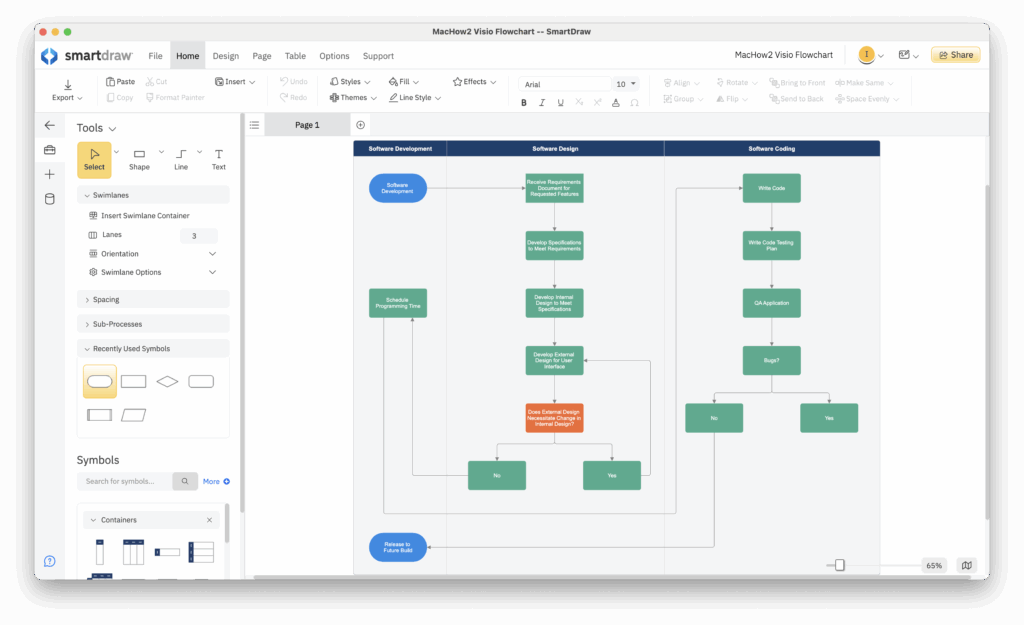
With over 1 million customers including GM, Pepsi and FedEx to name a few, SmartDraw is arguably the most established diagramming software available outside of Visio. SmartDraw has been around over 20 years and during that period has been downloaded more than 22 million times. Until 2016, SmartDraw Desktop was only available on PC but now the company offers a fully functional cloud version that Mac users can finally use making SmartDraw compatible with Mac for the first time. The impressive thing is that the cloud version of SmartDraw includes every feature of SmartDraw Desktop Business Edition. The toolset is exactly the same as the desktop version with an impressive 34,000 symbols and 4,500 templates which cater for the many different users of SmartDraw. SmartDraw Cloud has templates for a wide range of diagramming needs including CAD designs, flowcharts, org charts, mind maps, brainstorming charts, decision charts, floor plans, landscape designs, decision trees, cause and effect diagrams, family trees and even recreating crime scenes. There are over 70 different categories of SmartDraw templates in all of which these are just a sample:

When you log into SmartDraw for the first time in your browser, you’re presented with a GUI that’s exactly the same as the Windows desktop version. The most striking thing about SmartDraw is the relative ease at which it allows you to create visuals compared to the complexity of Microsoft Visio or Adobe Illustrator. SmartDraw achieves this through a combination of a simplified, clear interface and automated templates which do a lot of the hard work for you. Compared to Visio, the choice of templates, the way the templates work and both the quality and choice of symbols is outstanding. And even if you don’t want to stick to the templates, they provide lots of inspiration with which to work with.
Within each template, there is a SmartPanel which contains thousands of high quality symbols, images and clip art to work with. One gripe with Visio is that many of the objects and images are quite dated and generic and SmartDraw provides more modern and eye-catching illustrations.
You can also search for symbols and SmartDraw will search its entire database so that you can import symbols from other templates too. The really clever thing however is the way SmartDraw automatically adjusts and revises the diagram when you make changes to branches and objects. For example, if you delete a branch in Visio, there’s a gap where it used to be and you need to manually plug that hole or re-balance the entire diagram which can be very tedious and time-consuming. SmartDraw on the other hand automatically closes any branch gaps and re-adjusts or re-balances the diagram so that it still flows and looks professional. You can see this in action when building an Org Chart:
When it comes to Visualization SmartDraw offers a huge choice in creating infographics and charts. If you need to create striking infographics, SmartDraw has a huge choice of categories and templates including population templates, World Date Map templates and process/cycle templates. In terms of charts, there’s everything from basic pie charts and bar charts to 3D charts and Relative Value charts for calculating ROI.
SmartDraw can easily extend to the needs of CAD too although it has to be said that it can’t really compete with major CAD for Mac software such as AutoCAD. However, there are plenty of templates for engineering to create electrical wiring plans, industrial designs and architectural blueprints. Certainly as a starting point for CAD designers, it’s a good choice as it’s easy to use.
If you’re a Microsoft Visio user however or have to deal with Visio files on a daily basis, the big question you’ll be wondering about is how does SmartDraw fare when opening Visio files? In our experience, SmartDraw Cloud seems to have absolutely no problem working with Visio files and preserves the formatting when importing Visio VSD and VSDX files into SmartDraw. You can do this very easily by going to the Account Menu and selecting Import Visio: 
After importing a Visio file, you can ungroup, change fill color, resize shapes and edit the Visio diagram with SmartDraw (note however that you can’t import VST or VTX Visio stencils and templates into SmartDraw). After you’ve finished editing a diagram, you can send it to Visio users by exporting to Microsoft Office format, PDF, SVG or PNG format. Visio file export is not yet supported although this is something that will be added soon according to SmartDraw.

You can even export to Pages – Apple’s alternative to Microsoft Word for Mac. Everything created in SmartDraw is saved in the cloud but you can also choose to save diagrams or export Visio files to Google Drive, Microsoft OneDrive and Dropbox.
Despite being entirely cloud based, SmartDraw is surprisingly fast and responsive. If you’ve used SmartDraw on Windows, you’ll notice no difference in how quick you can get things done on SmartDraw on your Mac compared to on PC or desktop. Since its cloud based, you can of course use it anywhere too, including on your iPhone if you want to make a last-minute edit.
Image quality is another area where SmartDraw impresses. SmartDraw offers the best image quality we’ve seen in a cloud diagramming software because it uses vector graphics rather than bitmap. Due to the higher demands of vector graphic rendering, almost all cloud software relies on rasterized bitmap graphics which are fuzzy and pixellated when you zoom in on them.
Vector graphics on the other hand store graphics as lines and curves and thus are smooth and crisp no matter how much you zoom on them. SmartDraw is the only cloud diagramming software that uses vector graphics which gives it an advantage over other online diagramming tools such as Lucidchart and Gliffy which are bitmap based.
The result is that SmartDraw images look extremely crisp, especially when adding graphics and illustrations such as this Landscape Design:
In terms of pricing, there’s no up front cost to SmartDraw like with Visio and there’s only one version. Currently Visio Standard costs $299 and Visio Professional $589.99. A single license for SmartDraw costs just $12.95 per month (billed annually). Of course, Windows users have the option of using Visio for Office 365 for $13 per month but this still doesn’t offer all of the functionality of the desktop version of Visio. And if you buy a license for a team of 50 users for example, SmartDraw works out considerably cheaper at $59.90 per user compared to $156 for Microsoft Visio for a comparable license. For bulk purchases of SmartDraw Cloud, you must request a quote first. Note that if you’re also a PC user and have already bought the $297 Windows version of SmartDraw 2016 Business Edition, you get SmartDraw Cloud for free for one year.
SmartDraw Customer support is also free via email or phone (Monday – Friday: 6 AM to 5 PM PST) and is provided at SmartDraw’s HQ in San Diego rather than offshore such as in India like with Microsoft Visio. Anyone that’s ever struggled with Microsoft’s outsourced customer support can vouch for how important direct customer support is if you’re facing a problem or issue with a critical project.
Overall, SmartDraw is hard to beat as an alternative to Visio on Mac and it’s great that we can finally use SmartDraw on a Mac. The cloud version offers all the functionality and quality of the Windows desktop version with the added bonus that SmartDraw just makes things so easy compared to Visio. To get a good overview of SmartDraw in action, you can watch a video of SmartDraw’s interface and features here:
And to learn more about SmartDraw on Mac, you can read our in-depth SmartDraw review.
Pros:
Imports and exports Visio files
Thousands of templates and shapes
PDF, PNG, SVG and Pages export
Easier and quicker to use compared to Microsoft Visio
Uses high quality vector graphics instead of bitmap
Works in your browser on any device including Mac, iPad and iPhone
Integrated with Google Drive, Microsoft OneDrive and Dropbox
Includes all the functionality, features and quality of the PC desktop version
Cons:
No native desktop client
No Visio file export (will be added soon though)
No support for Visio VST or VTX templates
Lucidchart For Mac (Monthly Pricing Plans. 7 Day Free Trial. Free Version For Single Users)

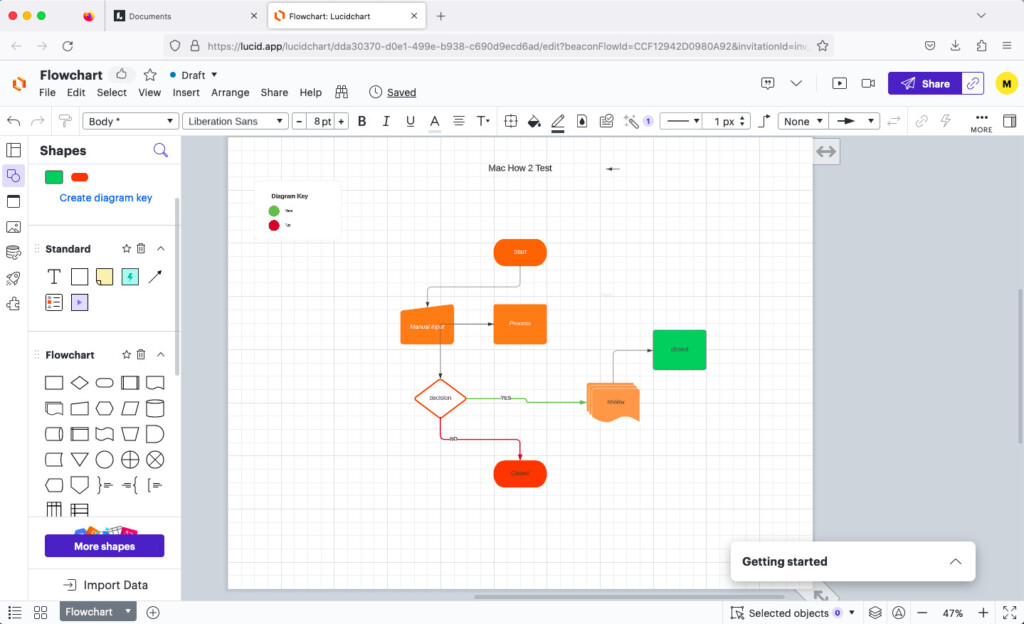
Lucidchart offers a fully functional professional Visio reader and editor for Mac which works in your browser and is therefore independent of whether you are using a Mac or PC. Although Lucidchart is entirely cloud based, if you want to work offline on your Mac desktop without an internet connection, there is a free Google Chrome plugin for Lucidchart which allows you to work offline using Google Chrome and then syncs changes as soon as you go online again. Lucidchart is also fully integrated with Google Drive, Google Docs and Microsoft Office for Mac. This means that you can open Visio files uploaded to Google Drive or Office 365 for example and insert diagrams into documents in Drive or Office. There are also Lucidchart plugins for Google Apps, JIRA and Confluence.
Because it’s web based, Lucidchart is an excellent option for those working on Visio projects in a team because it’s so easy to share work. Or if you just need a quick and easy solution to open a Visio file on your Mac in a hurry, the free Basic Single User option is a fast and simple solution. Lucidchart has no problem importing, editing and exporting Visio files and was actually the first web based app to allow you to do so. However, to edit Visio files on Mac using Lucidchart you need to upgrade to at least the Pro or Team version – the Basic Single User version will only let you open and view them. You can import Visio files for editing in Lucidchart in VDX, VSD and VSDX format meaning you can import files from Visio 2003, 2007, 2010 and 2013. To do so, simply log in to your Lucidchart account and click File > Import Diagram on your Documents page. Then select the Visio file you want to import from your Mac’s hard drive and the document will open in Lucidchart. As you can see, you can also import files from another diagramming tool Gliffy and more recently, they’ve added support for OmniGraffle files too.
Exporting to Visio is also easy enough. Just open your Lucidchart document, select File > Download As and Choose “Visio (VDX)” to export the file in Visio’s VSD format.
Lucidchart also allows you to upload and insert PNG, JPG and SVG files into document and export your final diagrams into most major image formats and PDF.
Lucidchart has a pretty big choice of templates and shapes, including popular ones like Cisco basic and extended libraries and VMWare stencils. There are also plenty of stencils for network diagrams or for creating schemas. If you need to extend these with specific Visio stencils however, you can also import Visio stencils in VSS or VSX format into Lucidchart (although Visio templates in VST or VTX format are not supported). Again though, this is option is only included in the Pro and Team versions of Lucidchart. To do this, you just open a document and click on “More Shapes” from the left-hand toolbox. Then select the “Import” button and select the stencil from your Mac. Once imported, Lucidchart creates a new library in your toolbox with the shapes from the stencil. You can drag and drop these just like any other Lucidchart shape although you may sometimes experience formatting issues with imported Visio templates as the feature is still in beta.
To clarify which Lucidchart plans support which Visio formats, use the table below for reference but in a nutshell, those needing a serious Visio alternative need either the Lucidchart Pro, Team or Enterprise plans.
If you need to view or edit Visio documents on the move, there’s also a free LucidChart mobile app for iOS that allows you to edit and collaborate on diagrams, although it can be a bit slow at retrieving your designs from the web. The app has recently been revamped to be quicker with a much better interface and new features. You can read more about Luidchart’s mobile app in our full review of Lucidchart for iPad here. In general, the Lucidchart team are very hot on updating the product based on customer feedback and changes are made pretty quickly. For instance, if there’s a file format that you need to be supported in Lucidchart, you can vote for it here and the developers are very responsive when it comes to any questions or problems you might have.
Most recently, Lucid Software has responded to popular demand by adding integrating Lucidchart with productivity tool Slack which means Slack users can use the “/lucidchart” command to instantly create and share diagrams. It also plans to add notifications so that other Slack users will be notified when others comment, edit and share their diagrams. Other recently added features due to feedback from users include a presentation mode that converts diagrams into slides and @mentioning in comments to make collaboration easier.
For Microsoft Office users, Lucidchart now features closer integration with Microsoft Office. Lucidchart now has add-ins (i.e. plugins) for Microsoft Word, PowerPoint and Excel that make it easy to edit and create Lucidchart flowcharts or diagrams directly in Office documents. All you need to do to install the Lucidchart plugin for Microsoft Office is open PowerPoint, Word or Excel and go to Insert > My Add-ins and then search for Lucidchart and install the add-in. You then simply either login to Lucidchart or open a new Lucidchart account to create or insert a diagram. This includes dynamic diagrams, flowcharts, and wireframes. You can also download the Lucidchart add-in from the Microsoft Store.

It’s not all work and no play with Lucidchart either. Lucidchart also features ways to make pop-culture flowcharts such as these examples for Which Game of Thrones House Do You Belong To? or Which Toy Story Character Are You?

Pricing depends on your exact needs although Lucidchart is free for a Basic Single User license but note that this is limited to 60 objects per document and 25MB of storage space. And although importing Visio VSD and VDX files is free in the Basic version, you can only export to Visio format if you upgrade to the Pro, Team or Enterprise version. Visio templates aren’t supported at all in the Basic version. Whichever option you choose, if you pay annually in advance, you can save up to 33% than paying monthly. 
If after trying the Team version, you decide to use Lucidchart across your entire company, you can upgrade to The Enterprise version which offers advantages such as document retention and account provisioning. There are several other advantages to the Enterprise version for administrators too, a summary of which you can see here:
On an end user level, there are fewer advantages to upgrading to Enterprise except auto-provisioning and a better level of customer support:
You can get a sneak peak at what Lucidchart looks like by opening the Visio viewer demo for free. You can also try a free 7 day trial of Lucidchart to judge for yourself (the trial has recently been reduced from 14 days although Lucidchart will extend the trial on request if you need more time to evaluate it). For a more in-depth look at Lucidchart, we strongly recommend you check-out our full review of Lucidchart. You can also see Lucidchart in action here:
Pros:
Integrated with Google Drive and Microsoft Office 2013
JIRA, Confluence and BOX
Easy to pick-up and learn
Import and Exports Visio files and stencils (Pro and Team versions)
PNG, PDF, and JPEG import/export
Works in your browser – no expensive or bloated software to install or maintain, Chrome plugin to work offline.
Cons:
Only allows Visio export with Pro or Team version
Monthly subscription model
Some formatting issues depending on complexity of Visio files imported
No support for Visio VST and VTX templates
OmniGraffle Pro ($99 Mac App Store. OS X 10.8+. iPad version also available for $49.99)

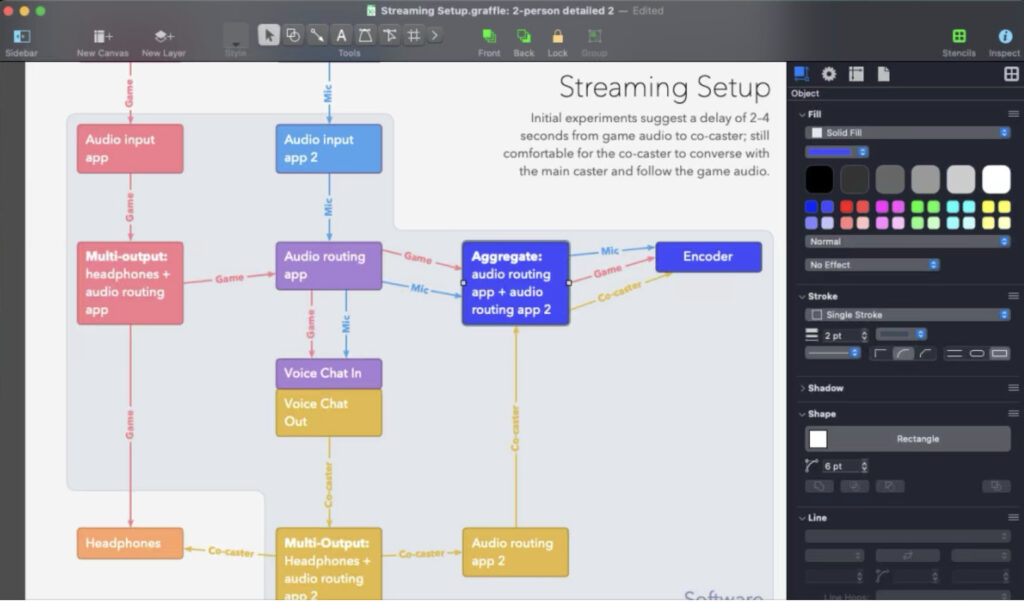
OmniGraffle Pro is a superb alternative to MS Visio on Mac with a more accessible and user friendly interface that’s easier to get to grips with and looks better than it’s other desktop competitor, ConceptDraw Pro (see below). Unlike ConceptDraw Pro which works on both PC and Mac, OmniGraffle is designed specifically for OS X so it’s definitely more Mac user oriented. It’s also easier and more straightforward to use than Visio on Windows and in some respects, is even more powerful.
The most important thing to be aware of from the start is that the basic version of OmniGraffle won’t suffice if you want a serious alternative to Visio. OmniGraffle costs $99 from the Mac App Store but you have to upgrade to the the Pro version via an in-app purchase for another $99 to get essential features such as the ability to import and export Visio files. So basically, it will cost you $198 for OmniGraffle Pro even though the basic version is listed in the App Store at $99. However, this is an essential upgrade for Visio users or those that work with Visio files because OmniGraffle Pro opens all Visio formats including VSD and VSDX files and Visio stencil files in VST and VSS format. If you need more stencils and templates for OmniGraffle, you’ll find plenty in our look at the best OmniGraffle Stencils.

Importing Visio files into OmniGraffle is very easy. Once it’s installed on your Mac, OmniGraffle automatically detects Visio files so that if you double click on them, they will automatically open in OmniGraffle. Alternatively, you can drag any Visio file to the OmniGraffle icon in your dock and it will open. There’s also OmniGraffle for iPad which can also open Visio files – simply tap and hold the Visio attachment in your email or any other app and the select Open in OmniGraffle. You can also of course go to the File Menu and select Import to import a Visio file or stencil.
The biggest problem you’ll experience with OmniGraffle is probably instability. OmniGraffle has no problem importing Visio files but does tend to struggle at times when it comes to editing. It can be incredibly frustrating when editing complex Visio files for OmniGraffle to suddenly crash or freeze and thus lose hours of work so it’s essential to save work frequently. One other drawback of OmniGraffle Pro is that it doesn’t quite offer the fine tuning precision of shapes and objects that Visio or ConceptDraw Pro do although only experienced Visio professionals will notice this.
Also, note that the Mac App Store download for Omnigraffle Standard version and OmniGraffle Pro are the same – the Pro features are unlocked when you purchase a Pro license from within the app itself as there’s no separate download for Pro. Just go to the OmniGraffle Menu and select In-App Purchase to upgrade to Pro. 
You can also see OmniGraffle in action here:
You can also watch some OmniGraffle tutorials here and read more about its features on the OmniGraffle website. If you’re impressed by OmniGraffle, we also recommend our OmniPlan for Mac review which is an incredibly effective productivity tool and organizer made by the same developer, OmniGroup.
Pros:
Native desktop Mac app – designed specifically for OS X
Easier to use than ConceptDraw
Imports and Exports all types of Visio files
One off payment – no subscription model
Cons:
Not as precise as Visio
Can be unstable sometimes
Requires a $99 in-app purchase to import and export Visio files and stencils taking total price to $198
No free updates
App Store version can’t be upgraded
ConceptDraw Pro (Desktop. $199)
ConceptDraw Pro is a serious alternative to Visio on Mac and a desktop based solution aimed at professional designers working in CAD environments. ConceptDraw Pro can import Visio VSD files (Visio 2007-2010 format) and the newer VSDX format (Visio 2013 and above). To import Visio files, simply go to File > Import and then select the Visio format you want to import.

VSDX files can be imported instantly this way although importing but VSD files is a bit more cumbersome. You have to email VSD files to [email protected] which triggers ConceptDraw’s automated Visio File Conversion Tool first and you will be sent back converted Visio files in VDX format. You can also send batches of zipped files for conversion and files are returned using the original file compression that you sent them in. This seems a rather odd way to convert files but it works and for most people anyway, the inbuilt VSDX import tool will be used more than for the older Visio VSD format.
You can also import Visio stencil VSS files but you must save them in Visio as an XML file first and then import them. This obviously means you’ll need to have access to Visio on Windows first or at least be able to ask someone to save the stencil as an XML file on Windows first. To do this in Visio, you need to open the VSS file and then go to File > Save As > Save As Type and select XML drawing which saves in .VDX format. In ConceptDraw, you can then simply import it by going to File > Import > XML For Visio. 
The same process applies if you want to import a Visio custom library or Visio files with custom data assigned to shapes.
ConceptDraw Pro has many of the features found in Microsoft Visio such as Snap To Grid, Layers and Connection Tools although they are located in different places on the interface which can take some getting used to at first. You can see where most of the most common Visio tools are found on ConceptDraw Pro for Mac here, many of which can be accessed with keyboard shortcuts to speed-up your workflow:
ConceptDraw Pro has tons of templates to get you going divided into different areas such as landscaping, engineering, management, science etc. It also features something called ConceptDraw Solution Park which effectively extends the capabilities of the program. In Solution Park, you can find more templates, audiovisual clips and tutorials to help make your documents more professional. ConceptDraw is also a great option for those that work between Mac and PC because one license is valid for both. ConceptDraw can also convert files, so you can edit them and export to MS Word, MS Project and Evernote. If you need to deal with ERD, UML and ORM formats, ConceptDraw is particularly ideal. You can download ConceptDraw for Mac for $199, and although it’s not exactly cheap (although exactly the same price as OmniGraffle Pro) many happy users are more than satisfied with it as an alternative to Visio for Mac. You can also try a 21 day free trial by signing up for a ConceptDraw account. If you want to see more of what ConceptDraw Pro can do, check out these samples of diagrams and charts created with it.
You can also see ConceptDraw Pro in action here:
Pros:
Native Mac desktop app (also for PC)
Imports and Exports Visio files with ease
Very powerful
Lots of useful templates
Extend functionality with ConceptDraw Solution Park
Cons:
Quite hard to learn at first – not as intuitive as OmniGraffle
No Free Upgrades
VSD file conversion procedure cumbersome
SmartDraw, Lucidchart, OmniGraffle Pro and ConceptDraw Pro are still the most viable Visio alternatives on Mac for those looking for a serious alternative to Visio on OS X. If you’re still not sure which to go for, we’ve put together a comparison chart that might help clarify things a bit.
Open & Edit Visio Files (VSD/VSDX/VDX)
Export To Visio (VSD/VDX)
Support For Visio Templates (VSS/VST/VTX)
Integration With Google Apps
Integration With Dropbox
Integration With Microsoft OneDrive
PNG/PDF/JPG Import/Export
Integration With Google Docs/Drive
Integration With Jira/Confluence
Photoshop Export
Templates
Automated Templates
Symbols & Clipart
Work Offline On Mac
Mobile App
Windows Desktop App
Sharing/Real Time Collaboration
Free Updates
Tutorials
Free Trial
As mentioned in the introduction, there are also a few other diagramming tools on Mac which don’t quite measure up to Visio standards but could still be sufficient depending on your needs. Here we look at the best of the rest.
Sketch for Mac ($99.99)

Sketch for Mac is the slight curve ball of the apps covered here but worth mentioning because it offers something a bit different to just a Visio alternative. If you only need the vector graphics editing power of Visio with some powerful graphics design features thrown in for good measure, then Sketch could be for you. Professional Visio users will probably find Sketch too lightweight compared to OmniGraffle, ConceptDraw and Lucidchart because Sketch puts a greater emphasis on graphics design than Visio.
Sketch certainly looks good too and has been designed specifically for OS X with a very slick and elegant interface which won it an Apple Design award. Sketch is a sort of mix between Adobe’s Illustrator and Microsoft’s Visio although it leans more towards the graphics design features of Illustrator than the technical diagramming features of Visio. However, for Graphic Designers that need a mix of both graphics design and vector graphics functionality, Sketch is definitely worth looking at. The one thing to watch out for is instability – many users complained of problems in version 2 although the most recent version 3 seems to have improved stability significantly.
At the end of 2015, the Sketch developer Bohemian Coding decided to remove Sketch from the Mac App Store and so you can only purchase Sketch for Mac directly from them now. The reasons for Sketch leaving the Mac App Store were mainly technical and by distributing directly to customers, the Bohemian Coding team feel that they can provide a faster, better customer experience than having to jump through all the hoops involved in submitting apps to Apple via the App Store. 
Note that there are special prices available for organizations that buy in bulk and students can get 50% off the full price of Sketch.
You can also see some video tutorials for Sketch here.
Pros: Includes both vector graphics and graphic design tools, Very slick interface.
Cons: Lacks the professional diagramming tools of Visio, Some bugs and instability.
Axure RP ($289 Standard License / $589 Pro License)

Axure RP works on both Mac and PC and has become a popular Visio alternative for wireframes, interactive prototypes and documentation. However, it is more aimed at the web designer market that those looking for a serious CAD program for industrial use on Mac. If you’re working with a web development team, Axure RP is arguably better than Visio though when it comes to creating wireframes and prototypes for web designs. Axure RP uses widgets which you can drag and drop into the canvas to add common webpage elements such as contact forms, tables, menus etc. The team collaboration features in Axure RP are excellent and you can easily export in HTML to DropBox to share with users that don’t have Axure installed. Our advice is try the 30 day free trial of Axure RP for Mac before taking the plunge because its considerably more expensive than most of the other options featured here at $289 for a Standard License and $589 for a Professional License. However, there are no further upgrade or subscription fees with Axure RP – once you own the license, there’s nothing else to pay for. If you want to know more, you see Axure RP in action here:
Pros: Excellent for web prototypes, Easy to collaborate with web designers and developers, Simple drag and drop widgets
Cons: Not a serious CAD alternative for industrial use, Expensive license (although it is a one off payment)
Nevron Draw ($39)

Nevron Draw is budget alternative to Visio on Mac if all of the above are out of your price range. Nevron Draw is available either in the Nevron Office suite ($49) which is a cheaper alternative to Microsoft Office although it only contains two products – Nevron Writer and Nevron Draw. Beyond free alternatives to Visio on Mac, Nevron Draw is about as cheap as it gets for a professional Visio like program for Macs. Of course, it can’t compare to the features you get in Visio but it does offer an impressive range of tools. There’s a very large number of shapes to choose from, it has a powerful formula based engine similar to Visio and there are automatic layout algorithms to speed things up. The other handy thing about Nevron Draw is that it works on both Mac and Windows if you regularly collaborate with PC users. You can also export your files to PDF or image format but note that there’s no support for importing or exporting Visio VSD files.
Nevron Draw is generally surprisingly easy to use for a diagramming software with such features, made easier by the fact that you customize the interface as you want. There are also lots of useful tutorials and tips about how to create custom shapes, how to connect shapes, specific tips for organizational charts etc. Nevron Draw is packed with free templates and more than suitable for mind maps, network diagrams, floor plans, fish bone diagrams, work flows, UML diagrams and electrical diagrams. GUI support is more limited however and there are no templates for software or hardware designers. You can test Nevron Draw instantly either by using the web version (requires the Microsoft Silverlight plugin) or by downloading the free trial. For $39, Nevron Draw generally represents excellent value for money and users get preferential rates of future upgrades.
Pros: Excellent value for money, Lots of shapes to choose from, Includes Nevron Writer if you buy the Nevron Office suite
Cons: Limited for professional use, No VSD file import or export, Not great for designing GUIs.
How To Run Visio On Mac
If none of these alternatives are what you’re looking for and you simply must have Visio on your Mac, then there are a few ways to run it in OS X. The most common and widely used method is by installing Windows on your Mac using a virtual environment such as Parallels (which you can also download and try for free) so that you can run both Windows and OS X side-by-side. Alternatively, you can install Windows on your Mac using Boot Camp which is a free tool included with your Mac but this only allows you to boot in either OS X or Windows at one time. Neither of these solutions are without their problems though and you’re far better going for a native Mac Visio alternative such as the ones we’ve covered here.
A more recent solution is to run Visio on Mac using Microsoft Azure RemoteApp. Microsoft Azure RemoteApp allows you to access Windows apps remotely from your Mac and we’ve found it works surprisingly well. Microsoft Azure RemoteApp uses Microsoft Remote Desktop which is one of the best RDP for Mac clients there is to remotely connect to a Windows server hosting Visio. The setup process can be a tricky but once done, you can launch Visio from your Dock like any other app. The best thing is you can try it free for 30 days with a trial of Microsoft Azure before deciding whether it’s sufficient for your needs. You can find full instructions how to set it up by reading our tutorial on how to Run Visio On Mac.

Some Mac users find however that the only truly reliable and satisfactory way to have access to Visio is to bite the bullet and buy a PC laptop for a few hundred dollars for the exclusive use of running Visio on (and any other Windows programs that aren’t available on Mac). This might not be as crazy as it sounds. If you’re willing to go down this route, or feel you have no other choice, there are now some very cheap PC laptops that in the long run, can work out cheaper than buying or subscribing to a Visio alternative on Mac. It’s obviously not an ideal solution but if you simply can’t live without Microsoft Visio, it may save you a lot of hassle and time.
Useful Visio For Mac Related Software
Finally, it’s worth mentioning a few bits of Mac equivalent software that Visio users often use alongside Visio on Windows. If you miss using Skype for Business alongside Visio when contacting clients and colleagues for example, you can now finally download Skype for Business For Mac. Its taken a few years for Microsoft to finally replace the much maligned Lync for Mac, but Microsoft claims to have rewritten Skype for Business from the ground-up for OS X. Since many Visio architects and users use SfB alongside Visio, this is definitely good news and one less thing missing from the Office toolkit for Office users on Mac.
If you’re an AutoCAD user and are looking for a CAD program to work alongside a Visio alternative on Mac, then check out our guide to the best CAD software for Mac.
If you’re a Visio user that sometimes needs to scan or OCR diagrams and Visio documents for editing, there is some excellent OCR software for Mac to get the job done quickly and accurately. Although there are fewer options on Mac than on Windows, we recommend reading our in-depth look at the Best OCR For Mac software if you need a solution to this.
Finally, even in 2016 architects and designers sometimes have no choice but to fax documents to clients or colleagues. The good news is if you need to fax Visio documents, you can do so directly from your Mac without a fax machine. We’ve shown you how easy it is in our tutorial on how to Fax From Mac.
Conclusion
SmartDraw, Lucidchart, Omnigraffle and ConceptDraw Pro still remain the best professional alternatives to Visio on Mac. Which one is best for you depends on whether you want something cloud based like SmartDraw and Lucidchart, or one that has it’s own desktop Mac client like Omnigraffle or ConceptDraw. The recent arrival of SmartDraw on Mac via SmartDraw Cloud has certainly shaken things up considerably however and in our opinion, it’s hard to beat it as a powerful but far easier to learn alternative to Visio. SmartDraw has been around longer than almost any other Visio like software on Mac and all that experience, features and user interface know-how has clearly gone into the online version.
However, if you’re a Microsoft Office user, although Lucidchart hasn’t been around as long and doesn’t quite have the slickness of SmartDraw, it does feature better Microsoft Office integration due to the Lucidchart Office add-in. This allows you to harness the power of Lucidchart within Microsoft Word, PowerPoint and Excel and if this is important for you, it may have the edge. The Lucidchart iPad app is also something that Visio users may also find appealing although this may be less entincing now that Microsoft has launched an official Visio for iPad app (although note that like Visio Online, Microsoft Visio for iPad doesn’t allow you to edit Visio files – it’s basically a Visio viewer for iPad).
The slight drawback of both SmartDraw and Lucidchart however is that they require monthly subscriptions. If you’re a serious Visio designer, this shouldn’t stop you as it’s well worth it but for occassional Visio use, it may not be worth it. In this case, you’re better to go for a native OSX desktop solution such as OmniGraffle or ConceptDraw Pro which only require a one-off purchase.
We hope however that this article has helped you discover a Visio alternative for Mac. If you’re interested in discovering more diagramming software on Mac, we also recommend reading our articles on Free Alternatives To Visio for Mac, Flowchart For Mac Software and Org Chart Software for Mac. If you’re interested in learning about alternatives to other Microsoft software on Mac, you may also find our articles on substitutes to Publisher For Mac, Access For Mac and Project For Mac useful too. And if you’re a design professional also interested in CAD drawing software on Mac too, don’t forget to check out our article on the Best CAD for Mac Software.
If you’ve tried a Visio alternative for Mac which you think is better, or don’t like one of the above solutions, let us know. Likewise, if you have any questions about using any of the Visio alternatives covered in this article though, let us know in the comments below.

If you are dead set on open source and “free” software I would say that Dia, http://www.diagram.ly or any other that has been around a while are good.
If you are willing to spend money on professional Visio alternative, and want to work with Visio files in a team, I would advise to look at ConceptDraw PRO.
Thanks Frank. As stated above, we’re going to look at free Visio alternatives on Mac, including Dia, in a future post shortly. This post focused exclusively on paid Visio for Mac alternatives as they are the most realistic solutions for professionals.
Awesome suggestion…. using it right now 🙂 – I started doing more on my Mac and less on Windows.
You may also try Nevron Draw – http://www.nevronoffice.com – it is a low cost alternative for drawing software on MACs.
Bob, Thanks for the tip. Nevron Draw is quite new but actually a pretty decent cheaper alternative to Visio on Mac so we’ve added it to the article.
You mentioned that ConceptDraw PRO works seamlessly with Visio files. Upon my knowledge it can’t handle, neither import nor export, vsd files (but Visio XML = vdx files only).
Anders, You can import VSD files into ConcepDraw Pro but you have to use ConceptDraw Visio File Conversion. It converts from Visio VSD into Visio XML files which have a VDX file extension. You simply have to email the VSD file to [email protected] and after about 15 minutes, it will be converted. I’ve made this clearer in the post now so thanks for highlighting.
Wow, thanks a lot for informing about this. I definitely will try convertor because I’ve been looking for a simple way to use Visio files on my Mac!
Conceptdraw should be a new penicillin for me 🙂
No problem Rogero – hope it helps you working with Visio files on Mac.
Try an app call ToutchDraw for Mac in the app store.
TouchDraw for Mac isn’t quite a professional alternative to Visio for Mac but we’ll look at it soon in a post about simpler free alternatives to Visio on Mac.
ConceptDraw PRO v10 can import and export Visio 2013 files in native format (VSDX), and it can import and export Visio 2010 files in Visio’s XML format (VDX).
The native save format for Visio 2013 is VDS. To open a VDS file one can send their file ConceptDraw’s file converter [email protected], or ask the originator of the file to save it in VDX. Both Visio 2013 and ConceptDraw PRO 10 now save the graphic files in a compressed format that makes files much easier to handle.
ConceptDraw PRO v10 can save drawings for users of either Visio 2010 or Visio 2013.
try Evolus Pencil, its a great open source program for Mac like MS Visio
http://pencil.evolus.vn/
Thanks Panji. Evolus Pencil probably isn’t suitable as a professional alternative to Visio for Mac but we’ll look at it soon in a post about free, simpler alternatives to Visio.
I’ve searched an information in the web regarding Visio alternatives.
Since we do migrate on Macs in my company (which are good news), I must to accept the fact of using a new tool (which is not very easy for some people).
But looks like there are several good analogues. I’ve already tried Omnigraffle and Concept draw PRO and second looks ideal for me and my team, because there still will be several Windows users and Conceptdraw supports both Mac&PC, also because of very professional templates and free Visio convertor service in PRO.
Thanks a lot to author.
Glad it helped! If you are working in a team that’s on both PC and Mac then Conceptdraw Pro is indeed an ideal alternative to Visio for Mac.
[…] ← Previous Next → […]
Thank you for this article. Very useful tips.
Thanks Gerome – glad it helped you.
Can Visio run under Parallels?
Paul, Yes you can run Visio on Mac using Parallels.
ConceptDraw is neat product and support is good. Thanks, glad that I found it.
Glad you found ConceptDraw to be a good alternative to Visio on Mac.
Can Visio open ConceptDraw files?
Yes. ConceptDraw on Mac can save files in a format that can be opened in Visio.
Any update on when the free Visio Alternatives to Mac article is going to be released?
Hi Jody, Sorry about the delay but now you finally have it – The Best Free Alternatives to Visio for Mac is here! Hope it helps you.
[…] but there a few contenders. For professional needs, we highly recommend you read our article on Best Alternatives to Visio for Mac. And if you just want a free way to view we recommend you read our article on Free Visio viewers […]
I would also recommend yEd Graph Editor. It is free and cross platform.
Hi, We took a look at yEd Graph Editor in the article Best Free Alternatives to Visio on Mac.
Thanks, great info! Which would you recommend if you have your own templates and stencils in Visio?
Patty, Glad it helped you! OmniGraffle Pro now supports importing of Visio templates and stencils. You simply move copy the stencils into your OmniGraffle stencils directory or go to File and then open the stencil and OmniGraffle will prompt you to save it in your stencil folder.
I like using visio to put floor plans together for houses. I have not found a replacement I can put on my make so I have to keep a PC too just for this. I am not looking for any 3d software for home designs. Is there a close comparable program for MAC.
Thanks
All of the above are fine for creating floor plans on Mac, especially Omnigraffle unless there is something specific in Visio that you need for floor plans.
I’ve found lots of Floor plan templates and elements in Conceptdraw Pro thankfully to this article
[…] Read More: Best Alternatives to Visio for Mac […]
This article was very well done – informative an well written. I do not know when an update is in order, but bravo!