

The best monitor for a Mac mini depends on how much you want to spend on the complete desktop setup. Our favorite upgrade for sharp text is the BenQ MA270S, while the Dell S2725QC is the budget option to compare if you want 4K and smoother scrolling.
The BenQ MA270U / MA270UP offers convenient Mac controls at a lower price than the MA270S. For an affordable matte 5K screen, the ASUS ProArt PA27JCV is particularly appealing. Choose the BenQ MA320UG for a larger screen, or the Apple Studio Display if you want the camera, microphones and speakers built in.
You do not need an Apple monitor, Thunderbolt 5 or a high charging wattage to get a good Mac mini setup. Spend first on the screen you will look at every day, then the connections and accessories you actually need.
The recommendations below cover different budgets, followed by advice on scaling and connecting one or more displays to your particular Mac mini.
Best Mac Mini Monitors at a Glance
| Monitor | Best for | Screen | Maximum refresh rate | Suggested Mac mini connection | US price guide |
|---|---|---|---|---|---|
| BenQ MA270S | Sharp text and Mac controls | 27-inch 5K, glossy | 70Hz | Thunderbolt 4 | Around $1,000 |
| Dell S2725QC | Budget 4K with smoother movement | 27-inch 4K, anti-glare | 120Hz | USB-C or HDMI | Around $350 |
| BenQ MA270U / MA270UP | Everyday 4K with Mac controls | 27-inch 4K; matte / glossy | 60Hz | USB-C | MA270U: around $550 MA270UP: around $550 |
| ASUS ProArt PA27JCV | Affordable matte 5K | 27-inch 5K, anti-glare | 60Hz | USB-C | Around $429 |
| BenQ MA320UG | A larger screen with 120Hz | 31.5-inch 4K, glossy | 120Hz | Thunderbolt 4 | Around $829 |
| Apple Studio Display (2026) | Integrated camera, audio and Apple controls | 27-inch 5K; standard or nano-texture glass | 60Hz | Thunderbolt | From $1,599 |
Price references were checked in September 2026 and are rounded manufacturer figures, except the Dell figure, which is our recommended buying ceiling rather than a current offer. BenQ’s figures come from its US store and model selector. These are not live Amazon prices. Stock, taxes, regional pricing and stand options can change the total. Refresh rates are the monitors’ maximum specifications; the Mac, cable and display configuration must also support them.
Availability matters: We found that BenQ’s US store showed the MA270S as out of stock at the time of writing although it was available on Amazon. You can also consider the PA27JCV if the BenQ is unavailable or carries an inflated marketplace price.
How We Chose These Monitors
We prioritized text clarity, sensible macOS scaling, adjustable stands, useful accessory connections and the total cost of building a desktop setup.
Our recommendations combine MacHow2’s published hands-on reviews with manufacturer specifications and buying research. We have reviewed the MA270S and matte MA270U, and our PD3225U review informs the alternative mentioned below. The Dell, ASUS PA27JCV, MA270UP, MA320UG and 2026 Apple display are research-based recommendations in this guide. Testing one BenQ model does not mean we have tested every related model or every Mac mini combination.
For more choices within a particular resolution, see our guides to the best 5K monitors for Mac and best 4K monitors for Mac.
1. BenQ MA270S (Best for Sharp Text and Mac Controls)
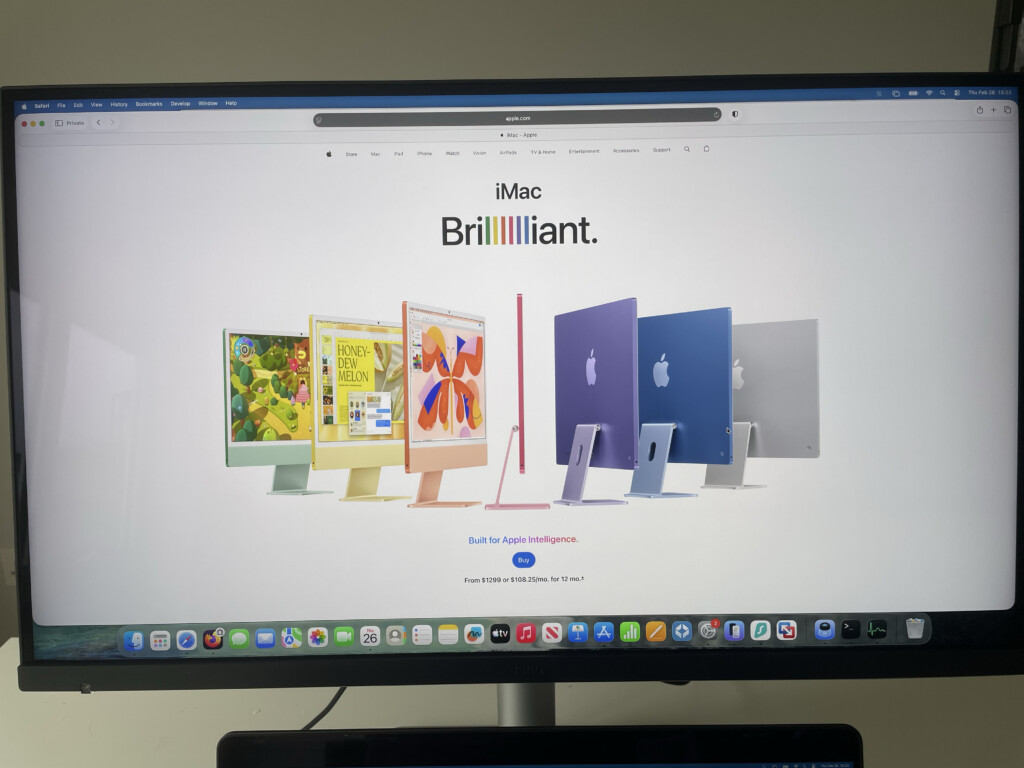
Why we recommend it: It gives a Mac mini a sharp, comfortable 27-inch desktop without the expense of Apple’s integrated camera and audio system.
The BenQ MA270S is the display we would put near the top of the list if you spend your working day writing, coding, editing photographs or reading small text.
Its 5120 × 2880 resolution provides approximately 218 pixels per inch. At the macOS setting that looks like 2560 × 1440, that allows an exact 2× scale with a useful amount of workspace.
In our MA270S review, the improvement in text clarity over the 4K MA270U was one of its most noticeable benefits. That is a particularly relevant upgrade for someone moving from a 27-inch 5K iMac to a Mac mini.
BenQ specifies a Nano Gloss IPS panel, 99% P3 coverage, 450-nit brightness and up to 70Hz. It also includes Thunderbolt 4, a USB hub, KVM switching and a height-adjustable stand.
For a Mac mini, the useful part of Thunderbolt is carrying the picture and accessory data through one cable. Display Pilot 2 adds convenient Mac keyboard brightness and volume controls. The monitor’s laptop-charging capability is simply unused by the mini.
The compromises are the glossy finish, basic speakers and lack of a webcam. Its modest HDR capability also makes it primarily a productivity and creative-work display; it is not a substitute for a specialist HDR screen.
Price: Around $1,000 from BenQ but often cheaper on Amazon. Buy it when the actual offer makes sense; the cheaper ASUS below is a strong alternative if stock is poor.
Pros
- Sharp 5K text at a practical 27-inch size
- Convenient Mac controls and accessory connections
- Height-adjustable stand included
Cons
- Glossy finish needs careful placement around windows
- No webcam and basic speakers
- Only a modest refresh-rate increase over 60Hz
2. Dell S2725QC (Best Budget Option to Compare)
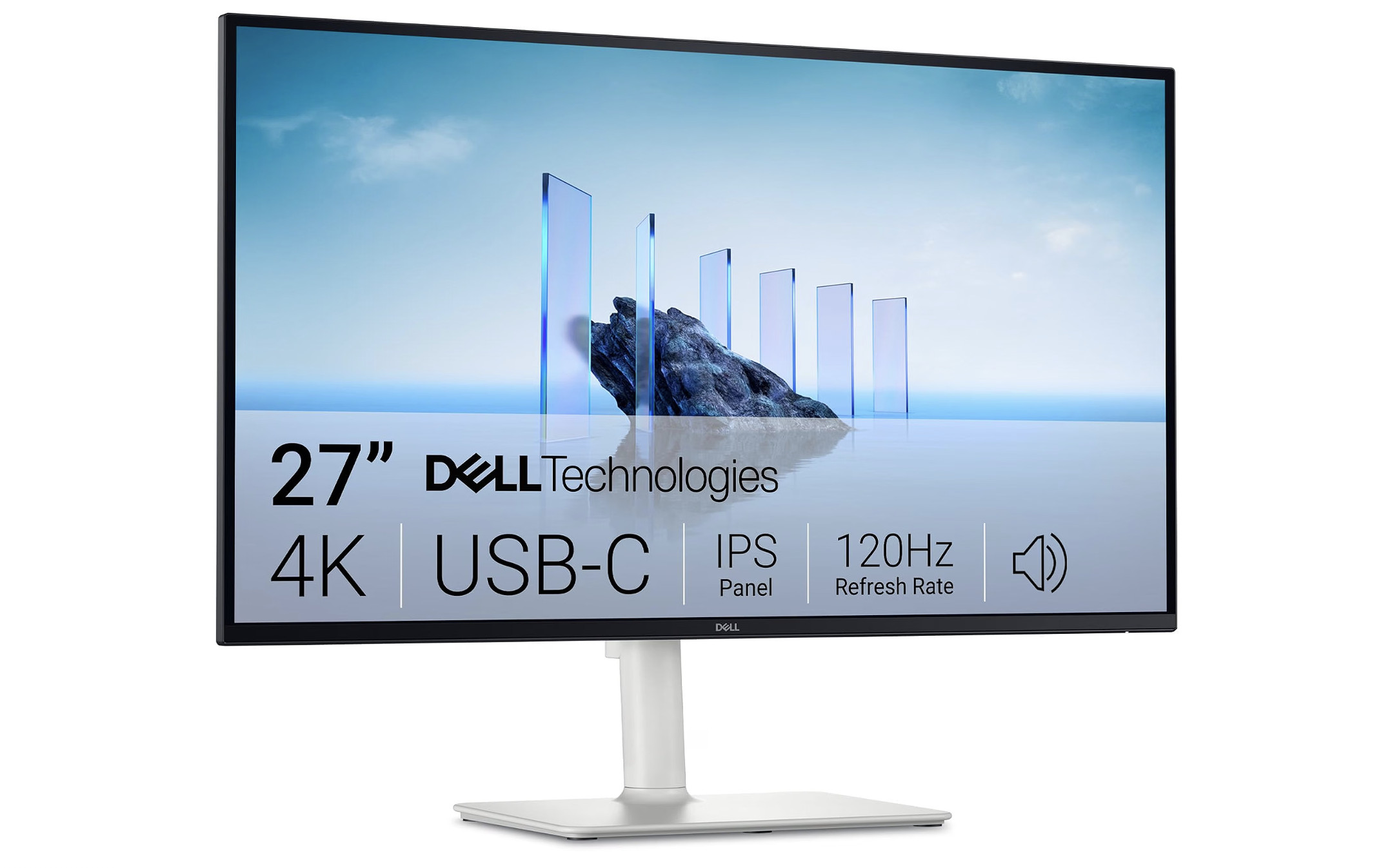
Why we recommend it: It puts the money into a useful 4K screen and smoother desktop movement, making it a sensible starting point for an affordable Mac mini setup.
The Dell S2725QC combines a 27-inch 4K IPS panel with up to 120Hz, an adjustable stand, a USB hub and two built-in 5W speakers. Dell specifies 99% sRGB coverage and USB-C video alongside two HDMI inputs. Dell S2725QC specifications.
For browsing, documents, spreadsheets and general home use, that is a practical set of features. You can use USB-C for the picture and the monitor’s accessory hub, or HDMI if you want to keep a Thunderbolt port free for something else.
The higher refresh rate can make scrolling and moving windows feel smoother on a compatible Mac mini. It is useful beyond gaming, although your chosen connection must support 4K at 120Hz.
Its limitations are straightforward. This is an sRGB-focused office and entertainment monitor, so a photographer with a demanding wide-gamut workflow should compare the creative alternatives. It has no webcam, and basic HDR support should not drive the purchase.
Buying advice: It is strongest value at $350 or less. That is our buying target, not a claim about today’s price. If a seller charges much more, compare the BenQ 4K models and ASUS 5K option before ordering.
Pros
- 4K with up to 120Hz
- Useful hub, speakers and adjustable stand
- USB-C or HDMI connection options
Cons
- No webcam or Thunderbolt
- Limited appeal for demanding wide-gamut work
- Older Mac mini connections may limit the refresh rate
3. BenQ MA270U / MA270UP (Best Everyday 4K Option With Mac Controls)
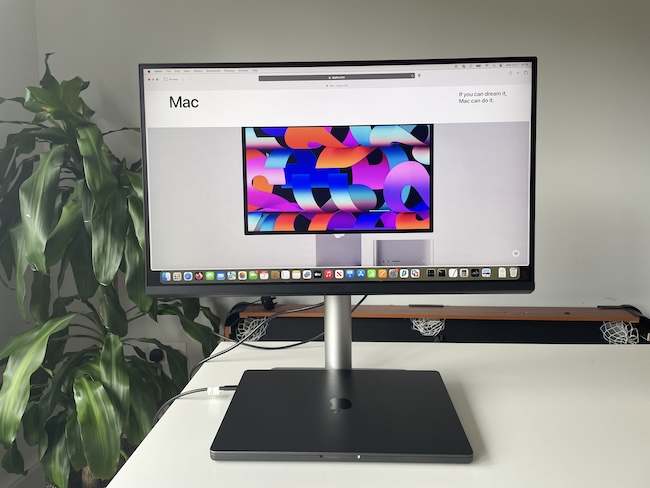
Why we recommend it: It makes brightness, volume and everyday display adjustments convenient without requiring a 5K budget.
The BenQ MA270U remains a good choice for an everyday Mac mini desk. In our MA270U review, its Mac integration was a highlight, and that remains relevant when using a separate keyboard with a desktop Mac.
BenQ now offers two finishes: MA270U is Nano Matte; MA270UP is Nano Gloss. The matte version suits a desk where reflections are hard to avoid. The glossy version is worth considering if you prefer a glass-like appearance and can control the lighting.
Both are 27-inch 4K IPS displays with 60Hz refresh rates and 95% P3 coverage. USB-C carries the video and hub connection, while Display Pilot 2 provides the Mac controls. See BenQ’s MA270U specifications and MA270UP details.
M-Book color matching is most useful if you also use a MacBook at the desk. A Mac mini has no internal screen to match, so the more persuasive desktop benefits are the convenient controls, stand and accessory hub.
The main decision is whether those features justify the price. The Dell offers 120Hz, while the ASUS PA27JCV gives you 5K for a relatively modest step up from BenQ’s listed US pricing. These BenQs remain worthwhile choices, but they should not automatically win just because they are marketed for Macs.
Price: Around $550 for both models in BenQ’s US store but maybe cheaper on Amazon.
Pros
- Convenient Mac keyboard controls
- Choice of matte or glossy finish
- Adjustable stand, USB hub and basic speakers
Cons
- Limited to 60Hz
- Less fine text detail than a 27-inch 5K monitor
- Price can approach more capable alternatives
4. ASUS ProArt PA27JCV (Best Affordable Matte 5K Option)
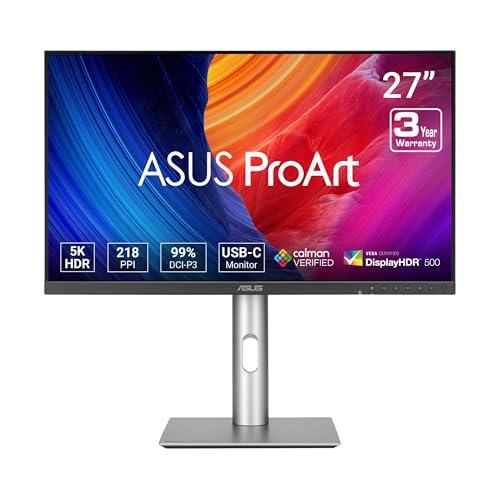
Why we recommend it: It is a compelling way to spend more of a Mac mini budget on resolution while keeping the total well below an Apple display setup.
The PA27JCV deserves particular attention if you want 5K but do not need Thunderbolt docking or an integrated webcam.
Its 27-inch, 5120 × 2880 IPS panel provides the same approximate 218 PPI as the MA270S and Studio Display. The LuxPixel anti-glare, low-reflection coating offers an alternative to the BenQ’s glossy finish.
ASUS specifies 99% DCI-P3, 100% sRGB and 95% Adobe RGB coverage, with factory calibration to Delta E below 2. You also get an adjustable stand, a USB hub and KVM switching for sharing peripherals between computers.
For a single Mac mini display, USB-C video and data are usually enough. You do not need to pay extra for Thunderbolt simply to obtain a sharp 5K picture. Use a suitable cable from a rear Thunderbolt port on the Mac to the monitor’s upstream USB-C input.
This remains a 60Hz monitor with basic speakers and no webcam. Its HDR support also falls short of the contrast and backlighting capabilities of the Studio Display XDR.
For most office work and non-HDR creative use, those compromises are easier to accept when the actual selling price is substantially below the glossy 5K alternatives.
Price: Approximately $700 on ASUS’s US product page but may be cheaper on Amazon.
Pros
- High text density at a lower price than many 5K displays
- Anti-glare surface and factory calibration
- Useful USB hub, KVM and adjustable stand
Cons
- Limited to 60Hz
- No Thunderbolt or webcam
- Basic audio and limited HDR
5. BenQ MA320UG (Best Larger Screen With Mac Controls)
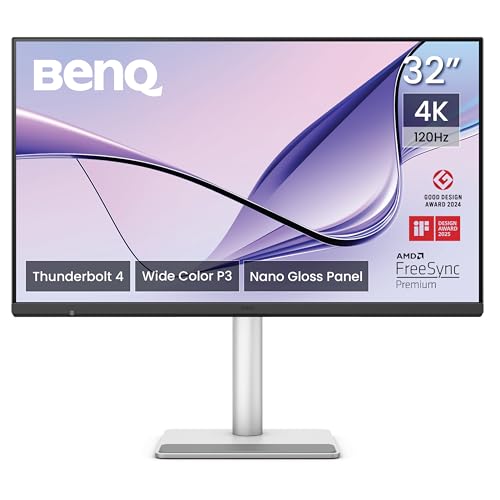
Why we recommend it: It combines a larger desktop display with 120Hz and the convenient controls of BenQ’s MA range.
The MA320UG is the option to consider if a 27-inch screen feels too small, or you sit far enough back that you would prefer larger text and interface elements.
BenQ specifies a 31.5-inch 4K Nano Gloss IPS panel, up to 120Hz, 98% P3 coverage and 450-nit brightness. The supplied stand adjusts for height, tilt, swivel and pivot. MA320UG specifications.
Thunderbolt 4 provides the display and accessory connection. There is also a downstream Thunderbolt port and KVM functionality, which can be useful if the Mac mini shares a desk with a laptop. Some Smart KVM features require Display Pilot 2 on both computers. BenQ MA320UG features.
Its size and smoother movement make a persuasive everyday combination. However, a larger 4K monitor does not contain more pixels than a smaller 4K monitor. At approximately 140 PPI, the MA320UG spreads the same resolution over a bigger area. Choose it for physical size and readability, rather than expecting the fine text of a 27-inch 5K display.
It also needs a little more desk space, and the glossy surface makes light placement important. The built-in speakers are basic, there is no webcam, and DisplayHDR 400 should be treated as a secondary feature.
Price: Around $830 in BenQ’s US store when checked. Check MA320UG buying options at BenQ.
Pros
- Larger screen with up to 120Hz
- Useful Mac controls and Thunderbolt connections
- Adjustable stand and KVM functionality
Cons
- Lower pixel density than the 27-inch options
- Glossy finish can reflect nearby light sources
- No webcam and limited HDR
6. Apple Studio Display (Best for an Integrated Mac Mini Setup)
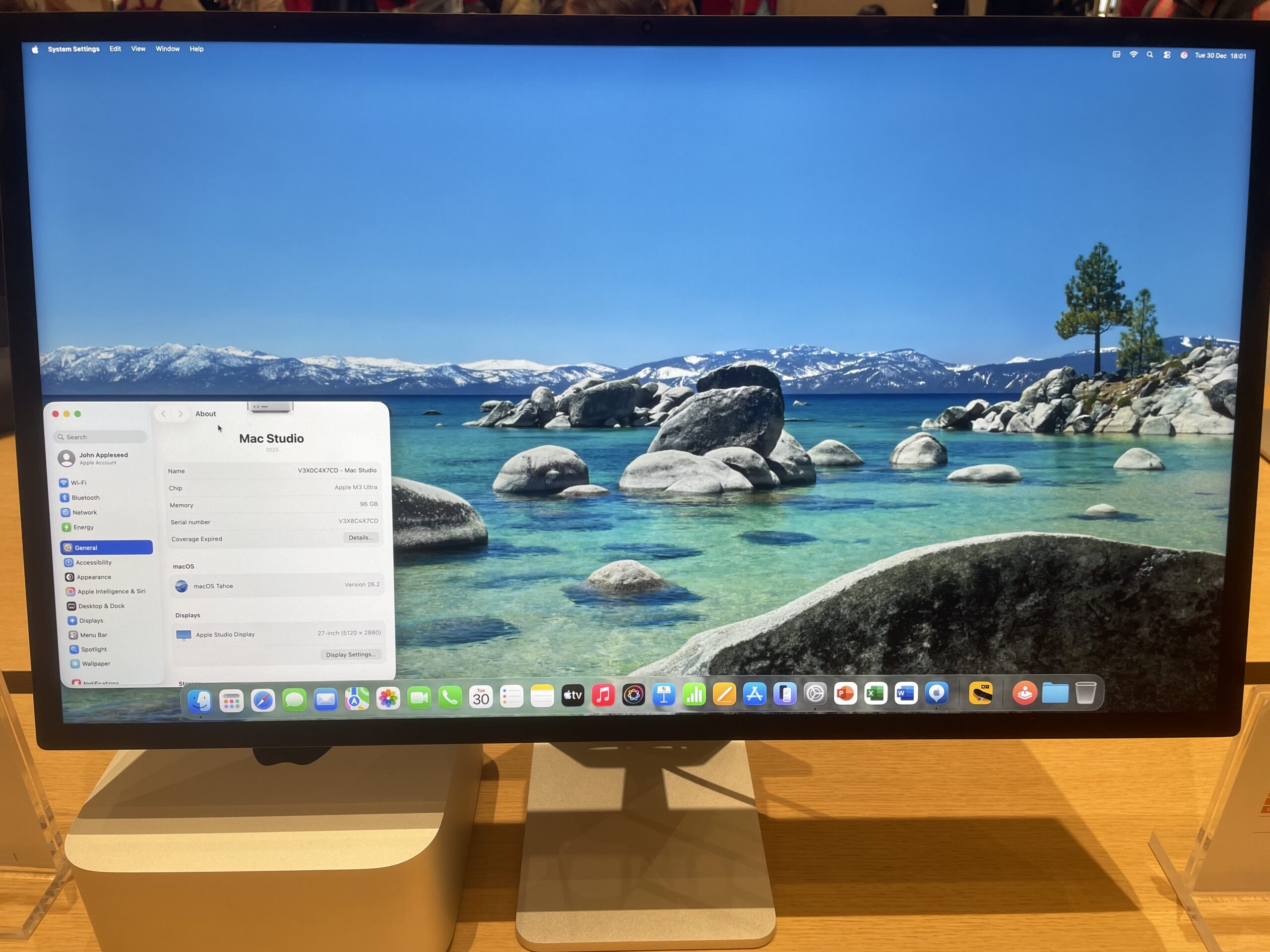
Why we recommend it: It supplies several things a Mac mini desk otherwise needs separately: a camera, microphones and a capable speaker system.
The 2026 Studio Display combines a 27-inch 5K panel with 600-nit brightness, P3 color and True Tone. It also includes a 12MP Center Stage camera with Desk View, three microphones and six speakers among other stunning specifications.
That package is particularly relevant to the Mac mini. There is no laptop screen or built-in webcam sitting beside the monitor, so an integrated display can keep the desk simpler.
Apple’s current model has one upstream and one downstream Thunderbolt 5 port, plus two USB-C accessory ports. Compatible older Thunderbolt Macs can still use it; owning an M5 Pro Mac mini is not a requirement. A display chain remains subject to the Mac’s supported configuration.
The limitations are the familiar ones: 60Hz, no HDMI input and extra cost for the height-adjustable stand. The standard Studio Display also lacks the mini-LED HDR capabilities of the XDR version. Apple’s 2026 display announcement explains the distinction.
Check the generation and compatibility before buying. The 2026 model officially supports Apple silicon Macs running macOS Tahoe 26.3.1 or later. Do not buy it for an Intel Mac mini merely because the ports appear to match.
Price: From $1,599 / £1,499 with standard glass and the tilt-adjustable stand. Check Studio Display options at Apple US or Apple UK. May also be available cheaper or refurbished for less on Amazon.
Pros
- Sharp 5K screen and native Mac controls
- Integrated camera, microphones and speakers
- A convenient way to complete a Mac mini desk
Cons
- Expensive, especially with height adjustment
- Limited to 60Hz; no mini-LED HDR
- No HDMI and no official Intel Mac support for this generation
Other Monitors Worth Considering
BenQ PD2730S for a Creative Workstation
The PD2730S is worth comparing if you want a matte 27-inch 5K display with Thunderbolt and dedicated creative controls. Its 60Hz panel and Hotkey Puck offer a different balance from the MA270S. See BenQ’s specifications and our PD2730S review.
It earns its place when those controls suit your work; a more powerful Mac mini does not automatically require a more expensive creative monitor.
Apple Studio Display XDR for HDR and 120Hz
The Studio Display XDR is the specialist upgrade for a Mac mini workstation that benefits from HDR. It combines 27-inch 5K resolution with mini-LED backlighting, 2,304 dimming zones and up to 120Hz. Apple specifies up to 1,000 nits SDR and 2,000 nits peak HDR brightness. Studio Display XDR specifications.
At $3,299, including the height-adjustable stand, it is a substantial additional investment. An M1 or base M2 Mac mini limits this display to 60Hz. Check Apple’s compatibility requirements before paying for the faster panel.
For ordinary documents, browsing and SDR photo work, the cheaper 5K monitors remain much easier to justify. View the Studio Display XDR at Apple and you may also get it cheaper on Amazon.
BenQ PD3225U at a Suitable Discount
The PD3225U remains relevant if you value a large matte IPS Black display and its creative controls. Our PD3225U review is useful for assessing that option.
However, compare its price with current alternatives before paying a premium for a 32-inch 4K display limited to 60Hz. Its color features do not change its lower pixel density. It is factory calibrated; that does not mean it continuously measures and recalibrates itself. Check the full BenQ PD3225U specifications for more.
Samsung ViewFinity S9 and Used 5K Displays
An attractively priced Samsung ViewFinity S9 or refurbished Studio Display can still be worth considering. Judge the actual unit, condition, seller, return policy and warranty against current alternatives.
An Amazon offer labeled Used – Like New is not, by itself, proof of manufacturer refurbishment. We would not choose one on the strength of an old discount screenshot or an advertised price that is no longer available.
Should You Choose 4K, 5K or an Ultrawide?
For a typical desk, 27-inch 4K is the value option; 27-inch 5K is the sharper text option.
A 27-inch 4K display has approximately 163 PPI, compared with 218 PPI for 27-inch 5K. A 31.5-inch 4K screen falls to approximately 140 PPI because it spreads the same pixels over a larger area.
On 5K, the macOS workspace that looks like 2560 × 1440 uses an exact 2× scale. On 4K, the equivalent exact 2× workspace looks like 1920 × 1080. Selecting a 2560 × 1440-sized workspace on 4K gives you more room but requires rescaling, which can make fine text slightly softer.
That does not make 4K a bad match for a Mac mini. Many people find it entirely comfortable, particularly when price or 120Hz is the priority. Try the text-size options in System Settings > Displays and choose what you can read comfortably throughout the day.
An ultrawide is useful for music-production timelines, large spreadsheets and several windows side by side. Check its actual resolution: 3440 × 1440 and 5120 × 2160 ultrawides are different propositions from a 27-inch 5120 × 2880 monitor. Screen width alone tells you little about text sharpness.
Our Studio Display alternatives guide covers a broader choice of screen formats.
Which Connection Should You Use With a Mac Mini?
USB-C and Thunderbolt
For the USB-C and Thunderbolt monitors above, a direct connection from a rear Thunderbolt port is a useful starting point. Use the monitor’s designated upstream video input and a cable that supports the required video mode and data connection.
On the compact M4/M4 Pro and announced M6/M5 Pro models, the front USB-C ports are USB data ports, not display outputs. A USB-C connector shape alone does not guarantee video support. Apple’s Mac mini specifications distinguish the front connections from the rear display-capable ports.
Thunderbolt is useful for fast accessories and supported display chains. It does not automatically make an otherwise identical picture sharper or more accurate than HDMI or ordinary USB-C video.
HDMI
HDMI is a perfectly reasonable choice for a compatible monitor, particularly if you want to reserve the Thunderbolt ports for storage or other peripherals. It carries the picture and audio, but does not connect a monitor’s USB hub to the Mac.
The base M1 and M2 Mac minis are limited to 4K at 60Hz through their built-in HDMI ports. The M2 Pro has more capable HDMI output, including supported configurations up to 8K at 60Hz or 4K at 240Hz. Do not apply the Pro model’s capabilities to the base M2. Apple’s M1 specifications and Mac mini display guidance.
For 5K or a high refresh rate, check the exact Mac, monitor input and cable together. A monitor’s maximum specification is not a promise that every connection can reach it.
Do You Need a Dock?
A dock is optional for a single monitor. Start with a direct connection, then decide whether you need extra accessory ports or an easier way to share the desk with a laptop.
The Mac mini already includes Ethernet and uses its own mains power supply. A monitor’s Ethernet port and 90W, 96W or 140W laptop charging therefore deserve less weight than they would in a MacBook buying guide.
How Many Monitors Can a Mac Mini Support?
Check Apple menu > About This Mac before planning a second or third display.
| Mac mini model | Maximum native displays | Main planning point |
|---|---|---|
| M1 | 2 | One through Thunderbolt and one through HDMI; the HDMI display is limited to 4K at 60Hz |
| M2 | 2 | Supports two Thunderbolt displays in an approved configuration, or Thunderbolt plus HDMI |
| M2 Pro | 3 | Higher resolutions and refresh rates can reduce the supported screen count |
| M4 | 3 | Check the permitted combination of resolutions, refresh rates and ports |
| M4 Pro | 3 | Supports configurations including three 6K displays at 60Hz |
| M6 / M5 Pro, announced for September 2026 | 3 | M6 has rear Thunderbolt 4; M5 Pro has rear Thunderbolt 5; configuration limits differ |
Sources: Apple’s M1 specifications, M2 and M4 display guidance and M6/M5 Pro specifications.
At the time of this update, Apple lists the M6 and M5 Pro models for pre-order, with availability beginning September 22, 2026. Their entries above reflect published specifications. Apple’s announcement.
For Intel Mac minis, check the exact year and model. Their limits vary, and current monitor compatibility can also depend on the macOS version they support.
A normal dock does not increase the Mac’s native display limit. Compatible Thunderbolt chaining can simplify supported connections, but ordinary DisplayPort MST chaining does not provide separate extended desktops in macOS. Dell explains the distinction in its Mac monitor compatibility guidance.
For a straightforward two-screen setup, separate connections are often easiest. On an M1 mini, that means planning one screen on Thunderbolt and the other on HDMI. Two HDMI sockets on a monitor are inputs; they do not turn it into a dock for a second screen.
Remember the Rest of the Desktop Setup
The Mac mini includes a small speaker, but you may prefer headphones or external speakers. It also needs a camera and microphone arrangement for video calls: a USB webcam, suitable headset or compatible iPhone setup can cover that need.
Only the standard Studio Display in the main shortlist includes a webcam and microphone array. The other main picks include basic speakers but need a separate camera.
Also check the stand height, screen finish and desk depth. A monitor that is comfortably positioned and free of distracting reflections is usually a better purchase than one with impressive specifications that does not fit your workspace.
FAQ
Can You Use a Non-Apple Monitor With a Mac Mini?
Yes. Many HDMI, USB-C, Thunderbolt and DisplayPort monitors work, with an appropriate cable or adapter. The important checks are the exact resolution, refresh rate and compatibility of the Mac and monitor. A retailer’s “for Mac” label is not a substitute for those checks.
Is a 5K Monitor Worth It for a Mac Mini?
It is particularly worthwhile for reading, writing, coding and detailed interface work, or if you are replacing a 27-inch 5K iMac. A good 4K monitor remains a sensible choice when total cost, physical screen size or smoother movement matters more.
Does a Mac Mini Need a Thunderbolt 5 Monitor?
No. Choose Thunderbolt 5 when its additional connectivity capabilities are useful to your setup. Many excellent 4K and 5K monitors use Thunderbolt 4 or ordinary USB-C video. A newer port does not improve the panel’s resolution or color quality.
Can the Monitor Power the Mac Mini Through USB-C?
No. The Mac mini uses its own mains cable. USB-C Power Delivery from these monitors is intended for compatible laptops and other devices, not for powering the mini.
Can You Use an Old iMac as the Monitor?
Not as a normal wired monitor for an Apple silicon Mac mini. Apple’s Target Display Mode applies only to certain older iMacs and older source Macs under specific conditions. Retina iMacs do not provide a standard display input. For more check out our guide on how to use an iMac as an external monitor.
Should You Buy One Large Monitor or Two Smaller Ones?
Choose one larger screen if you want a continuous workspace and fewer cables. Choose two if you prefer keeping applications on separate screens or want to add a cheaper secondary display. There is no need for both monitors to match, provided your Mac supports the intended combination.