

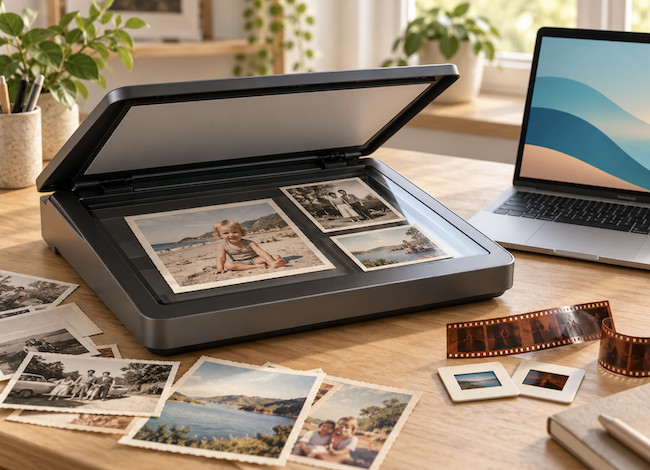
If you want to digitise a family archive, the right scanner depends far more on the type and condition of the originals than on the highest number printed on the box.
For a large box of loose prints, the Epson FastFoto FF-680W is the clear convenience pick. For irreplaceable photographs, albums and a mixture of prints and film, the Epson Perfection V850 Pro is the better-quality but much slower option. If your archive is mainly 35mm negatives or slides, a dedicated film scanner such as the Plustek OpticFilm 8300i Ai is a much better fit than a general flatbed.
The important Mac-specific point is that a USB socket alone does not guarantee compatibility. Before buying, check that the manufacturer or scanning-software provider supports your exact version of macOS, especially if you use macOS 27 Golden Gate on an Apple silicon Mac.
The Best Photo Scanners for Mac Compared
| Photo scanner | Best for | Type | Prints | Negatives and slides | Mac note |
|---|---|---|---|---|---|
| Epson FastFoto FF-680W | Digitising hundreds or thousands of loose prints quickly | Sheet-fed photo scanner | Yes — up to 36 photos per batch | No | Best balance of speed, Wi-Fi and photo-specific software |
| Epson Perfection V850 Pro | High-quality prints, negatives, slides and medium-format film | Flatbed / film scanner | Yes | Yes — 35mm, medium format and 4 × 5-inch film | Epson supplies an Image Capture driver for current macOS releases |
| Plustek OpticFilm 8300i Ai | The best quality from 35mm slides and negatives | Dedicated 35mm film scanner | No | Yes — 35mm only | SilverFast 9 supports macOS 27 and the 8300i |
| Canon CanoScan LiDE 400 | Occasional prints, artwork and documents on a smaller budget | USB flatbed | Yes | No | Canon lists macOS 27 support via AirPrint; it is still a wired scanner |
| Plustek ePhoto Z300 | A simple, compact way to scan ordinary printed photos | Sheet-fed photo scanner | Yes — one at a time | No | Check Plustek’s current Mac installer before ordering |
Which Photo Scanner Should You Buy?
- You have boxes of ordinary 6 × 4-inch prints: buy the Epson FastFoto FF-680W. It is the fastest, least laborious choice.
- Your photos are curled, delicate, mounted, torn or one-of-a-kind: use a flatbed, preferably the Epson Perfection V850 Pro. Do not feed fragile originals through an automatic feeder.
- You are scanning slides or negatives: choose the Plustek OpticFilm 8300i Ai for 35mm, or the Epson V850 Pro if you also need prints, medium format or 4 × 5 film.
- You only have a small number of prints to archive: the Canon CanoScan LiDE 400 is the sensible inexpensive option.
- You want a small, straightforward print scanner without the FastFoto’s price: choose the Plustek ePhoto Z300.
1. Epson FastFoto FF-680W — Best for Large Photo Collections
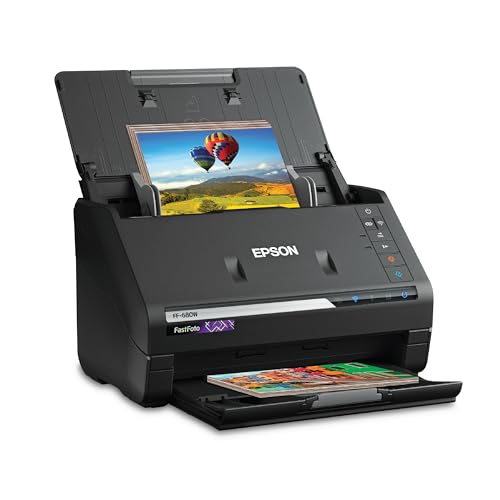
The Epson FastFoto FF-680W is the right choice when the main obstacle is the sheer number of prints you need to scan. It is designed specifically for photos rather than being a document scanner pressed into service.
It can scan loose prints as fast as one photo per second at 300 dpi and accepts up to 36 standard-size photos in a batch. Crucially, its one-pass duplex design can capture writing on the back of a print at the same time as the image on the front — useful for preserving dates, names and notes written by relatives.
The FastFoto uses a 600 dpi optical sensor and can output scans at up to 1200 dpi. That is more than enough for most printed family photographs, but it is not a substitute for a dedicated film scanner when you need to recover detail from a 35mm negative.
Its companion software includes practical restoration tools such as colour restoration, red-eye reduction, crop, rotate and de-skew. It can connect by USB or Wi-Fi, although a direct USB connection is usually the less troublesome choice for a long archive session.
Why it is our top pick: It turns a project that could take weeks with a flatbed into a manageable weekend job without treating family photos as generic office paper.
What to know before buying:
- It is for loose printed photos, not negatives or slides.
- Do not put curled, brittle, glued, heavily embossed or otherwise fragile prints through the feeder.
- Epson’s support page should be checked for your precise macOS release before purchase, then use the current FastFoto/ScanSmart download rather than an old disc or download link.
2. Epson Perfection V850 Pro — Best for Quality and Mixed Archives
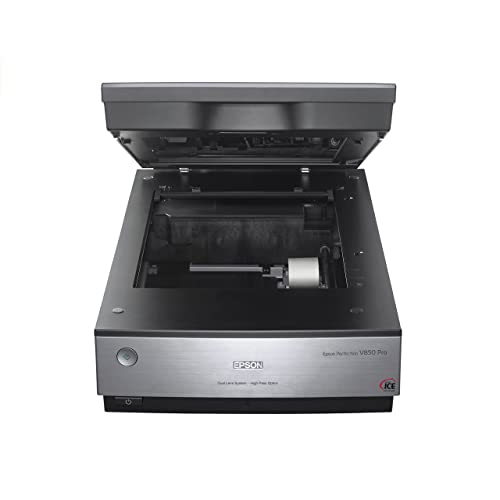
The Epson Perfection V850 Pro is expensive, physically large and much slower than the FastFoto, but it is the most versatile option here for anyone who wants the best possible digital archive from a varied collection.
It is a proper flatbed photo and film scanner with a dual-lens system, up to 6400 dpi scanning for film holders and a claimed 4.0 Dmax. It can scan printed photos and artwork up to A4/8.5 × 11.7 inches, plus 35mm strips, mounted slides, medium-format film and 4 × 5-inch film with its supplied holders.
That flexibility matters. A flatbed lets you scan originals that should never go through a feeder: delicate prints, album pages, small photographs, curled prints and oddly shaped material. The V850’s film capability also makes it a much stronger long-term purchase than a print-only scanner if you discover a drawer full of negatives later.
Epson’s current support information lists an ICA driver for Apple Image Capture, including macOS 27 Golden Gate. That is useful, but still download the driver and software information for your Mac before buying because scanner usage can differ between Image Capture, Epson software and SilverFast.
Choose it if: You value quality and flexibility over speed, or you need one machine for both printed photos and film.
Avoid it if: You have thousands of ordinary loose prints and no film. The FastFoto will be dramatically quicker and easier.
Pros:
- Excellent choice for prints, slides, negatives and medium-format film
- Flatbed is safer for delicate or irregular originals
- High-resolution film scanning and strong shadow detail
- Current Image Capture driver support for recent macOS versions
Cons:
- Expensive and bulky
- Slow for a large box of individual prints
- More setup and scanning knowledge required than with a simple feeder
3. Plustek OpticFilm 8300i Ai — Best for 35mm Slides and Negatives

The Plustek OpticFilm 8300i Ai is the specialist choice for a 35mm archive. Unlike a flatbed, it is built solely for 35mm negative strips and mounted slides, which lets it concentrate its optics and software on film rather than trying to do every kind of scan.
It offers true 7200 dpi optical resolution, a built-in infrared channel for dust and scratch detection, and is sold with SilverFast Ai Studio 9. It also includes IT8 calibration support, which is valuable if faithful colour matters as much as resolution.
SilverFast’s current support information lists the OpticFilm 8300i for macOS 27 Golden Gate, and its September 2026 update included revised 8300i drivers. That is a much more reassuring Mac story than relying on a discontinued film scanner with a decades-old installer.
This is not a scanner for printed photographs, medium format or 4 × 5 film. It is also a deliberate, frame-by-frame scanner rather than a speedy feeder. But if the aim is to make quality enlargements from 35mm film, it is the strongest recommendation in this guide.
Choose it if: Your archive is primarily 35mm slides or negatives and you care about detail, colour, dust removal and shadow information.
Avoid it if: You only have printed photographs, or need to scan 120/medium-format film.
Pros:
- Dedicated 35mm scanner with true 7200 dpi optical resolution
- Infrared dust-and-scratch channel
- Current SilverFast support for macOS 27
- Strong choice for slides, negatives and quality enlargements
Cons:
- Does not scan paper prints, medium format or 4 × 5 film
- Slower and more hands-on than a photo feeder
- Specialist price for a specialist job
4. Canon CanoScan LiDE 400 — Best Budget Flatbed for Prints

For occasional photo scanning, the Canon CanoScan LiDE 400 remains a good compact flatbed. It produces up to 4800 × 4800 dpi scans, takes roughly eight seconds for a colour letter-size scan at 300 dpi, and has a useful upright stand so it takes up less desk space between jobs.
It is a better choice than a portable document scanner for photographs because you place each print safely on a glass platen. It is also useful for artwork, certificates and items that cannot be passed through a feeder.
There is no transparency unit, so it cannot scan slides or negatives. It is also a USB-only scanner: its USB-C cable supplies power and data, but it does not have Wi-Fi.
Canon’s current compatibility information lists the LiDE 400 for macOS 27 Golden Gate via Apple AirPrint, rather than through a newly issued Mac scanner driver. That distinction is worth making: AirPrint support here is a Mac compatibility route; it does not turn the LiDE 400 into a wireless scanner. Check Canon’s support page for the UK version and your exact macOS release before you order.
Pros:
- Compact, inexpensive and simple for individual prints
- 4800 dpi flatbed scans for photos and artwork
- No external power supply needed
- Safer than a feeder for older or delicate prints
Cons:
- No slides or negative scanning
- No Wi-Fi or batch feeder
- Slower than the FastFoto for large collections
5. Plustek ePhoto Z300 — Best Simple Compact Photo Scanner
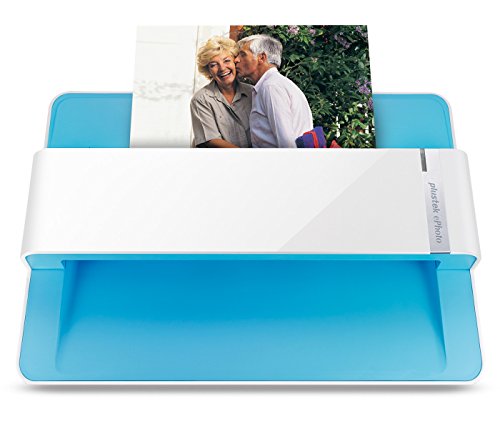
The Plustek ePhoto Z300 is a compact alternative for people who want to scan loose printed photos quickly but do not need the FastFoto’s large-batch support.
It is a single-sheet feed scanner with a CCD sensor, 300/600 dpi scanning and automatic cropping. Plustek quotes around two seconds for a 4 × 6-inch photograph. It handles common photo sizes from 3 × 5 to 8 × 10 inches, as well as documents, receipts and postcards.
This is the middle ground: more convenient than lifting a flatbed lid for every print, but better suited to smaller batches than a true high-volume photo feeder. It does not scan slides or negatives.
Plustek provides a Mac installer through its support page, but this is exactly the type of older model for which you should confirm current macOS 27 support before purchase. If you already own one, try the current ePhoto software first; only consider third-party software after checking compatibility with the precise Z300 model.
Pros:
- Fast, space-saving option for ordinary printed photos
- Simple feed-and-scan scanner with automatic cropping
- Also useful for small paper documents and receipts
- Better fit than a general portable document scanner for photo prints
Cons:
- 600 dpi maximum optical resolution
- No slide or negative scanning
- Not suitable for fragile, curled or mounted photographs
- Current macOS support needs checking before purchase
Why We No Longer Recommend Document Scanners as Photo Scanners
The previous version of this guide included the Canon imageFORMULA R40 and Brother DS-640. Both can capture an image of a photograph, but neither is a genuine photo-archiving recommendation.
They lack a transparency unit for slides and negatives, do not offer photo-specific restoration as their core use case, and are less appropriate for valuable old originals than a flatbed or purpose-built photo feeder. The Brother DS-640 is also a manual-feed portable scanner, not a high-capacity photo feeder.
If your real priority is receipts, paperwork or a paperless office, see our guide to the best document scanners for Mac. It is a different buying decision from preserving family photographs.
What to Look for in a Mac Photo Scanner
1. Printed photos, film or both?
Start with the originals you actually have.
- Printed photos: a flatbed or photo feeder is best.
- 35mm slides and negatives: a dedicated film scanner gives better quality and dust handling than a cheap all-purpose scanner.
- Medium format or 4 × 5 film: choose a capable flatbed such as the Epson V850 Pro, or a more specialised professional film scanner.
- Fragile originals or albums: use a flatbed. Never risk irreplaceable material in a feeder simply to save time.
2. Optical resolution, not inflated numbers
For ordinary printed photos, 600 dpi is a sensible archival starting point and is usually more useful than scanning every print at an enormous interpolated resolution. Move up to 1200 dpi when you expect to crop tightly or make larger prints.
Film is different. Negatives and slides are much smaller and hold more detail, so a dedicated scanner with higher optical resolution is worthwhile. Do not compare manufacturers’ maximum figures without checking whether they are optical or software-interpolated.
3. Current macOS and Apple silicon support
This is the most important compatibility check for Mac owners. Before spending money:
- Visit the manufacturer’s support page and select your exact macOS version, including macOS 27 Golden Gate where applicable.
- Check that there is a current driver, scanner app or explicitly supported Apple Image Capture/AirPrint route.
- Confirm support for Apple silicon rather than assuming that an old Intel-era installer will work.
- Download the software and read the installation notes before the return window ends.
Image Capture is useful but not magic. It works when macOS can recognise the scanner through a compatible ICA/AirPrint driver or scanner service. It is not a generic replacement for every missing manufacturer driver.
Likewise, TWAIN support and AirPrint are not interchangeable terms. TWAIN is an interface used by third-party scanning applications; AirPrint is an Apple printing/scanning technology. Neither one automatically means that a USB scanner is wireless or that every feature will work in every app.
4. Restoration tools and file format
Automated colour restoration and dust removal can be helpful, but do not overwrite your only scan with an aggressive automatic correction. Keep an untouched TIFF or high-quality JPEG master, then save a separate restored copy to share.
For an important archive, scan the front and back of photographs where there is handwriting. Give files a consistent name, include the year or approximate decade where known, and keep a second copy in cloud storage or on another drive.
Can You Use VueScan With an Older Photo Scanner?
Often, yes. VueScan is one of the best ways to keep a worthwhile older scanner working on a newer Mac. It supports more than 8,000 scanners and runs on both Intel and Apple silicon Macs.
It is particularly useful when a manufacturer has stopped updating its own app, but it is not a guarantee that every scanner, connection type or special feature will work. Check VueScan’s exact supported-scanner list before buying a used model or relying on it for an existing one.
One correction to many older VueScan recommendations: a one-time licence does not now mean unlimited future updates. You can keep using the version released during your included update period, but continuing updates require the paid VueScan Update Program. That is still good value if it saves a high-quality scanner from becoming e-waste, but it should be part of the buying decision.
What About the Epson Perfection V600?
The Epson V600 remains a popular second-hand model and there are plenty of old articles recommending it. We would not buy one new at a premium in 2026 simply because it used to be the default budget film-scanning pick.
If you find a cheap, well-kept V600, first confirm support for your exact Mac and macOS version and make sure you have a return route. VueScan may be a useful fallback for compatible units, but it does not make an ageing product a better new purchase than a current V850 Pro, a dedicated Plustek film scanner or a purpose-built print scanner.
FAQ
What is the best photo scanner for a Mac?
For most people with a large number of loose printed photos, the Epson FastFoto FF-680W is the best overall choice because it is purpose-built for high-volume scanning. The best alternative for quality, film and delicate originals is the Epson Perfection V850 Pro.
What is the best scanner for 35mm negatives and slides on a Mac?
The Plustek OpticFilm 8300i Ai is the strongest pick here for 35mm film because it is a dedicated 35mm scanner with 7200 dpi optical resolution, infrared dust detection and current SilverFast support for macOS 27. Choose the Epson V850 Pro instead if you also need to scan printed photographs, medium format or 4 × 5 film.
Is 600 dpi enough for scanning old photos?
For most standard printed photographs, yes. 600 dpi preserves plenty of detail for archiving, sharing and moderate enlargements. Use 1200 dpi when you need extra room to crop or enlarge. For negatives and slides, use a film scanner with higher optical resolution.
Will an old photo scanner work with an Apple silicon Mac?
Possibly, but do not assume it will. Check the manufacturer’s current support page and the VueScan compatibility list for the exact scanner model. The critical issue is the scanner driver or scanning software, not whether the scanner has a USB cable.
Is it safe to scan old photos in a feeder?
Only feed photos that are flat, dry, clean and in good condition. Use a flatbed for curled, torn, sticky, brittle, embossed, mounted or irreplaceable photographs. Taking longer is better than losing a unique original.
Can I use my iPhone instead of a photo scanner?
For a few snapshots to share with family, an iPhone scanning app can be convenient. For a proper archive, a dedicated scanner gives more consistent lighting, sharper edges, less glare and better control over resolution and colour. It also cannot turn a phone into a true negative or slide scanner without additional equipment.
Our Verdict
The best photo scanner for your Mac is not necessarily the one with the highest advertised resolution. Buy the Epson FastFoto FF-680W for speed with loose prints, the Epson Perfection V850 Pro for quality and mixed media, and the Plustek OpticFilm 8300i Ai for serious 35mm film scanning.
Most importantly, verify the software for your Mac before you buy. That one step prevents a bargain scanner from becoming an expensive, unsupported box in a cupboard.