

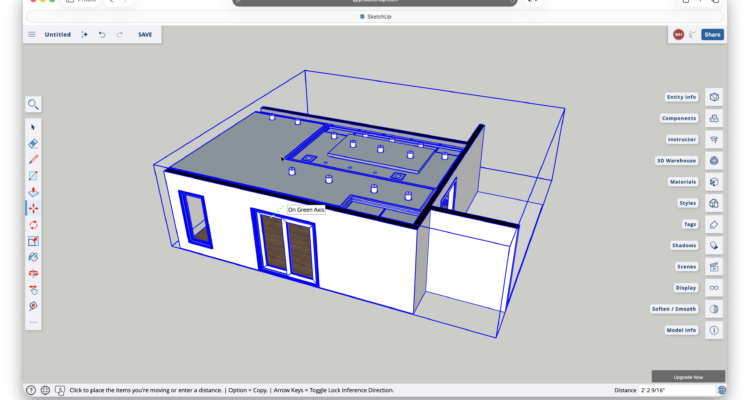
SketchUp is a browser-based 3D modeling tool that we rank among the best CAD software for Mac and also included in both our roundups of the best home design software for Mac and 3D modelling software for Macs.
Although there are more powerful CAD tools out there, as far as free CAD applications go, the free version of SketchUp is easily one of the best I’ve tried.
However, it sits in a slightly different category from traditional “drag-and-drop” home planners.
In this review, I take it for a spin and see what it can do for a variety of tasks and projects. I tested it on a Mac but the free version works in any browser and will be of interest to users on all platforms.
SketchUp Background
Originally launched in 2000, acquired by Google in 2006 (which is always a good sign), and later sold to Trimble in 2012, SketchUp is one of the most recognizable names in 3D modeling.
Many users in the US will also recognize it from the home renovation TV show Fixer Upper, where SketchUp is often used to visualize remodels.
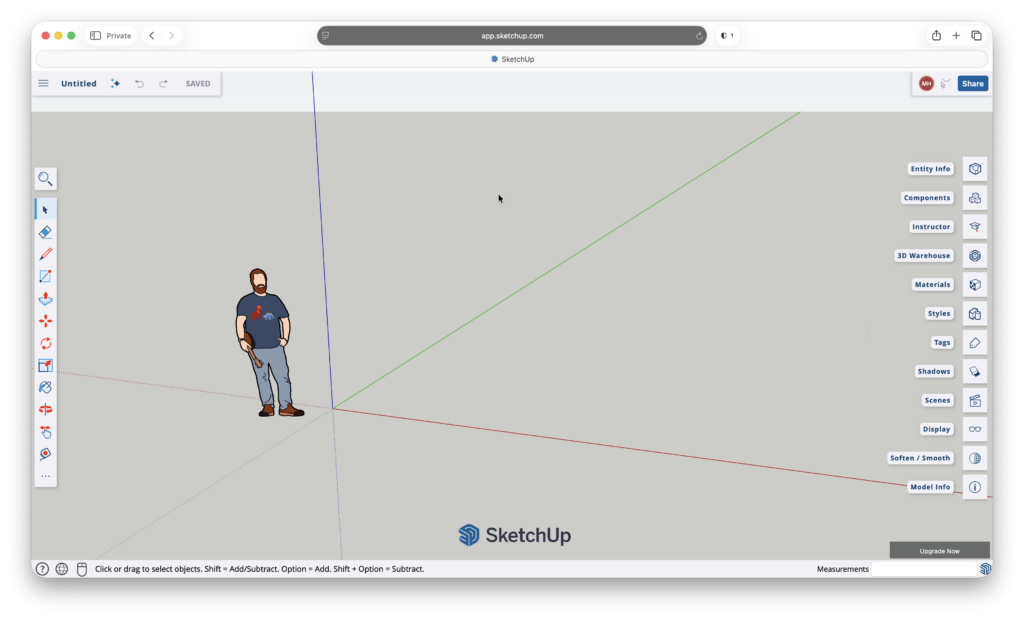
Despite its popularity in architecture and construction, SketchUp is not a purpose-built home design app. Instead, it’s a general-purpose 2D and 3D modeling tool that can be used for:
- Floor plans & interior design
- Landscape and garden layouts
- Furniture modeling
- 3D printing and prototyping
One of SketchUp’s biggest attractions is that it offers a genuinely usable free version – something that’s becoming increasingly rare in CAD software.
However, that free version also comes with very real limitations, especially for Mac users.
SketchUp Pricing & Versions

SketchUp’s pricing structure is one of its most confusing aspects, so it’s worth clearing this up properly from the start. Note that “SketchUp Make” is no longer available and has been replaced by the web version.
SketchUp Free (Web)
- 100% free for personal use
- Runs entirely in your browser (Safari, Chrome, Firefox)
- No desktop app
- No offline use
- Very limited import/export formats
This is the version most people mean when they say “SketchUp Free”.
SketchUp Go (Web + iPad)
- Paid plan (billed $10.75/month paid annually or $19.99 paid monthly)
- Same web version as SketchUp Free
- Adds:
- SketchUp for iPad (native app, offline use, Apple Pencil support)
- Cloud storage via Trimble Connect
- Better import/export options
This is aimed at tablet-based designing, not serious desktop CAD work.
SketchUp Pro (Desktop)
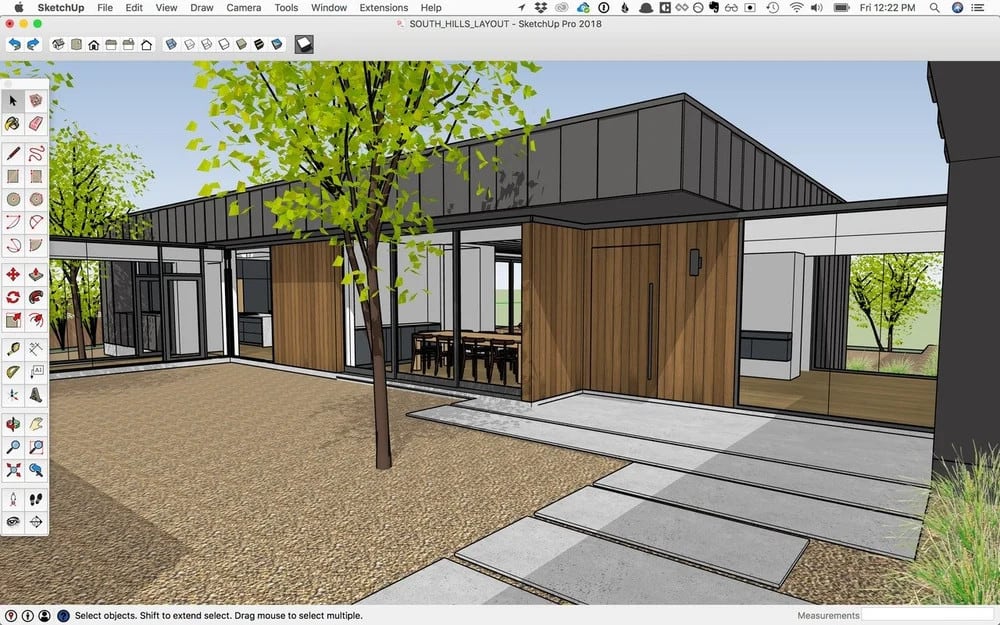
- Paid plan (billed $33.25/month paid annually or $99.99 month paid monthly)
- Full desktop app for macOS and Windows
- Offline modeling
- Access to extensions and plugins
- Includes LayOut (2D documentation tool)
- Required for professional architectural workflows
SketchUp Studio
- Paid plan billed $68.25/mo (billed annually – no monthly plan)
- Everything in Pro, plus advanced capabilities targeted at visualization and complex workflows, including:
- Revit file importing directly into SketchUp
- 3D point cloud modelling (Scan Essentials)
- Built-in photorealistic rendering and animation export (e.g., V-Ray integration)
- Virtual walkthroughs and 360° panoramas
- Designed for architects, BIM workflows, and advanced visualization
So basically, if you want the desktop SketchUp app on macOS, you must pay for SketchUp Pro or Studio.
Studio is generally overkill for casual users or those focused purely on basic home design or floor planning. But if you’re a design professional, architectural visualizer, or part of professional CAD team, it’s worth considering.
SketchUp Versions Comparison Table
Below is a comparison of how the different versions measure-up to each other. As you can see, the Pro and Studio versions offer by far the most amount of features plus the advantage of a Mac desktop app.
| Feature | Free | Go | Pro | Studio |
|---|---|---|---|---|
| Browser modelling | ✅ | ✅ | ✅ | ✅ |
| Desktop app (macOS/Windows) | ❌ | ❌ | ✅ | ✅ |
| 2D documentation (LayOut) | ❌ | ❌ | ✅ | ✅ |
| Extension Warehouse | ❌ | ❌ | ✅ | ✅ |
| Advanced import/export | ❌ | Partial | Full | Full |
| Revit import | ❌ | ❌ | ❌ | ✅ |
| Point cloud modelling | ❌ | ❌ | ❌ | ✅ |
| Photoreal & animation export | ❌ | ❌ | Optional | ✅ |
User Interface
SketchUp is impressively quick to get started with. There’s no installation, no license key, and no system configuration – just sign in and start modeling.
The interface is clean and minimal:
- Left toolbar: drawing, push/pull, move, rotate, scale, camera tools
- Right sidebar: Instructor panel, measurements, materials, layers, warehouse access etc
- Canvas: fully interactive 3D workspace

I found that the Instructor panel on the right is especially helpful for beginners, offering contextual guidance as you select tools such as this one on how to rotate designs.

That said, SketchUp is not “plug-and-play”. Unlike dedicated home design apps, there’s very little automation. You’re expected to:
- Draw walls manually
- Set dimensions yourself
- Understand faces, edges, and groups
- Control the camera in 3D space
The famous Push/Pull tool is brilliantly intuitive, but SketchUp still requires you to think like a modeler rather than a decorator.
Annoyingly, I found that there are no traditional templates or preset designs to play with, but you can explore and modify thousands of user-created layouts and models in the 3D Warehouse – there’s everything from houses and furniture to skyscraper and city buildings.

It’s not just objects either – you can download entire layouts such as kitchens, lounges, bathrooms and more.

You can move the camera around your 3D design at any time and there are predefined camera angles and you can choose how long you want transitions between angles to be.
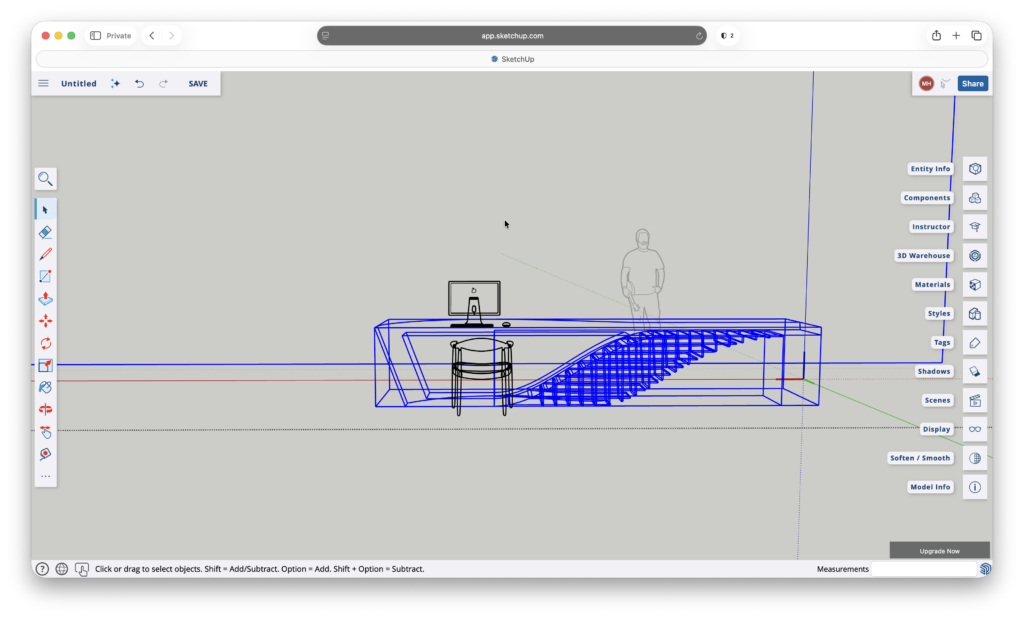
In summary, the free version of SketchUp is remarkably generous and all of the essential features that you get in Pro version are there including:
- Push/Pull Modeling: Turn 2D shapes into 3D objects instantly.
- 3D Warehouse Access: Import free models to use or modify.
- Camera Tools: Navigate your design freely or use preset views.
- Measurement Tools: Input exact dimensions while drawing.
- Web-Based: No download or installation required – works in your browser.
- Instructor Panel: Get contextual help while you work.
Floor Plans
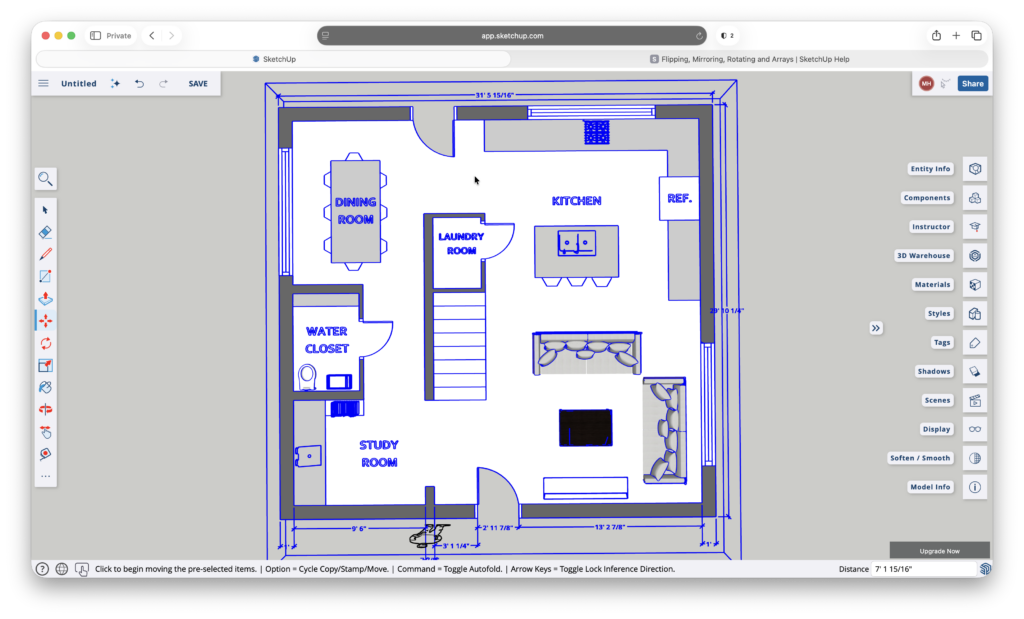
SketchUp can be used for floor plan design, although it’s not the easiest way to do it. Tools such as SmartDraw offer far more automation and are easier to use for beginners.
What Works Well
- Exact measurements (type dimensions as you draw)
- Clean, scalable geometry
- Easy transition from 2D floor plans to 3D models
- Ability to group walls, rooms, and furniture
Where It Falls Short
- No dedicated floor plan mode
- No automatic wall creation
- No door/window snapping
- No room labels or area calculations
- No 2D drafting tools (without Pro)
In practice, drawing a floor plan in SketchUp means:
- Switching to top-down view
- Drawing wall outlines manually
- Using Push/Pull to extrude walls
- Cutting openings for doors/windows
It’s powerful, but time-consuming, especially compared to tools like SmartDraw, which are designed specifically for fast 2D floor plans.
Home & Interior Design

For home and interior design, SketchUp sits somewhere between conceptual modeling and DIY architectural visualization.
Strengths for Home Design
- Excellent spatial awareness
- Free access to the massive 3D Warehouse
- Easy furniture placement and scaling
- Materials and textures for walls, floors, surfaces
You can quickly build up:
- Kitchens and bathrooms
- Room layouts
- Furniture arrangements
- Renovation concepts
Limitations for Interiors
- No lighting simulation
- No automatic room objects
- No cost estimation
- No photorealistic rendering (without Pro + plugins)
This makes SketchUp ideal for visualizing ideas, but less suitable for polished interior presentations.
If your goal is interior or residential design specifically, Live Home 3D is significantly easier and more specialized.
Landscape & Outdoor Design
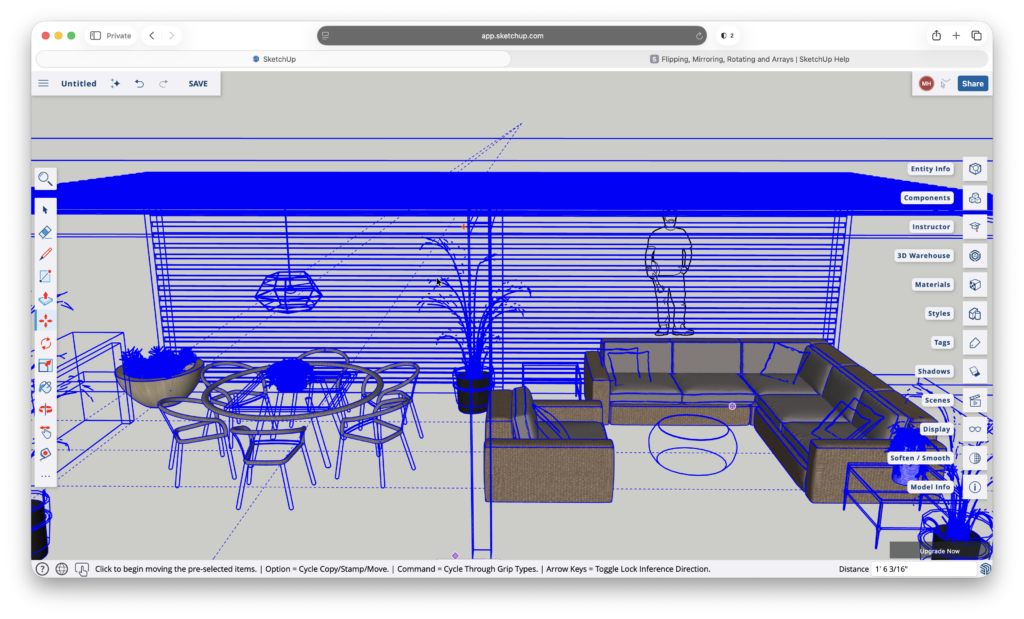
Landscape and garden design is one area where the free version of SketchUp shows both its flexibility and its limitations.
What You Can Do
- Model patios, decks, driveways
- Lay out gardens and outdoor structures
- Place trees, fences, sheds from 3D Warehouse
- Build terrain manually using geometry
What You Can’t Do (Without Pro)
- Use advanced Sandbox tools
- Generate realistic terrain automatically
- Apply vegetation systems
- Simulate slopes and grading accurately
For casual garden planning, SketchUp Free is fine. For serious landscape architecture, SketchUp Pro (with extensions) is essential.
3D Modelling & 3D Printing
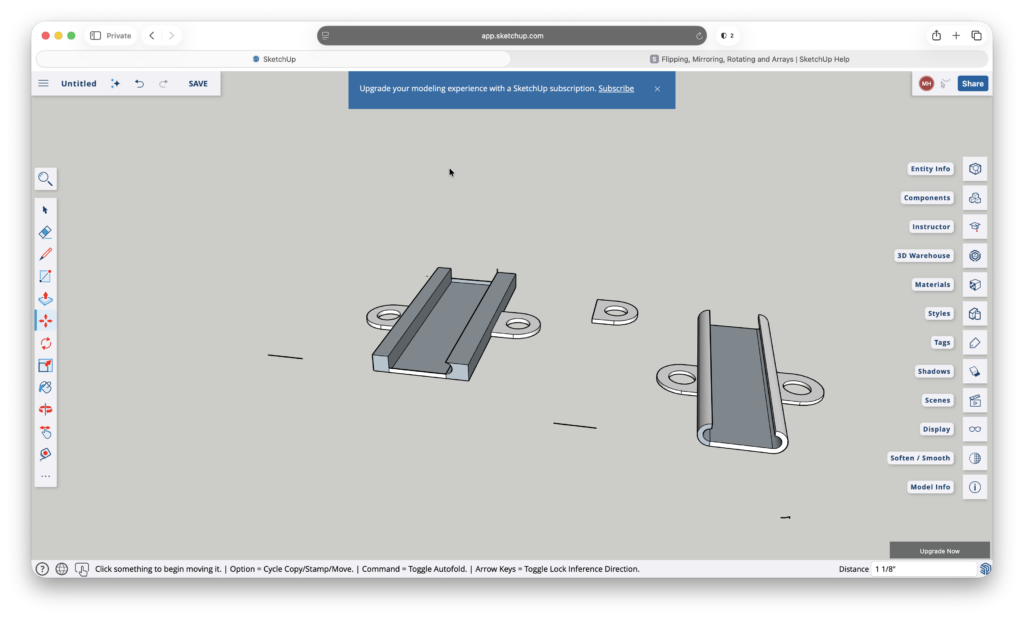
SketchUp isn’t just for floor plans or home layouts – it’s a capable tool for general 3D modelling and can be used for 3D printing. You create models by drawing 2D shapes and using the Push/Pull tool to turn them into 3D forms, while groups and components help organize repeating elements like furniture, doors, or decorative features.
For 3D printing, SketchUp allows export in STL format, the standard for most 3D printers. Models need to be watertight solids with correctly oriented faces, and exported STL files can then be sliced in software like Cura or PrusaSlicer.
Strengths:
- Fast, intuitive creation of 3D geometry
- Precise measurements and scaling
- Access to millions of pre-built objects in 3D Warehouse
- Direct STL export for printing
Limitations:
- No built-in mesh repair or advanced solid operations
- Best suited for simple or architectural shapes rather than complex organic forms
- Only STL export is available in Free (no OBJ, PLY, or other formats)
For beginners, SketchUp Free is an excellent way to learn 3D modelling and produce basic 3D prints. More advanced users or professionals may want SketchUp Pro or Studio for enhanced export, extensions, and rendering capabilities.
Exporting in SketchUp Free vs SketchUp Pro

SketchUp Free’s biggest drawback is exporting.
SketchUp Free Export Formats
- PNG (images)
- STL (3D printing)
That’s it.
There’s no DWG, DXF, PDF, OBJ, or 3DS support, which makes collaboration with architects, builders, or engineers extremely difficult.
SketchUp Pro is required for professional file exchange and documentation.
Below you can see exactly how the different editions compare to each other when it comes to exporting and features.
| Feature | SketchUp Free | SketchUp Go (Web) | SketchUp Pro |
|---|---|---|---|
| Export Formats | PNG, STL | + DWG, DXF | + PDF, 3DS, OBJ |
| Offline Use | ❌ | ✅ (mobile) | ✅ (desktop) |
| Extensions Support | ❌ | ❌ | ✅ |
| Advanced Terrain Modeling | ❌ | ❌ | ✅ |
| Rendering Tools | ❌ | ❌ | ✅ |
| Cost (per year) | Free | $10.75/month paid annually | $33.25/month paid annually |
SketchUp Extensions (Pro Only)
Once you move to SketchUp Pro, you can unlock the Extension Warehouse, which gives you access to tools for:
- Photo-realistic rendering
- Terrain and vegetation modeling
- Importing CAD files (DWG/DXF)
- Generating construction documents
- Custom materials and textures
As a Mac user, this also opens up Enscape support – ideal for rendering on Macs if you’re into architectural visualization or walkthroughs.
Performance on Apple Silicon Macs
SketchUp Free runs entirely in the browser, so performance is generally excellent on Apple Silicon Macs.
However, I did notice that bigger models were slower to respond in SketchUp – the application even warns you about this before you download them from the 3D Warehouse.
SketchUp Pro (desktop) still runs via Rosetta 2, but performance should be more stable and smoother than the web version, even on complex models.
SketchUp on iPad & Mobile (SketchUp Go)
SketchUp Go extends the browser experience to iPads and tablets, making it possible to design on the go. The native iPad app supports Apple Pencil, letting you draw and edit directly with touch or stylus. You can work offline, then sync your models to the cloud via Trimble Connect when you’re back online.
The interface is simplified for touch gestures: pinch to zoom, swipe to orbit, and tap to select objects. While it lacks some advanced Pro features like extensions and LayOut, it’s ideal for quick edits, on-site measurements, or conceptual design while mobile.
Learning Resources & Community Support
SketchUp benefits from a large and active community, which is invaluable for beginners and hobbyists. Key resources include:
- 3D Warehouse – millions of pre-made models for inspiration or modification
- SketchUp Help Center – official guides for tools, workflows, and troubleshooting
- SketchUp YouTube tutorials – free step-by-step videos for modelling, layout, and rendering
- Community forums – exchange tips, share models, and ask questions
- User blogs and third-party courses – detailed lessons on floor plans, furniture, or landscape modelling
Rendering & Visualization
SketchUp Free does not include built-in rendering. This means you can view your models in basic shading and textures, but there’s no photorealistic lighting, shadows, or reflections.
If you need high-quality visualizations, SketchUp Pro or Studio allows integration with dedicated rendering software plugins like:
- V-Ray – realistic lighting and materials for interiors and exteriors
- Enscape – real-time walkthroughs and VR visualization
- Twilight Render / Lumion – additional rendering engines for professional outputs
This distinction is important for users who want presentation-ready images versus casual or conceptual modelling.
File Sharing & Collaboration
SketchUp Go, Pro, and Studio include Trimble Connect, a cloud-based collaboration tool. With it, you can:
- Store models online
- Share with clients, colleagues, or contractors
- Manage version control and updates
- Access projects across devices
This is especially useful for teams, on-site architects, and designers working remotely. SketchUp Free users do not have these features – files are stored locally in the browser and must be exported manually for sharing.
Is SketchUp Free Worth Using in 2026?
SketchUp Free is a good choice if:
- You want to learn 3D modeling
- You’re sketching renovation ideas
- You need conceptual home layouts
- You don’t need CAD exports
You’ll outgrow it if:
- You need floor plans for builders
- You want professional documentation
- You require plugins or rendering
- You want offline desktop access
Alternatives To SketchUp
If SketchUp Free feels too technical or slow for your needs, these are often better options:
- Live Home 3D – Best for interior and residential design
- SmartDraw – Fast, simple floor plans
- Shapr3D – Touch-first CAD, excellent on Apple Silicon
For more check out our look at SmartDraw vs Sketchup and Live Home 3D vs Sketchup for more.
If SketchUp feels too advanced or technical, there are other tools better suited for specific tasks:
Check out our guides to the best home design software for Mac and best CAD software for Macs for more.