

We ranked macOS Dictation as one of the best dictation tools for Mac, and best of all, it doesn’t cost a cent.
Dictation is built into macOS and allows you to enter text almost anywhere you can type, including Apple Pages, Microsoft Word, Notes, Mail and many other applications.
It’s easy to activate, and its accuracy has improved significantly since it was first introduced on the Mac.
However, if you plan to dictate regularly or need to transcribe large amounts of text, we recommend checking our guide to the best dictation software for Mac before relying entirely on macOS Dictation.
Some commercial dictation tools offer personalised vocabulary, voice profiles and correction features that can improve accuracy over time. They may also provide more advanced formatting, editing and transcription tools than macOS Dictation.
macOS Dictation uses Apple’s built-in speech-recognition technology, which is also used by Siri. On compatible Macs, newer on-device language models can improve recognition, but Apple Intelligence is not required to use basic Dictation.
If you need meetings transcribed and organised into summaries and easily digestible notes, we also recommend checking out our guide to the best AI note-taking apps for Mac.
Here, we show you how to activate and use macOS Dictation on both Apple silicon and Intel Macs. We also explain whether it works offline and what happens to your voice recordings.
Dictation vs Voice Control
Firstly, it’s important to understand that macOS Dictation is different from Voice Control.
Dictation converts your speech into text wherever you would normally type. You can use it in word-processing software, email clients, messaging apps and most other applications containing a text field.
Voice Control is an accessibility feature that allows you to control your Mac and perform tasks using spoken commands. In addition to dictating text, it can open apps, click buttons, navigate menus and interact with items on the screen.
When Voice Control is enabled, standard macOS Dictation is unavailable because Voice Control provides its own dictation functionality.
How to Activate Dictation on Apple Silicon Macs
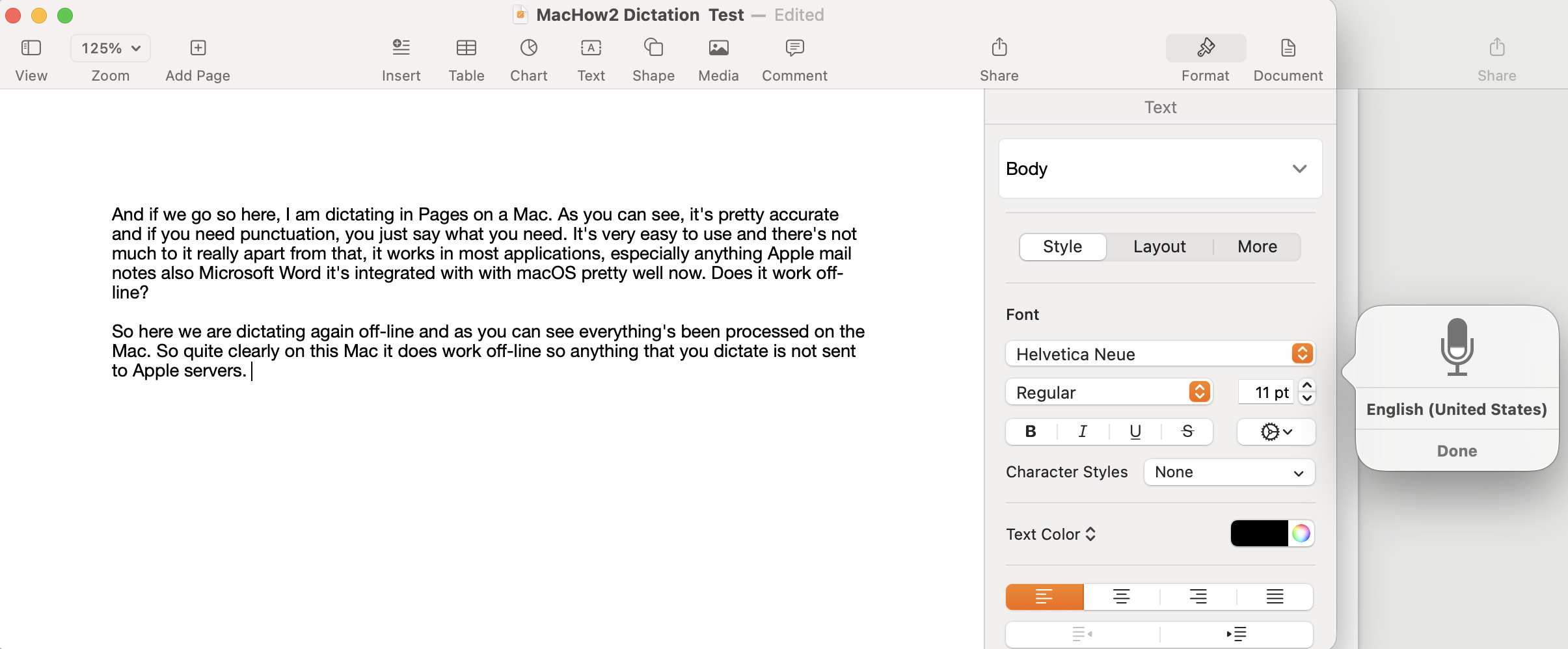
On supported Apple silicon Macs and languages, general text Dictation can be processed entirely on your Mac without sending your audio or transcript to Apple.
However, on-device processing depends on your Mac, selected language and where you dictate.
To check whether your setup supports offline Dictation, open System Settings > Keyboard and read the message displayed when you click on “About Ask Siri, Dictation & Privacy”.
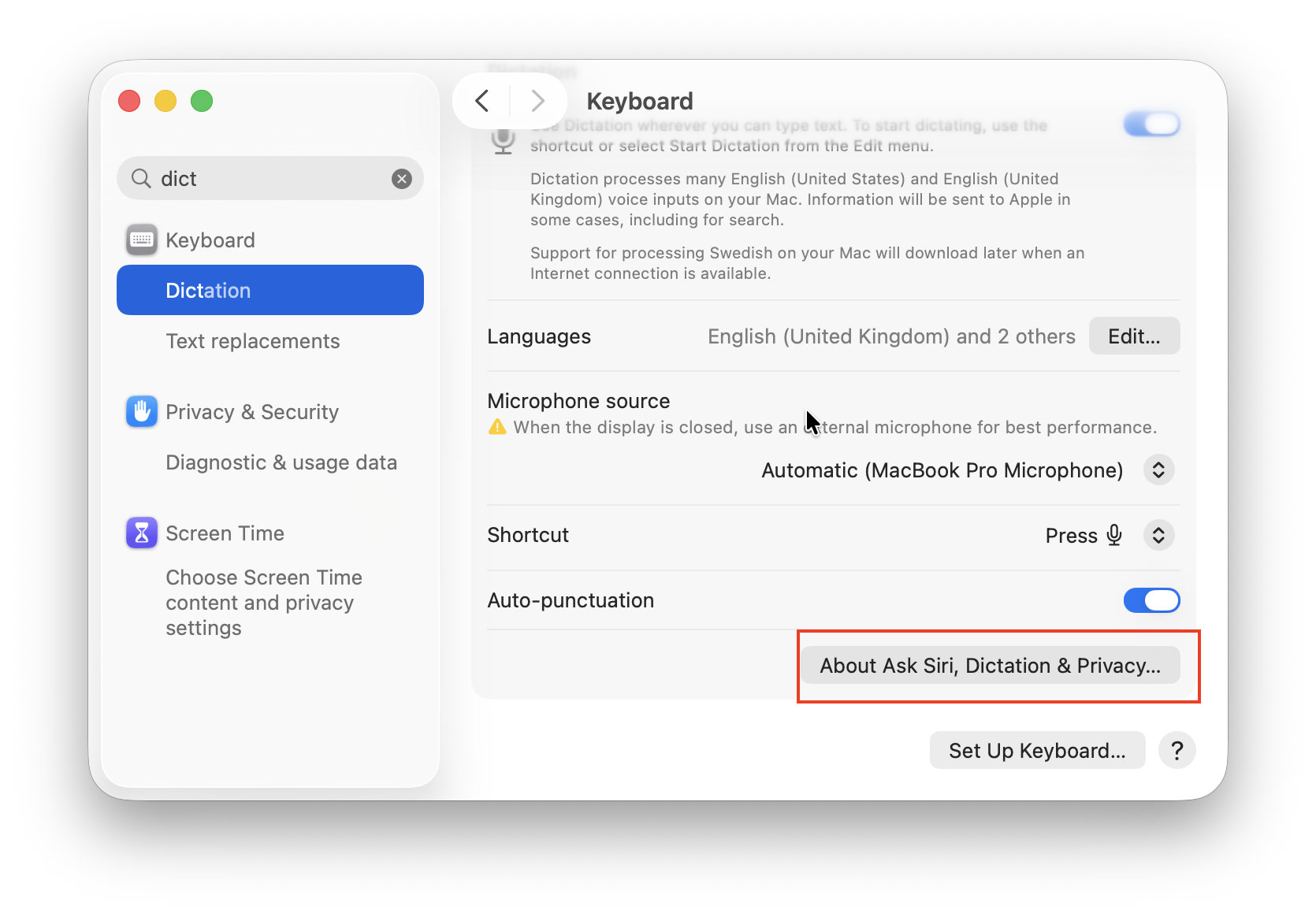
Apple states here whether your voice input and transcripts are processed on the device or require an internet connection.
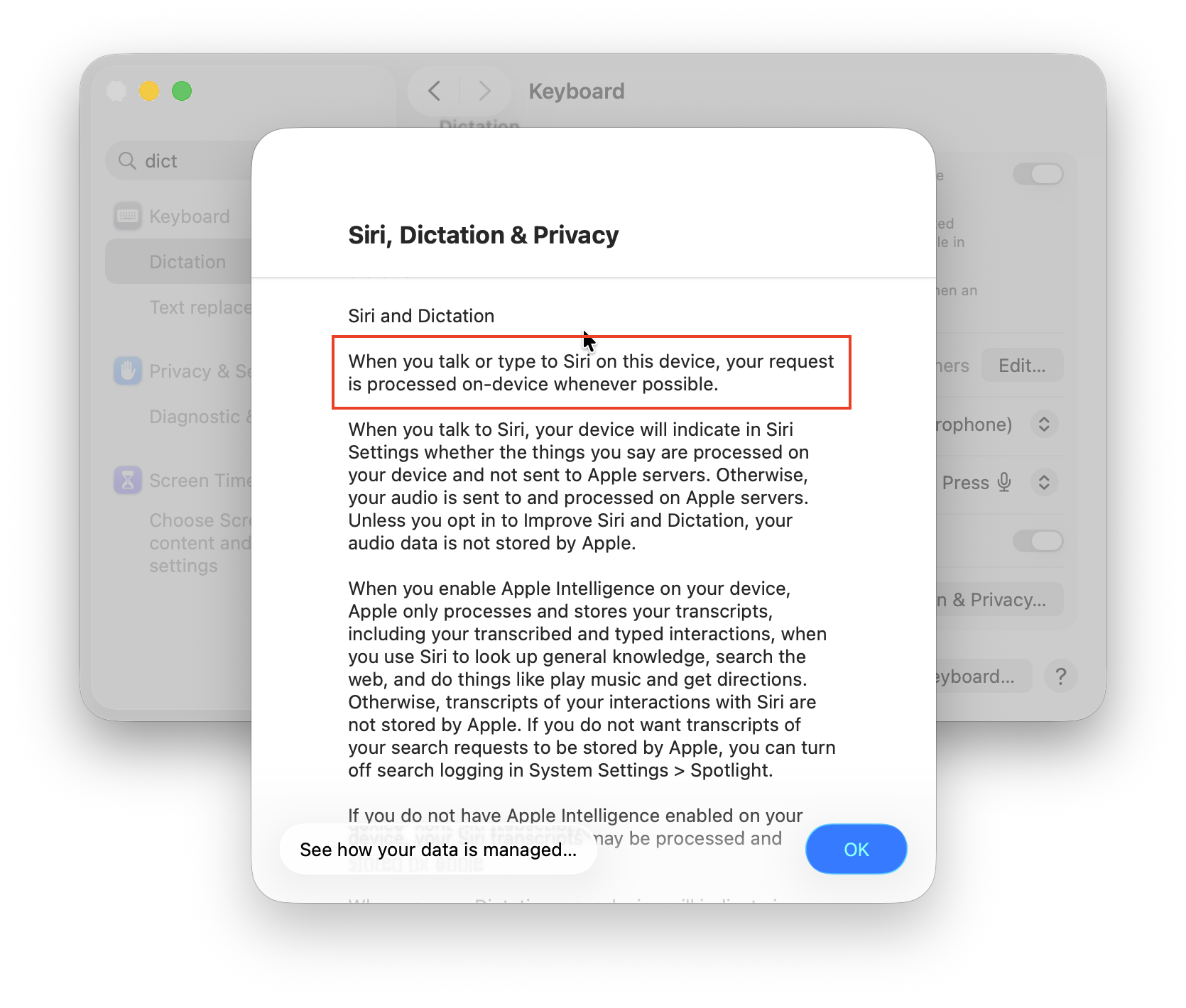
To activate Dictation on an Apple silicon Mac:
- Click the Apple logo in the top-left corner of the screen and select System Settings.
- Select Keyboard in the sidebar or search System Settings for “Dictation”.
- Scroll down to the Dictation section.
- Toggle Dictation on and click Enable when prompted.
When you activate Dictation, Apple may ask whether you want to share audio recordings to improve Siri and Dictation.Select Share Audio Recordings if you are comfortable allowing Apple to store and potentially review samples of your Siri and Dictation interactions. Select Not Now if you don’t want Apple to store these recordings.
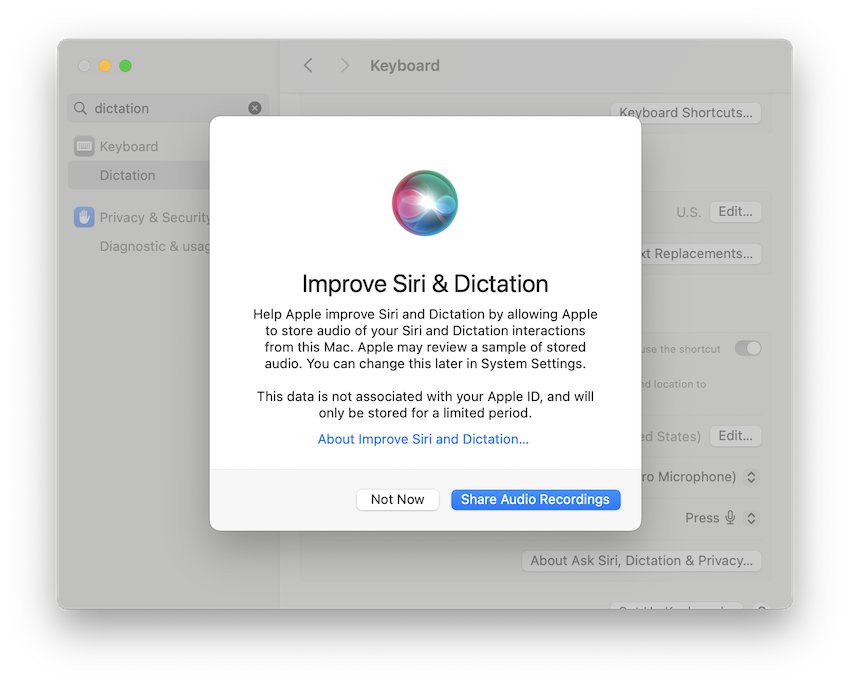
This choice does not disable Dictation and does not determine whether your speech is processed online or on your Mac. The separate Improve Siri & Dictation setting only controls whether Apple can store and potentially review samples to improve its services.
On older versions of macOS, you can activate Dictation by going to System Preferences > Dictation and then clicking on the Dictation tab and checking the “On” button.
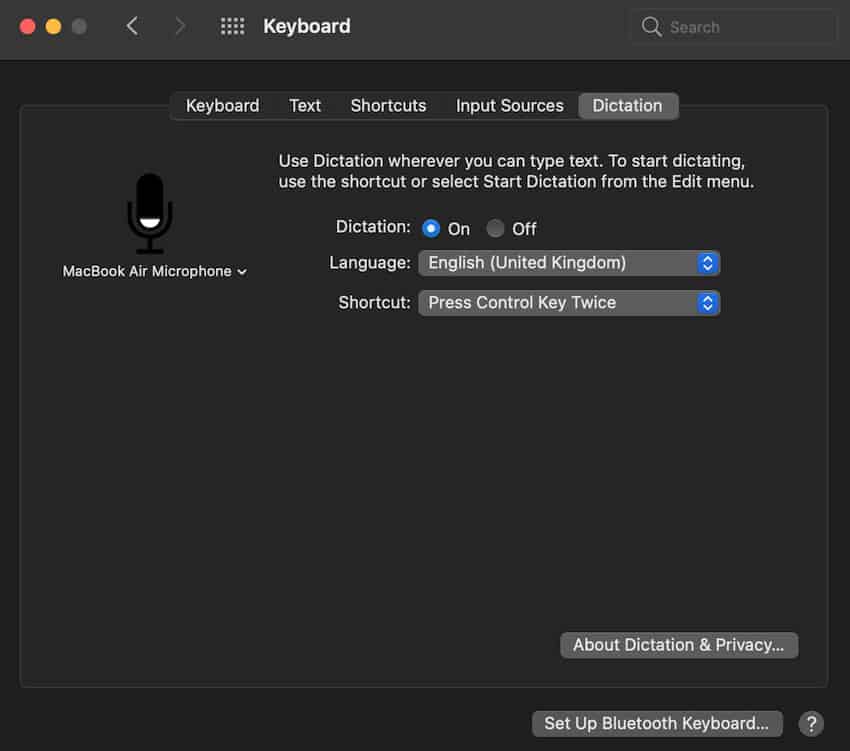
On current Apple silicon Macs, you can dictate text of any length without a fixed timeout. You can also use the keyboard while speaking, allowing you to correct or add text without ending the Dictation session.
Dictation stops automatically when no speech is detected for 30 seconds. You can also stop it manually by pressing the Escape key, pressing the Microphone key again or using your chosen Dictation keyboard shortcut.
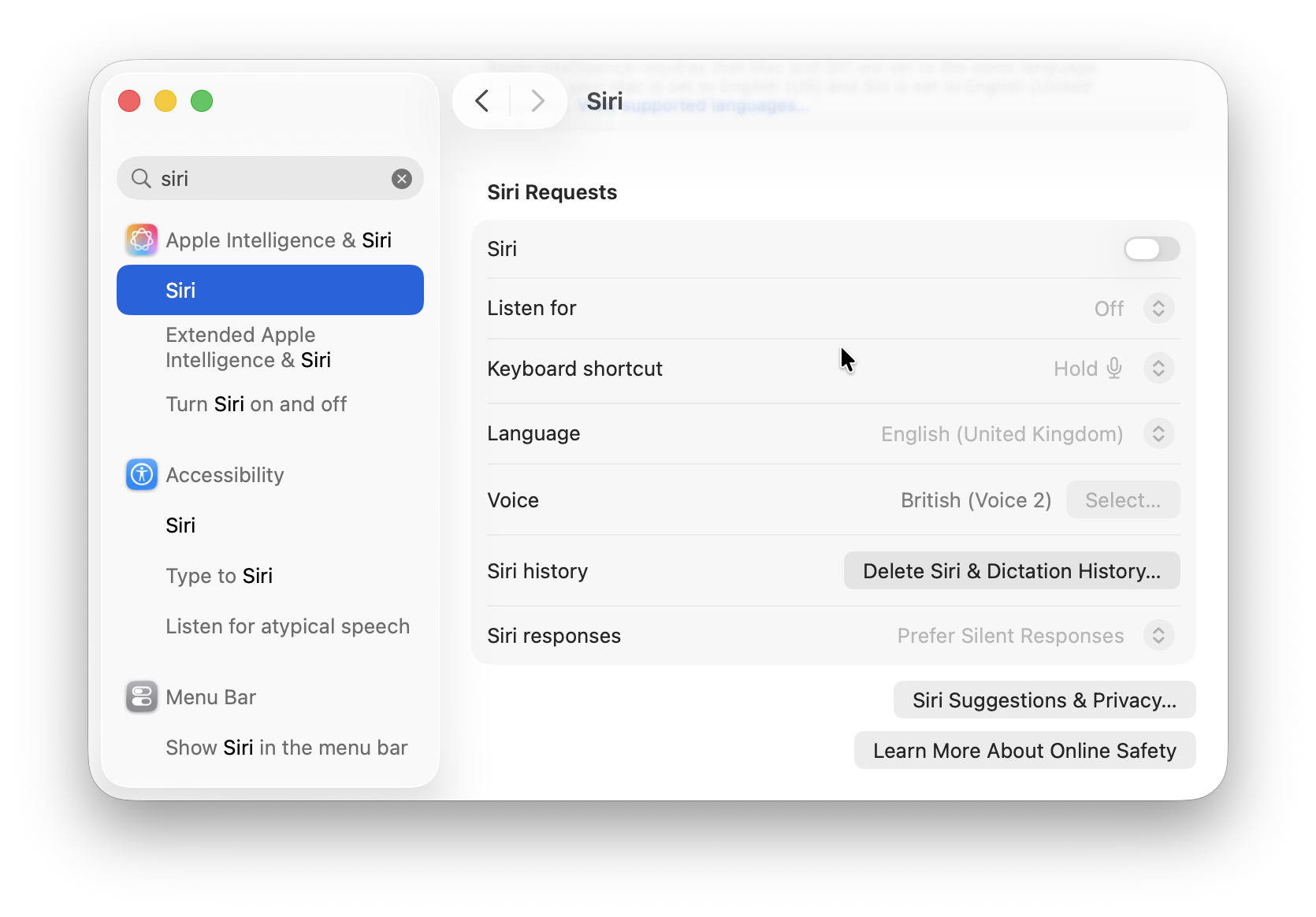
A history of Siri and Dictation interactions may be stored on your Mac and used for personalisation. You can delete it by going to System Settings > Siri > Siri History > Delete Siri & Dictation History…
The exact name and location of this setting may vary slightly between macOS versions.
How To Activate Dictation On Intel Macs
On Intel Macs, general Dictation will usually require an internet connection because Apple removed the downloadable Enhanced Dictation feature in macOS Catalina.
However, Apple’s current guidance is to check the message underneath System Settings > Keyboard > Dictation to determine whether your particular Mac and selected language use on-device or server-based processing.
To activate Dictation on an Intel Mac running a recent version of macOS:
- Click the Apple logo in the top-left corner of the screen.
- Select System Settings > Keyboard.
- Scroll down to Dictation.
- Toggle Dictation on.
- Click Enable when prompted.
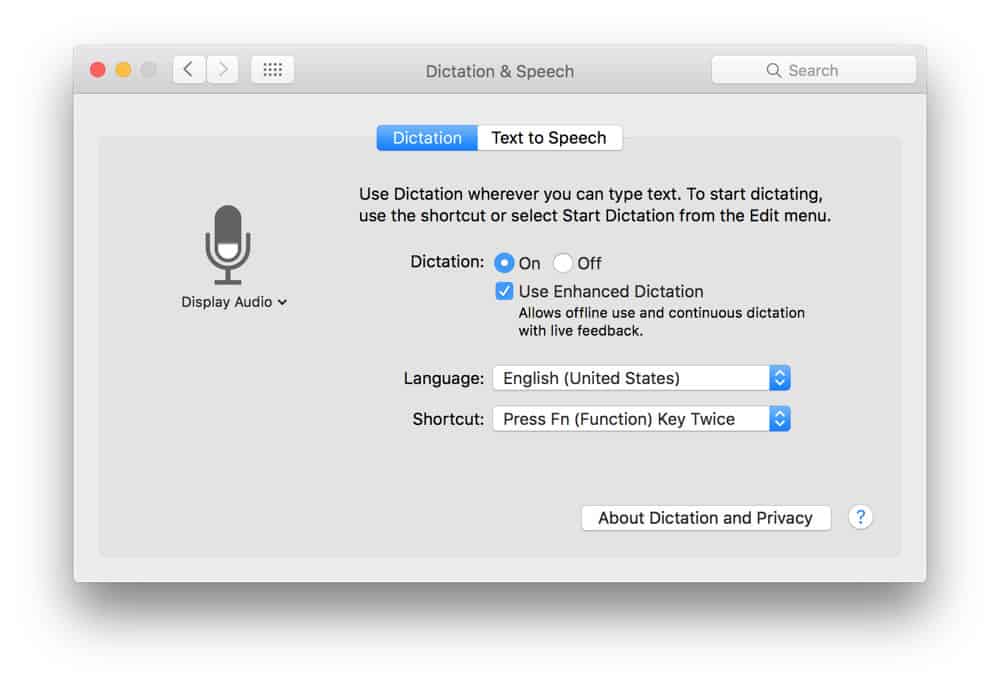
On macOS Monterey and earlier, go to System Preferences > Keyboard > Dictation, select On and then click Enable Dictation.
When prompted, you can choose whether to let Apple store audio samples to improve Siri and Dictation.
Select Share Audio Recordings to opt in or Not Now if you don’t want Apple to store samples of your audio.
You can change this later by going to:
System Settings > Privacy & Security > Analytics & Improvements > Improve Siri & Dictation
On older macOS versions, you can delete your interaction history by going to System Preferences > Siri > Delete Siri & Dictation History.
Enhanced Dictation on Older Intel Macs
If you’re using macOS Mojave or earlier, you may see an Enhanced Dictation option (see screenshot above).
Enhanced Dictation downloaded the necessary language files to your Mac, allowing supported languages to work offline and providing continuous dictation without sending your speech to Apple’s servers.
Apple removed Enhanced Dictation in macOS Catalina, so this option is unavailable in Catalina and later versions of macOS.
Dictation Languages on Mac
macOS Dictation supports dozens of languages and regional dialects, although availability and features vary by language and region.
Some languages support additional features such as:
- On-device processing
- Automatic punctuation
- Multiple language switching
- Emoji insertion
- Continuous dictation
You can see Apple’s current list on its macOS feature availability page.
To add or change a Dictation language:
- Go to System Settings > Keyboard.
- Scroll down to Dictation.
- Click Edit next to Languages.
- Select the languages and regional dialects you want to use.
- Deselect a language if you want to remove it.
If you configure more than one language, you can switch between them while dictating by clicking the currently selected language next to the Dictation cursor. You can also press the Globe key, if available, and choose another language.
How to Change the Dictation Microphone
You can use your Mac’s built-in microphone or an external microphone with macOS Dictation.
To change the microphone:
- Open System Settings > Keyboard.
- Scroll down to Dictation.
- Click the menu next to Microphone source.
- Select the microphone you want to use.
If you select Automatic, macOS attempts to choose the microphone you’re most likely to use. This might be your Mac’s built-in microphone, an external USB microphone, a connected display or a Bluetooth headset.
A good-quality external microphone may improve accuracy, especially in a noisy room or if you’re sitting some distance from your Mac.
How To Dictate On Mac
Once you’ve activated dictation, you can then dictate on your Mac in any app that supports it such as Apple Pages.
To start dictating on your Mac follow these instructions:
- Open a page in the app you want to dictate into such as Apple Pages.
- Go to Edit > Start Dictation or press the F5 key with the microphone on which is the default key for starting recordings.
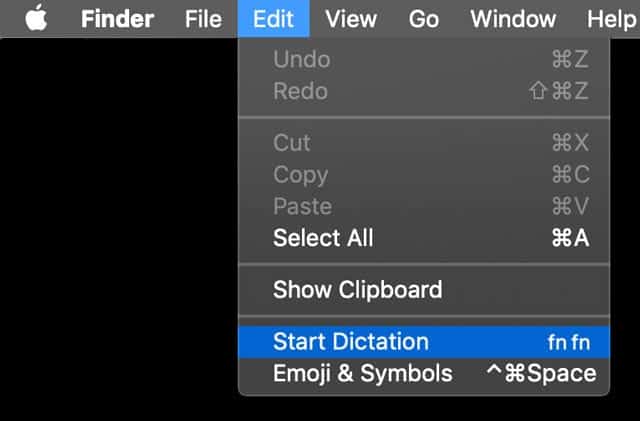
You can also configure your own Microphone shortcut key in System Settings.
When the cursor starts pulsing or you hear the activation tone, begin speaking.
The transcribed words will appear as you talk. If macOS is uncertain about a word, it may underline it in blue.
Click the underlined word to see suggested alternatives, or type or dictate the correct word yourself.
One advantage of professional dictation software is that it may provide more advanced ways to correct mistakes, create custom vocabulary and format complex documents.
When you’ve finished, press the Escape key, press the Microphone key again or use your Dictation keyboard shortcut.
Dictation also stops automatically if no speech is detected for 30 seconds.
How to Set a Dictation Keyboard Shortcut
You can customise the keyboard shortcut used to start and stop Dictation.
To do this:
- Open System Settings > Keyboard.
- Scroll down to Dictation.
- Open the Shortcut menu.
- Select one of the available shortcuts or choose Customize to create your own.
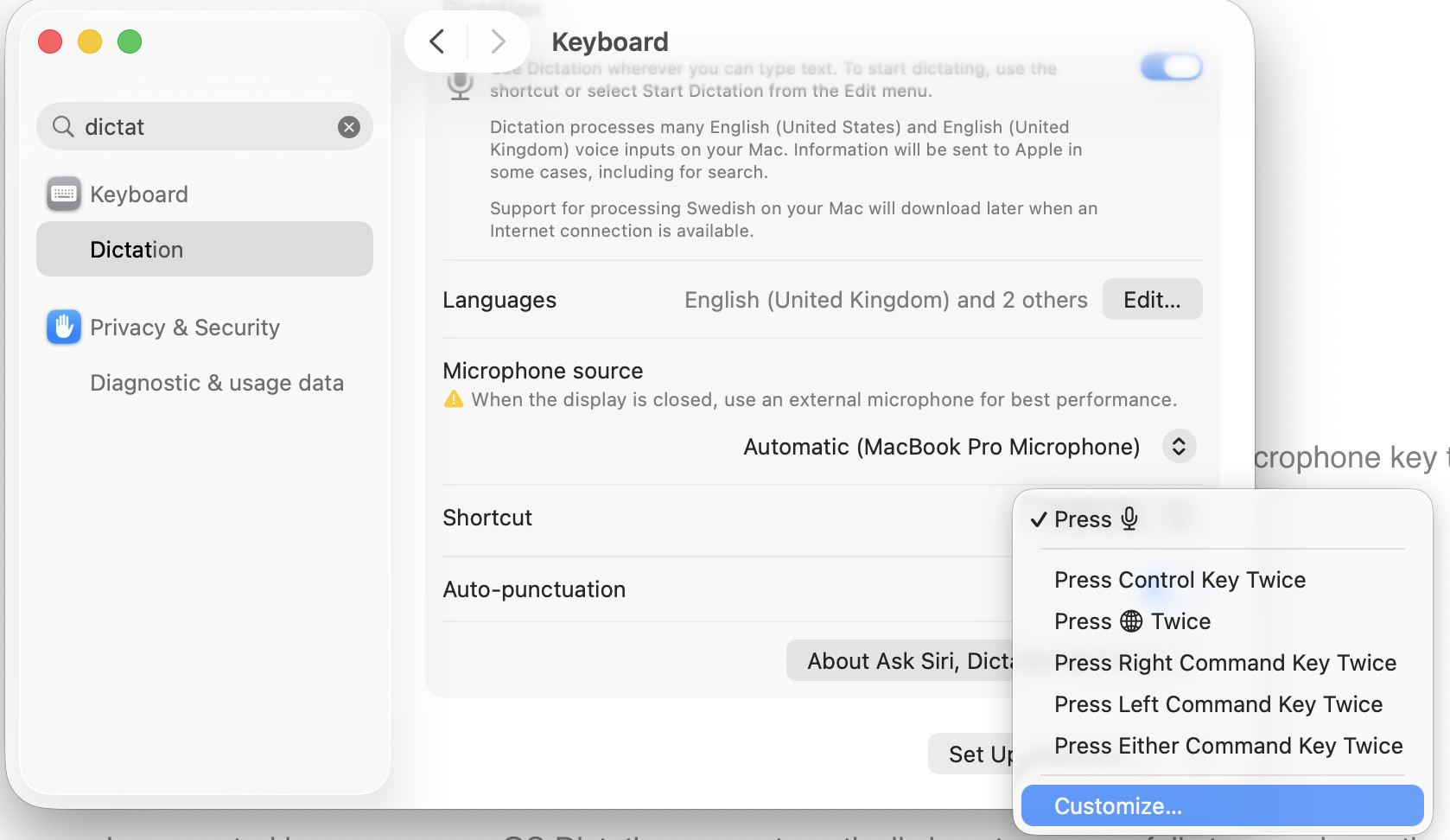
Depending on your Mac keyboard, you may also be able to press and release the Microphone key to start Dictation.
Dictation Punctuation Commands on Mac
In supported languages, macOS Dictation can automatically insert commas, full stops and question marks as you speak.
You can enable or disable this feature under:
System Settings > Keyboard > Dictation > Auto-punctuation
Even with automatic punctuation enabled, you can speak punctuation and formatting commands when needed.
Some of the most useful commands include:
- Say “full stop” to insert a full stop.
- Say “comma” to insert a comma.
- Say “question mark” to insert a question mark.
- Say “exclamation mark” to insert an exclamation mark.
- Say “new line” to move to the next line.
- Say “new paragraph” to start a new paragraph.
- Say the name of an emoji, such as “heart emoji”, to insert it.
You can find a more complete list in Apple’s guide to commands for dictating text on a Mac.
Does macOS Dictation Work Offline?
Whether macOS Dictation works offline depends on your Mac, selected language and where you dictate.
On supported Apple silicon Macs and languages, general text Dictation – such as dictating into Pages, Notes, Mail or Word – can be processed entirely on the Mac.
In this case, your voice input and transcript are not sent to Apple, and Dictation can continue working without an internet connection.
However, Apple warns that on-device processing may not apply when dictating into a search box. Unsupported languages and configurations may also require Apple’s servers.
The most reliable way to check is:
- Open System Settings > Keyboard.
- Make sure Dictation is enabled.
- Read the privacy message displayed when you click “About Ask Siri, Dictation & Privacy”
macOS will tell you whether your voice input and transcripts are processed on the device or sent to Apple’s servers.
You can also test offline Dictation by disconnecting your Mac from Wi-Fi and dictating into an app such as Notes. If the words continue appearing, Dictation is being processed locally for that language and text field.
For more, check our guide to dictating offline on a Mac.
What Happens When Apple’s Servers Are Used?
If your Mac indicates that an internet connection is required, your speech is sent to Apple’s servers for processing.
Apple says that the things you dictate are not stored unless you opt in to Improve Siri & Dictation.
However, Apple may retain related request information, such as:
- The category of the request
- Whether it was completed successfully
- Device specifications and configuration
- Performance statistics
- Approximate location if relevant Location Services are enabled
Apple associates this information with a random, device-generated identifier rather than your Apple Account or email address.
Third-party apps that use Apple’s Speech Recognition service may also send audio to Apple. This is separate from using the standard macOS Dictation feature and may be subject to the app developer’s own privacy policy.
Does Improve Siri & Dictation Enable Offline Dictation?
No. The Improve Siri & Dictation setting does not control whether your speech is processed on your Mac or Apple’s servers.
Instead, it gives Apple permission to store and potentially review samples of your Siri and Dictation interactions to improve its speech-recognition technology.
You can turn this setting on or off by going to:
System Settings > Privacy & Security > Analytics & Improvements > Improve Siri & Dictation
For maximum privacy, leave this setting turned off and confirm that the message under System Settings > Keyboard > Dictation says your voice input and transcripts are processed on the device.
Can Intel Macs Dictate Offline?
Intel Macs running macOS Mojave or earlier may support offline dictation through the old Enhanced Dictation option.
Apple removed Enhanced Dictation in macOS Catalina. Consequently, Dictation on Intel Macs running Catalina or later will usually require an internet connection.
However, users should check the message underneath System Settings > Keyboard > Dictation rather than relying on the processor alone, as processing can also depend on the selected language and macOS version.