

MotiveWave is one of the most powerful professional trading platforms available with a dedicated Mac desktop app.
In fact, it’s one of the first truly dedicated Mac trading software although a Windows and mobile version is now available.
It combines advanced charting and technical analysis with direct broker integration, allowing you to analyze markets, place trades and manage positions without switching between different platforms.
Its biggest strengths are order flow analysis, Elliott Wave tools, highly customizable chart layouts and support for more than 30 brokers and data services.
Unlike many professional trading platforms, MotiveWave also provides separate versions for both Intel and Apple Silicon Macs, so there’s no need to use a virtual machine, CrossOver or another workaround.
However, MotiveWave is not aimed at casual investors. The interface has a steep learning curve, market data is not included and the more advanced editions are expensive.
For this review, I tested MotiveWave version 7 on an M3 MacBook Pro running macOS Tahoe using Google and Yahoo Finance as a data service and also testing a broker connecting with Interactive Brokers.
You can also test it for yourself by downloading the free 14 day trial.
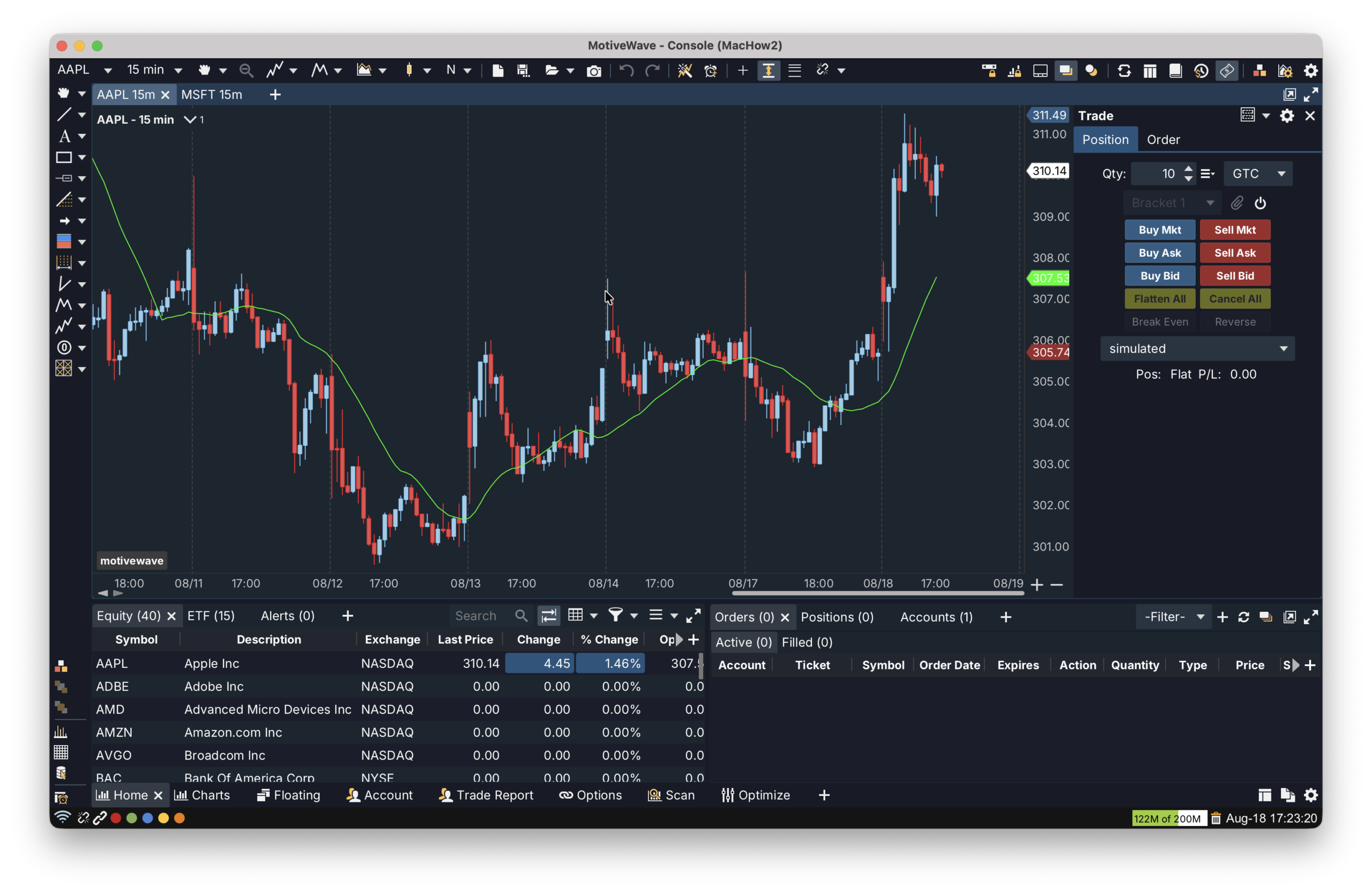
MotiveWave at a Glance
| Feature | Details |
|---|---|
| Platforms | macOS, Windows and Linux |
| Mac support | Separate Apple Silicon and Intel downloads |
| Current version | Version 7.0.29 at the time of writing |
| Minimum macOS | macOS 10.12.6 Sierra or later |
| Markets | Stocks, futures, forex, options, CFDs and cryptocurrency, depending on the connection |
| Broker/data integrations | More than 30 |
| Built-in studies | 280 to more than 290, depending on edition |
| Live trading | Standard edition or higher |
| Advanced order flow | Order Flow, Professional and Ultimate |
| Elliott Wave tools | Elliott Wave Lite and Ultimate |
| Strategy backtesting | Professional and Ultimate |
| Market data included | No |
| Free version | Community edition |
| Trial | 14 days free, normally with Ultimate features |
| Starting paid price | $24 per month or $245 one-time |
| Best for | Active technical, futures, order flow and Elliott Wave traders |
What Is MotiveWave?
MotiveWave is a desktop trading and market-analysis platform for macOS, Windows and Linux.
It is important to understand that MotiveWave is not a broker. It provides the charts, analysis tools and trading interface, but your account, funds, market access and order execution remain with your connected broker.
The instruments you can analyze and trade therefore depend on the broker or data service you connect to MotiveWave.
Supported markets include:
- Stocks and ETFs
- Futures
- Forex
- Options
- CFDs
- Cryptocurrency
- Indices
Its current connections include Interactive Brokers, TradeStation, FOREX.com, FXCM, Tradier, Binance, Kraken and Bitstamp, along with futures brokers and services that connect through CQG, Rithmic or CTS.
The list of supported connections changes, so check that your broker and operating system are supported before buying a licence.
Older versions of this review referred to OANDA and DirectFX. Neither appears on MotiveWave’s current connection list, so you should not assume that they are still supported.
Installing MotiveWave on a Mac
MotiveWave provides separate installers for Apple Silicon and Intel Macs.
This is better than relying on a single Intel version running through Rosetta on an M-series Mac. Make sure you download the correct package for your processor.
If you are unsure which Mac you have, click the Apple logo in the menu bar and select About This Mac. Any Mac with an M-series processor is an Apple Silicon Mac.
MotiveWave’s published system requirements are relatively modest:
- macOS 10.12.6 Sierra or later
- 64-bit operating system
- 4GB of RAM, with 8GB recommended
- 1GB of free storage, plus additional space for historical and tick data
- Apple Silicon or a four-core Intel processor
- Graphics hardware with at least 512MB of memory
These requirements are only a baseline. If you plan to run multiple charts, order-flow studies, historical tick data and several external displays, we would recommend considerably more than 8GB of memory.
Our Installation Experience
To access the free 14 day trial you need to create an account either with your Google or Apple ID or by providing an email address.
I then downloaded the Apple Silicon package and installed it on an M3 MacBook Pro.
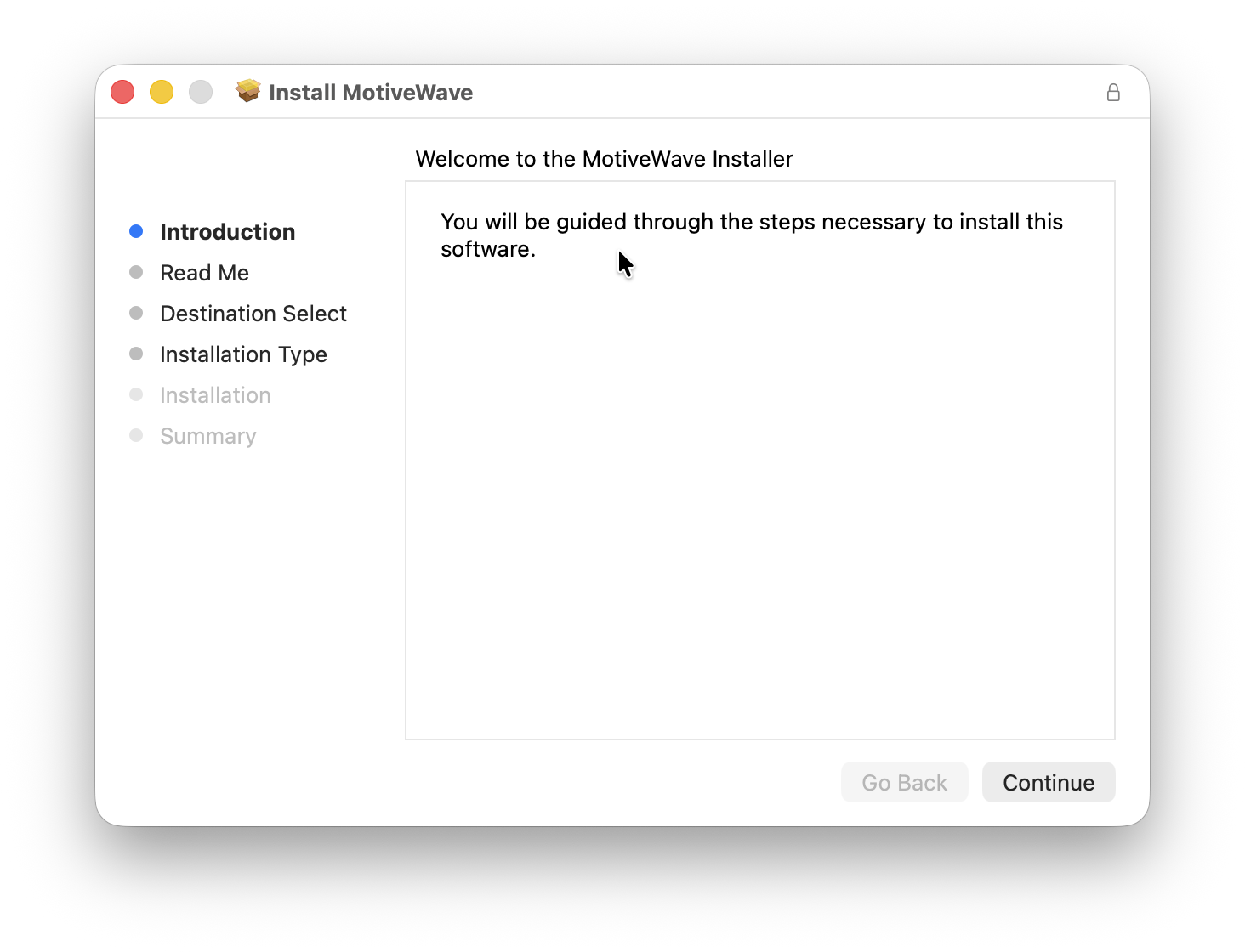
After running the installer, you’ll need to authenticate the sign-in.
Recent MotiveWave 7 updates have replaced traditional licence-key entry with account sign-in. You can now sign in using your email address or authenticate through Google or Apple.
This makes moving between computers easier, although one licence can still only be active on one computer at a time.
MotiveWave can be installed on multiple Macs or PCs using the same licence, but you must close it properly on one computer before opening it on another. Running it simultaneously on two computers requires a second licence.
On first launch, MotiveWave took a few seconds to open and used approximately 7% of my Macs CPU with a basic workspace loaded – pretty lightweight for any trading app.
Important Note for Existing MotiveWave Users
MotiveWave changed its workspace data format in version 7.
A workspace created in MotiveWave 6 can be opened in version 7, but after it has been converted, it cannot be reopened in an older version.
We strongly recommend creating a backup before upgrading. You may also want to restore the backup into a separate test workspace until you are certain everything works correctly.
Setting Up a Broker or Data Connection
One of the first things MotiveWave asks you to do is create a workspace and choose a broker or market-data connection.
This is a crucial difference compared with platforms that provide their own market data: MotiveWave does not include market data with any edition.
You must connect it to:
- A supported broker that provides data
- A separate market-data service
- A demo or trial data account
- Imported CSV, ASCII or MetaStock data
MotiveWave still includes a free Google/Yahoo connection for historical stocks, indices and limited currency data. However, this source no longer provides live or delayed quotes, making it unsuitable for testing live trading or real-time order flow. However, for the purposes of this review, I used the Google/Yahoo connections for demonstration purposes.
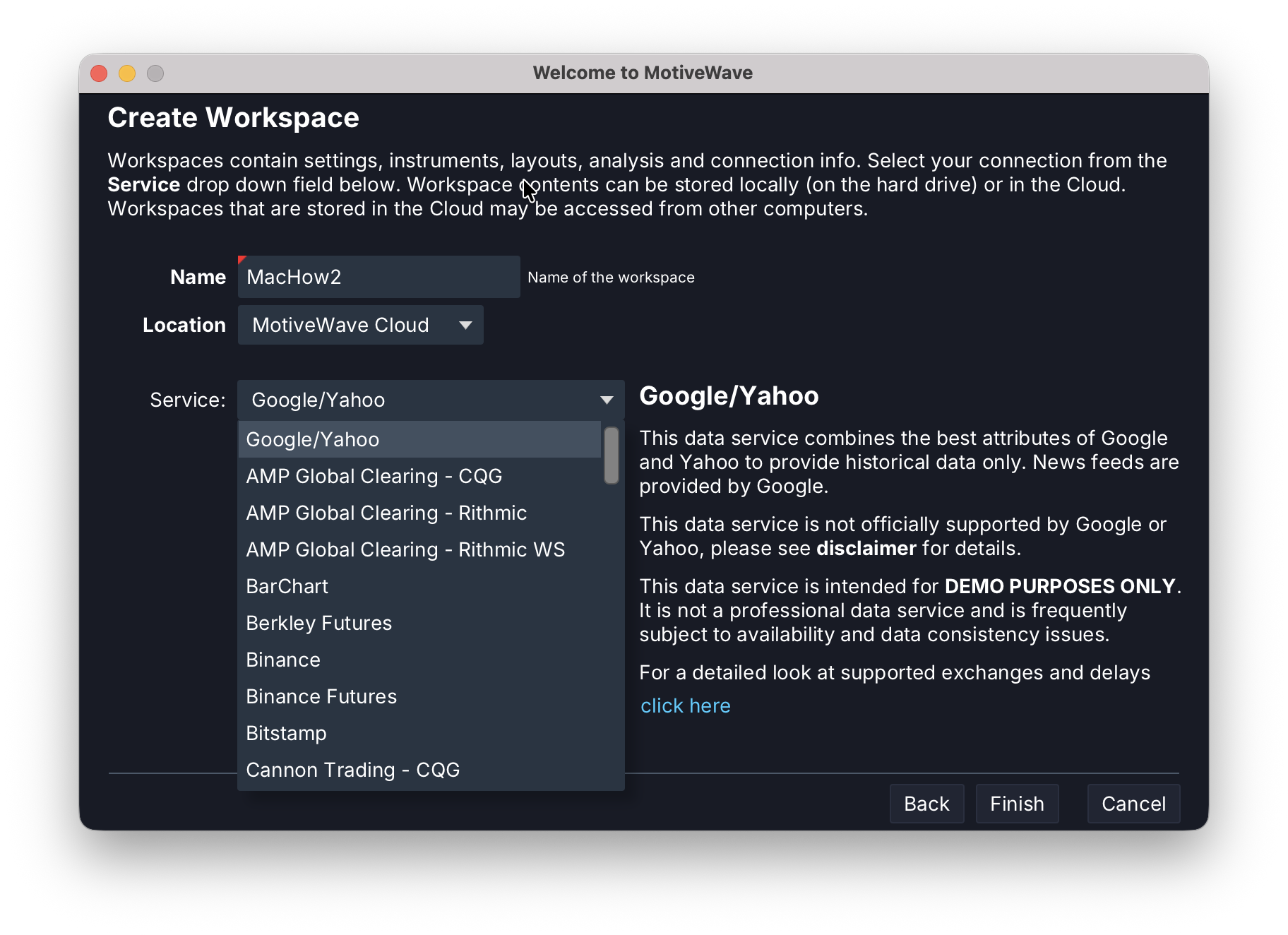
Other available data sources include BarChart, CryptoCompare, dxFeed, IQFeed and TrueData, although availability, exchange coverage and fees vary.
For a meaningful test of the Volume Imprint, Order Heatmap, advanced DOM and other order-flow tools, your connection must provide the required tick or Level II data.
Workspaces and Multiple Connections
A MotiveWave workspace combines a connection with its own charts, layouts, settings, instruments and locally stored data.
You can create unlimited workspaces in every edition, but the number of connections allowed inside one workspace depends on your plan:
- Community, Standard, Order Flow and Elliott Wave Lite allow one broker or data service per workspace.
- Professional and Ultimate allow multiple broker and data connections within the same workspace.
You can still use several brokers with a lower edition, but each one must be opened in a separate workspace.
This is less convenient if, for example, you want data from dxFeed while sending orders to Interactive Brokers within the same layout. Professional or Ultimate makes this sort of setup much easier.
Our Connection Experience
Although I used Google/Yahoo data for testing purposes, I also tried connecting MotiveWave to Interactive Brokers.
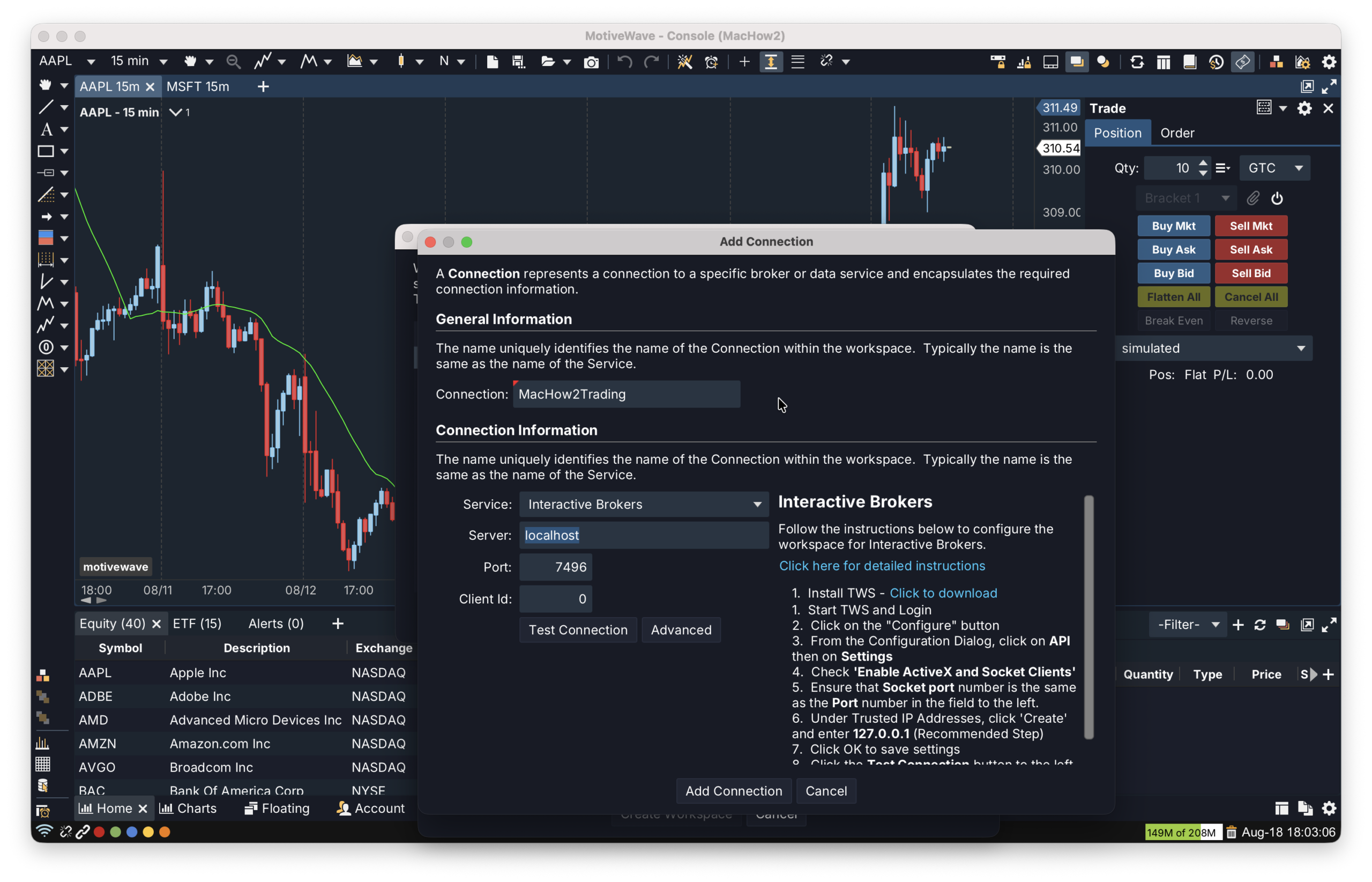
Setting up the connection will depend on what the broker uses for authentication. In the case of Interactive Brokers, you need to download TWS and configure it to allow ActiveX and Socket Clients and then use the credentials to connect MotiveWave to it.
This connected quite quickly for me and the first chart took approximately 5-10 seconds to load its historical data. Real-time quotes then quickly followed updating smoothly.
Closing the Mac, allowing it to sleep and then re-opening MotiveWave resulted in a brief delay to data populating but generally, it was very responsive to waking from sleep.
MotiveWave Interface and Workspaces
The MotiveWave interface is built around a main Console containing charts, watchlists, order panels, account information and other components.
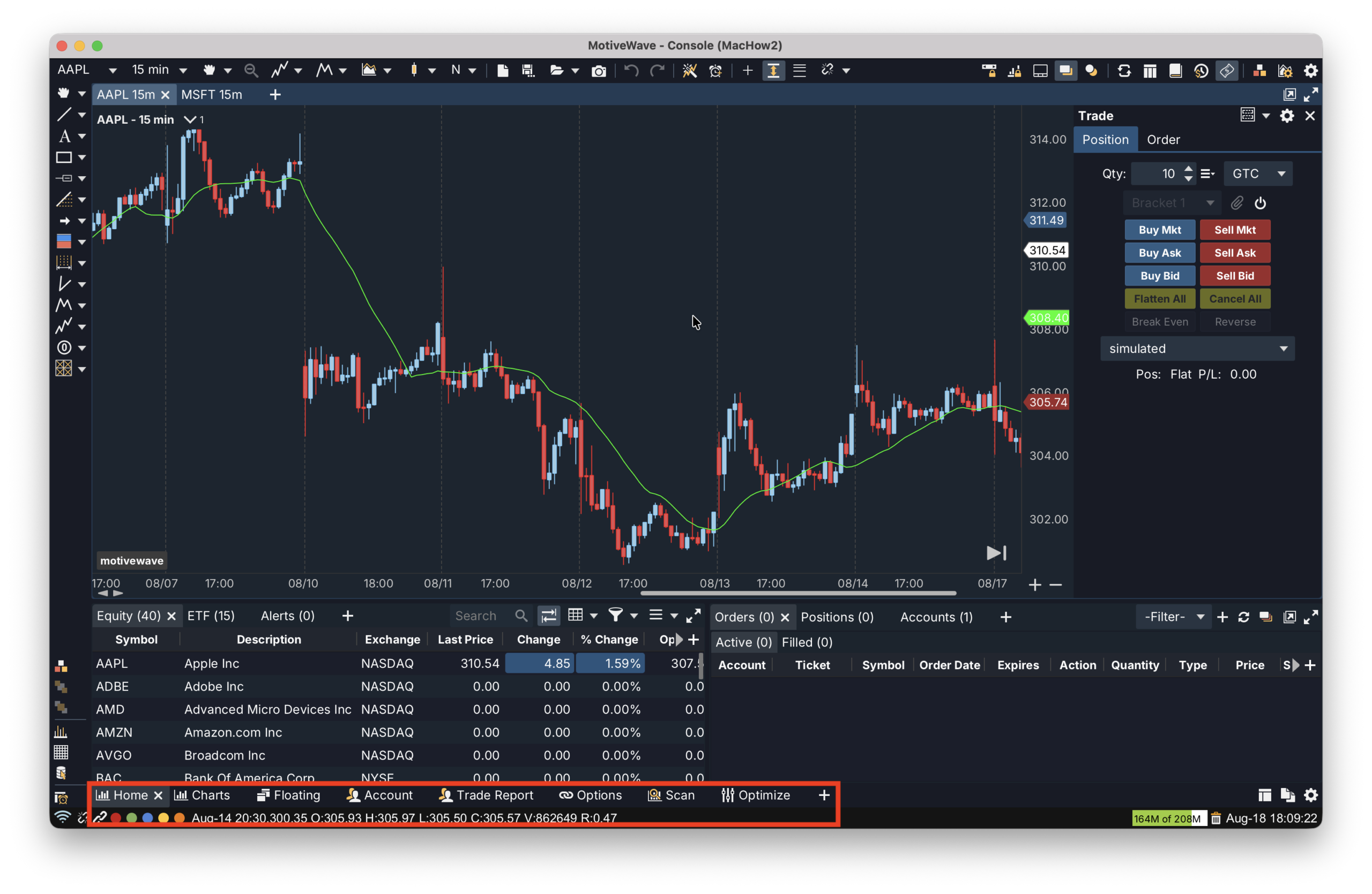
Pages along the bottom of the Console allow you to move between different layouts. The default workspace can include pages for:
- Home
- Charts
- Floating windows
- Accounts
- Trade reports
- Options
- Scanners
- Strategy optimization
- News
Some pages only appear if they are supported by your edition or data connection.
You can create additional pages, divide them into different panels and drag components into the position you want.
Charts can also be detached into floating windows. Professional and Ultimate add Desktops, which work like additional Console windows containing their own pages and layouts.
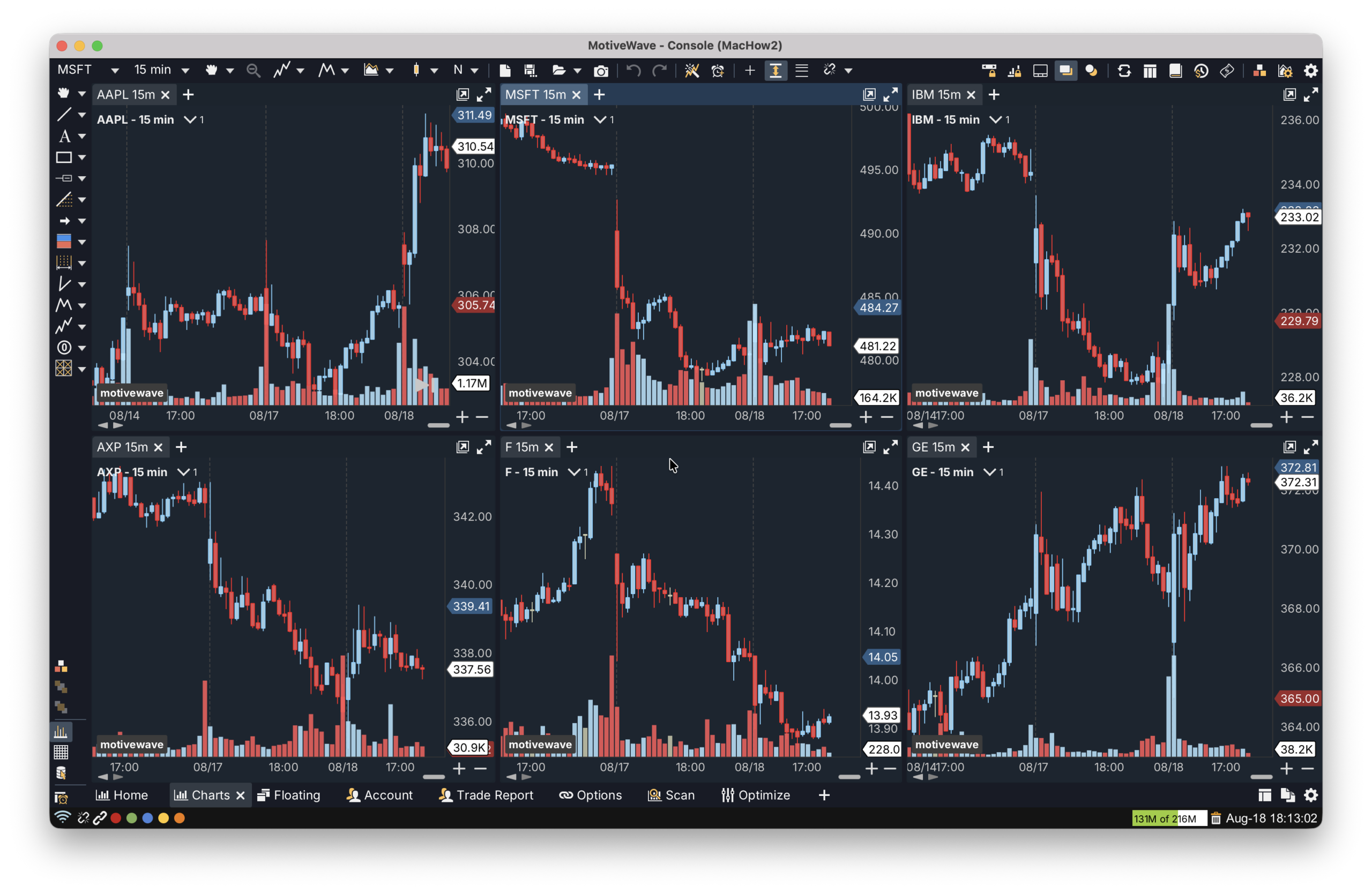
This flexibility is one of MotiveWave’s biggest strengths, particularly if you use two or more displays. However, it also takes some learning how this all works.
TradingView is easier to understand initially, whereas MotiveWave feels more like a professional desktop workstation that you customize right down to the last detail.
Our Experience With the Interface
The interface initially felt quite overwhelming.
It took me some time to create a layout containing charts, watchlist, DOM and other panels that I wanted to monitor.
Adding and rearranging components was easy though while the text and icons on my MacBook display display were very clear.
On an external 5K display too (in my case the excellent BenQ MA, text, chart labels and icons scaled perfectly as you can see below.
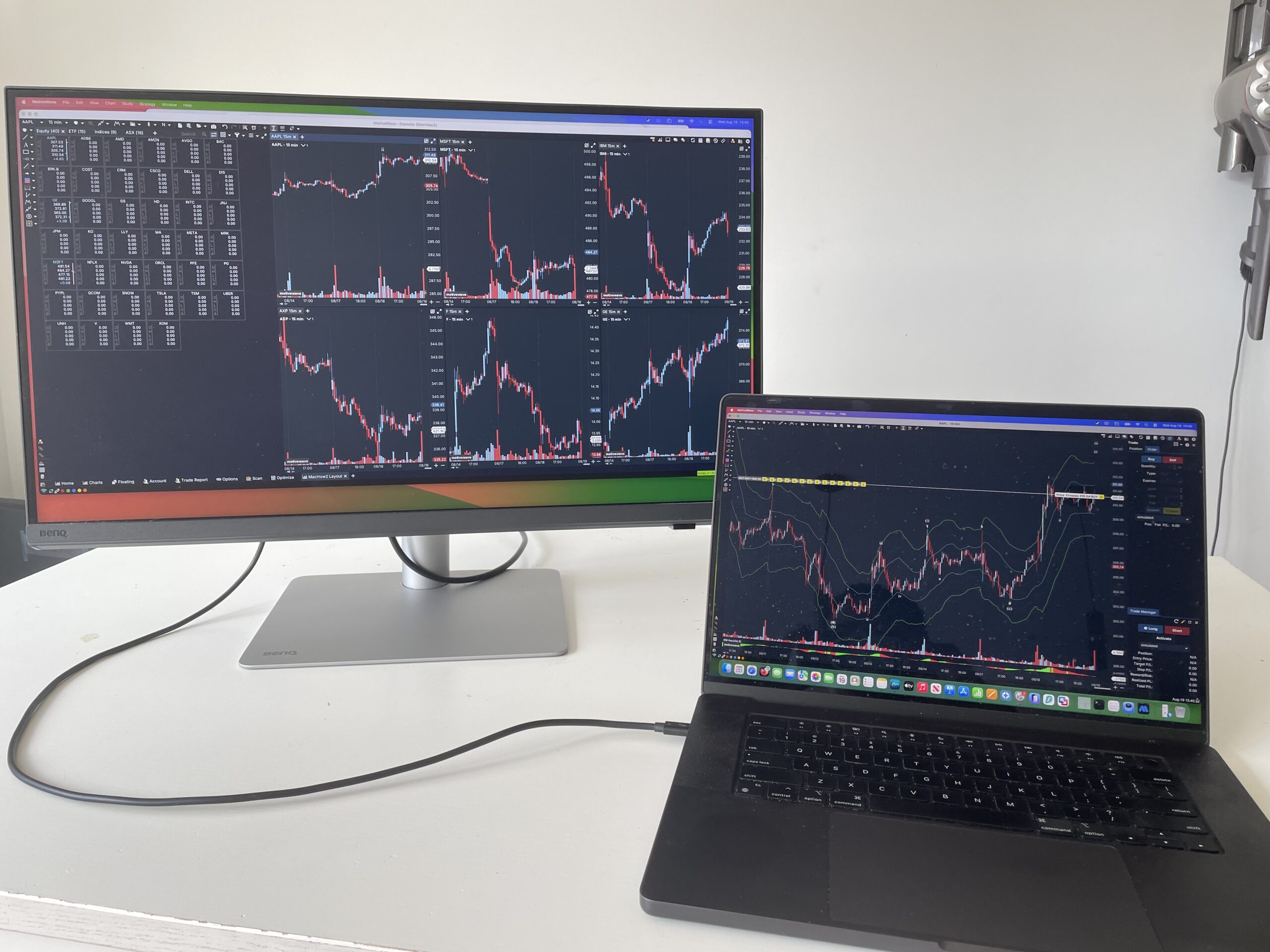
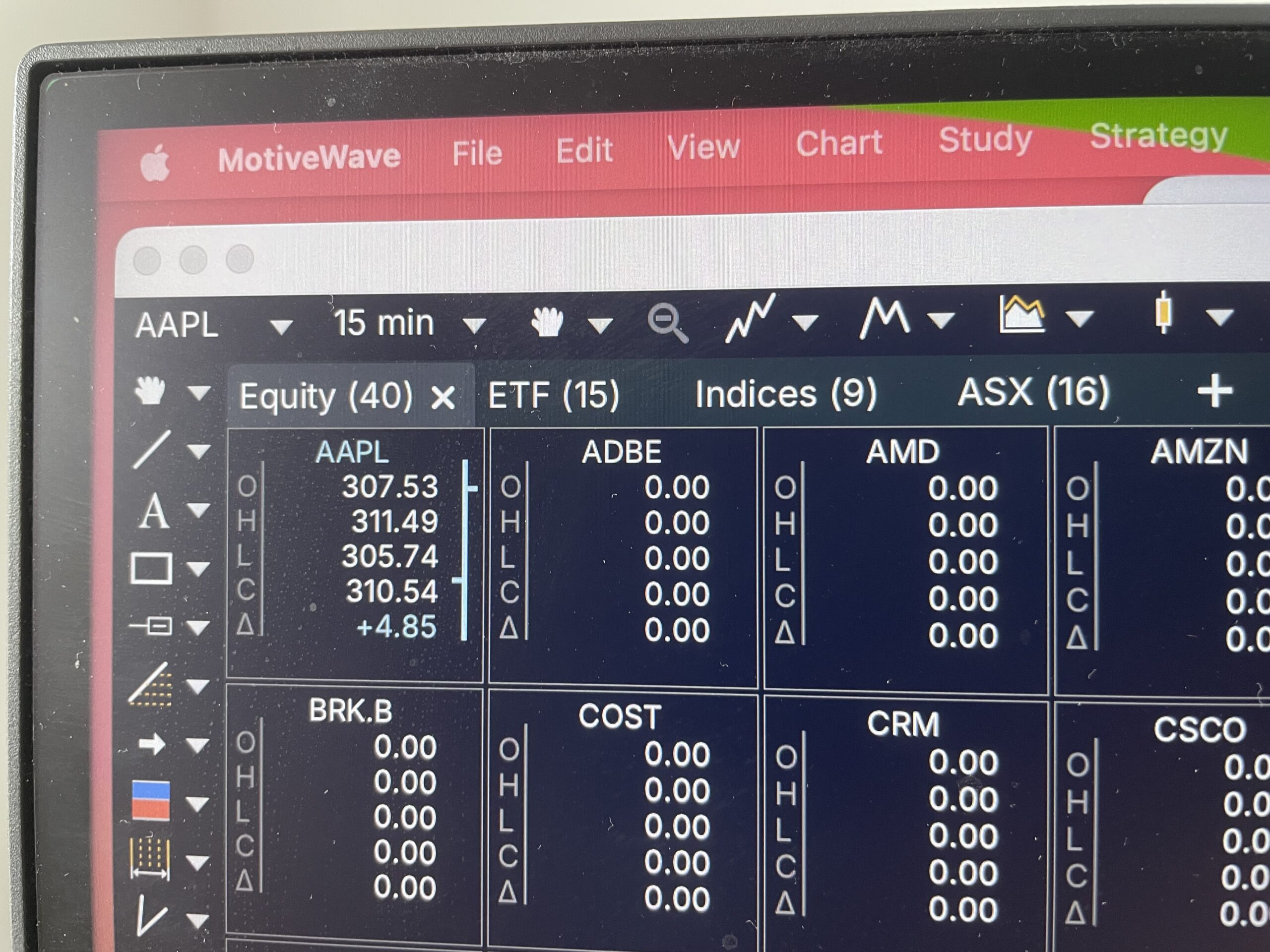
As you can see in the close-up below, the quality on a 5K display is excellent with razor sharp text. On a 4K monitor, they may not be as clear due to macOS scaling issues.
Charting and Technical Analysis
Charting is at the heart of MotiveWave, and there is a huge amount of depth available.
All editions include 18 chart bar styles and three data modes. These include:
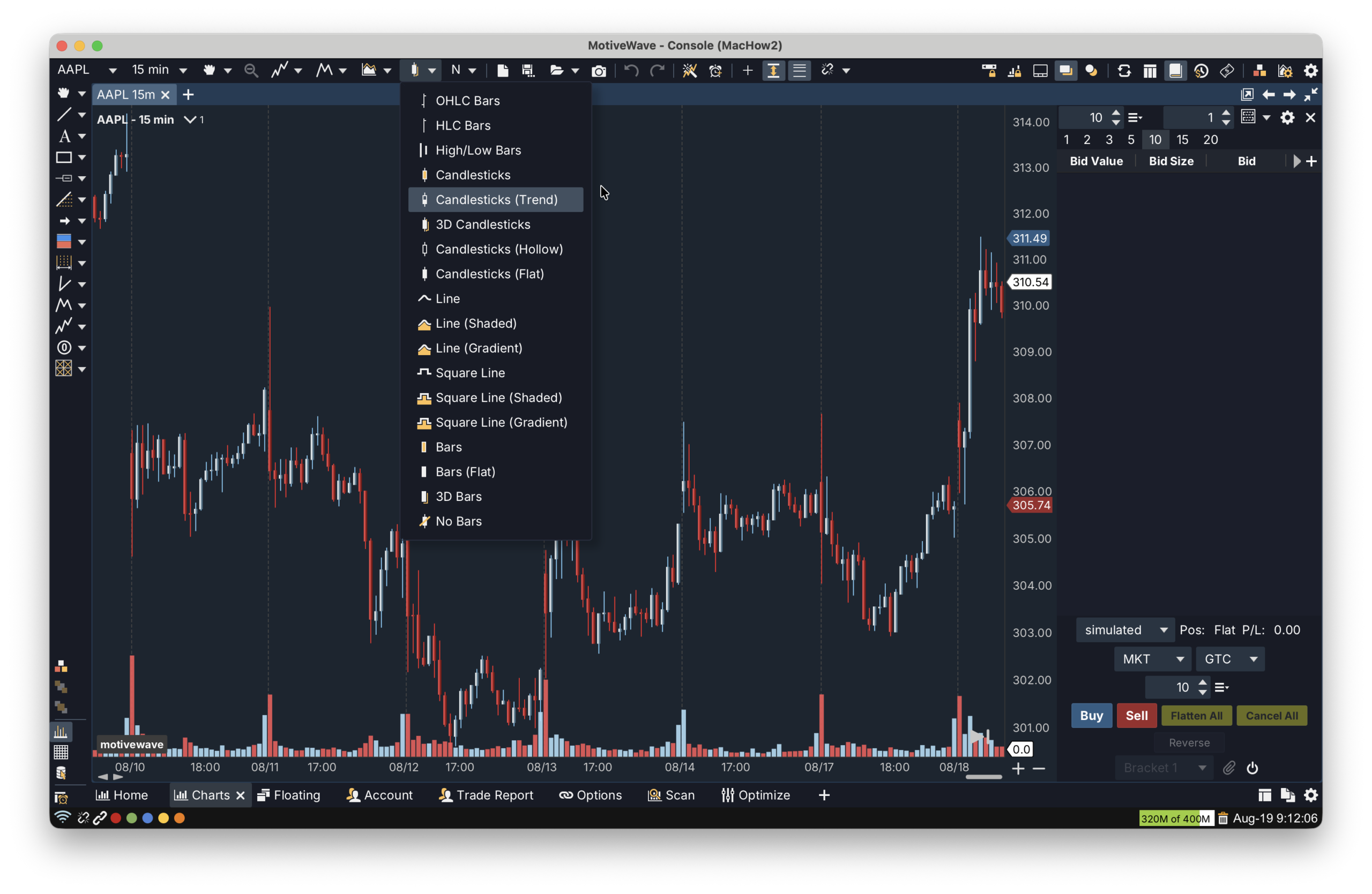
- Candlestick variations
- OHLC and HLC bars
- High/low bars
- Line and shaded-line charts
- Square-line charts
- Heikin Ashi
- Percentage change
Paid editions add non-linear and second-based charts, including:
- Tick
- Range
- Renko
- Hybrid Renko
- NT Renko
- Constant volume
- Point and Figure
- Reversal
- Second-based bars
- Millisecond-based bars
Second and millisecond charts require historical tick data from a compatible connection.
Depending on the edition, MotiveWave includes between 280 and more than 290 built-in studies and indicators. There are also drawing tools for trend lines, channels, regression analysis, support and resistance, Fibonacci analysis, Gann analysis, cycles, shapes and annotations.
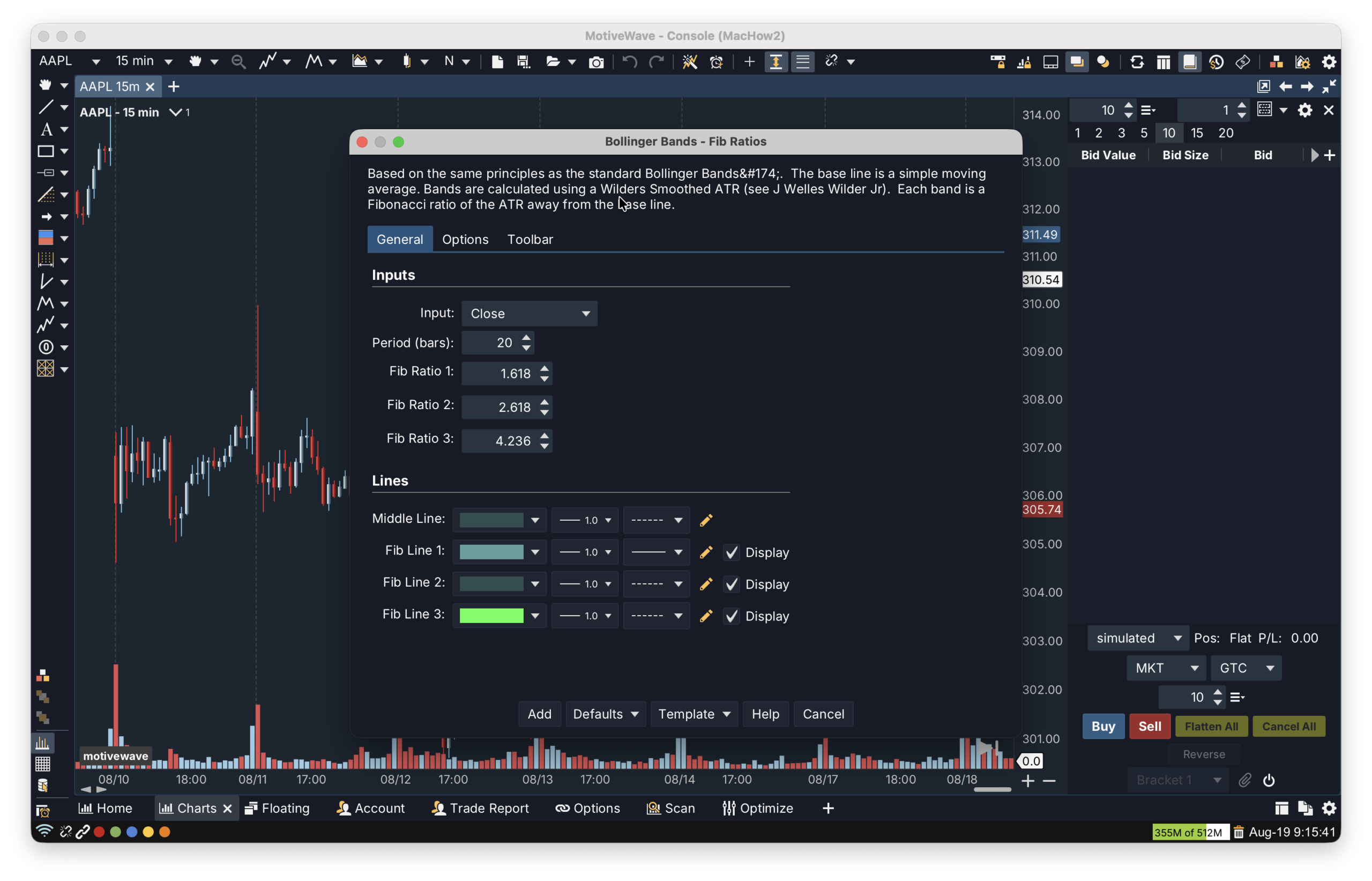
Studies can be saved as templates and applied to other charts.
Chart linking is particularly useful when working with several timeframes. You can link charts by instrument so that changing the symbol updates every linked chart while retaining its timeframe. Alternatively, you can link them by timeframe and change the interval across several different instruments simultaneously.
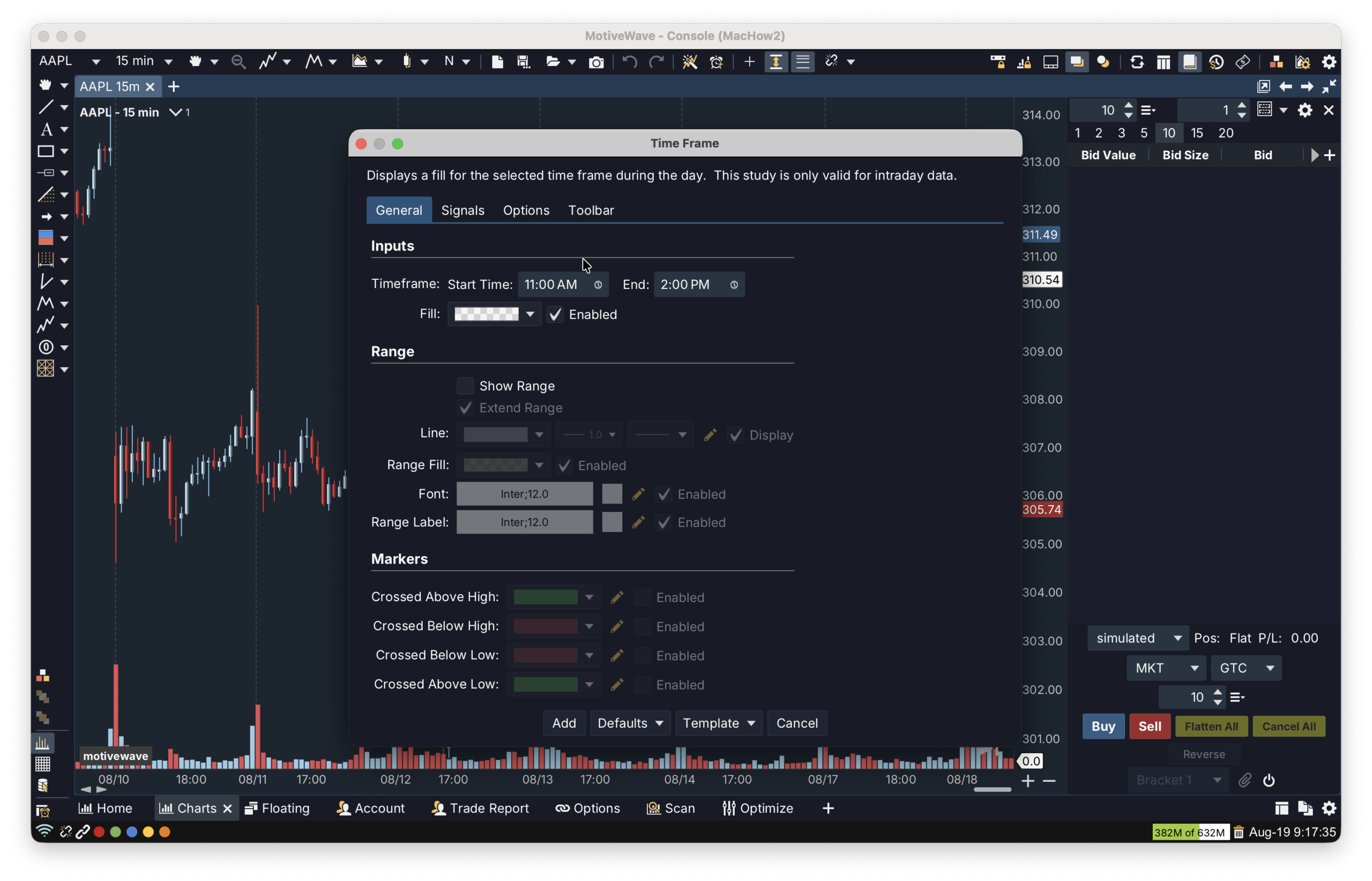
Timeframe visibility controls also allow you to show an annotation or drawing only on specific intervals. This helps prevent charts becoming cluttered when moving between short- and long-term views.
Our Charting Experience
During testing, I created numerous charts using various timeframes and chart types.
Chart rendering was smooth as was zooming through years of historical data.
Adding studies was straightforward, while editing settings and saving templates took little effort.
Adding indicators is also easy with the ability to customize methods, smoothing factors and periods.
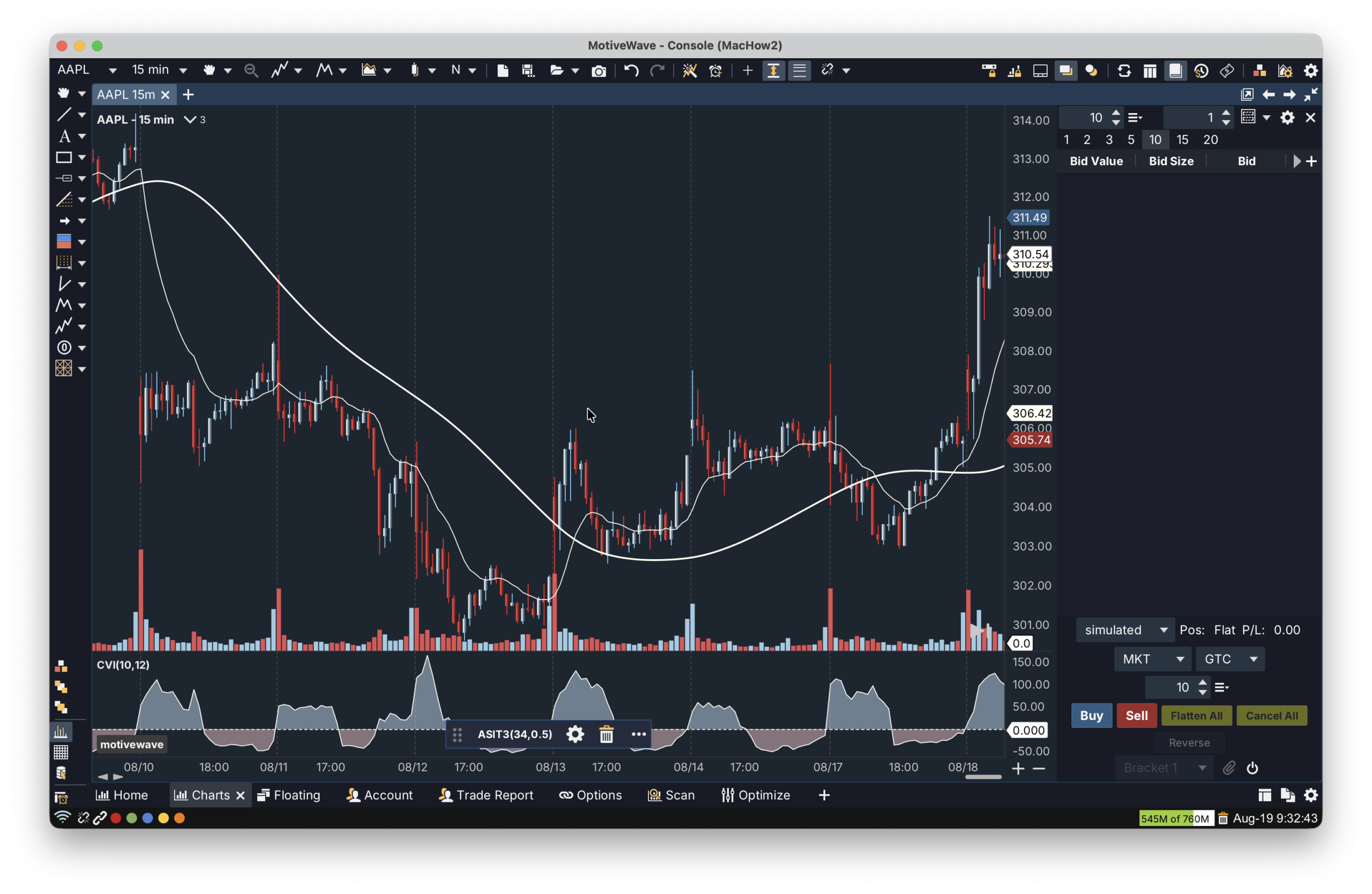
Compared with TradingView, MotiveWave’s charts felt more configurable although I would say less intuitive.
Order Flow Analysis
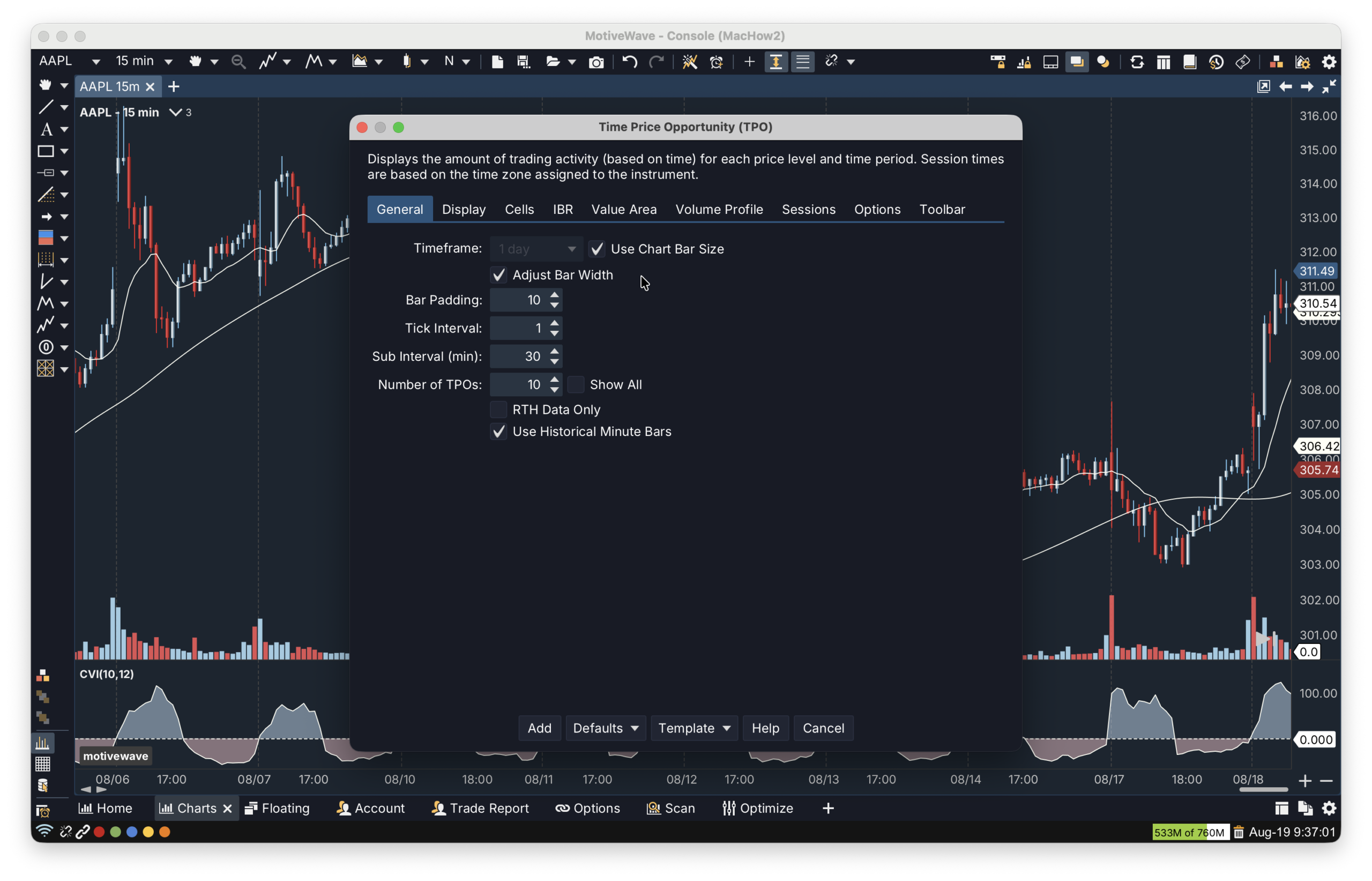
Order flow is one of the main reasons to choose MotiveWave over a simpler charting platform.
The Community, Standard and Elliott Wave Lite editions include only basic order-flow tools such as VWAP, Volume Profile and a basic DOM.
The full order-flow package is included with Order Flow, Professional and Ultimate.
This adds:
- Advanced Depth of Market
- Volume Imprint
- TPO or Market Profile
- Bid/Ask Volume
- Cumulative Delta
- Delta Volume
- DOM History
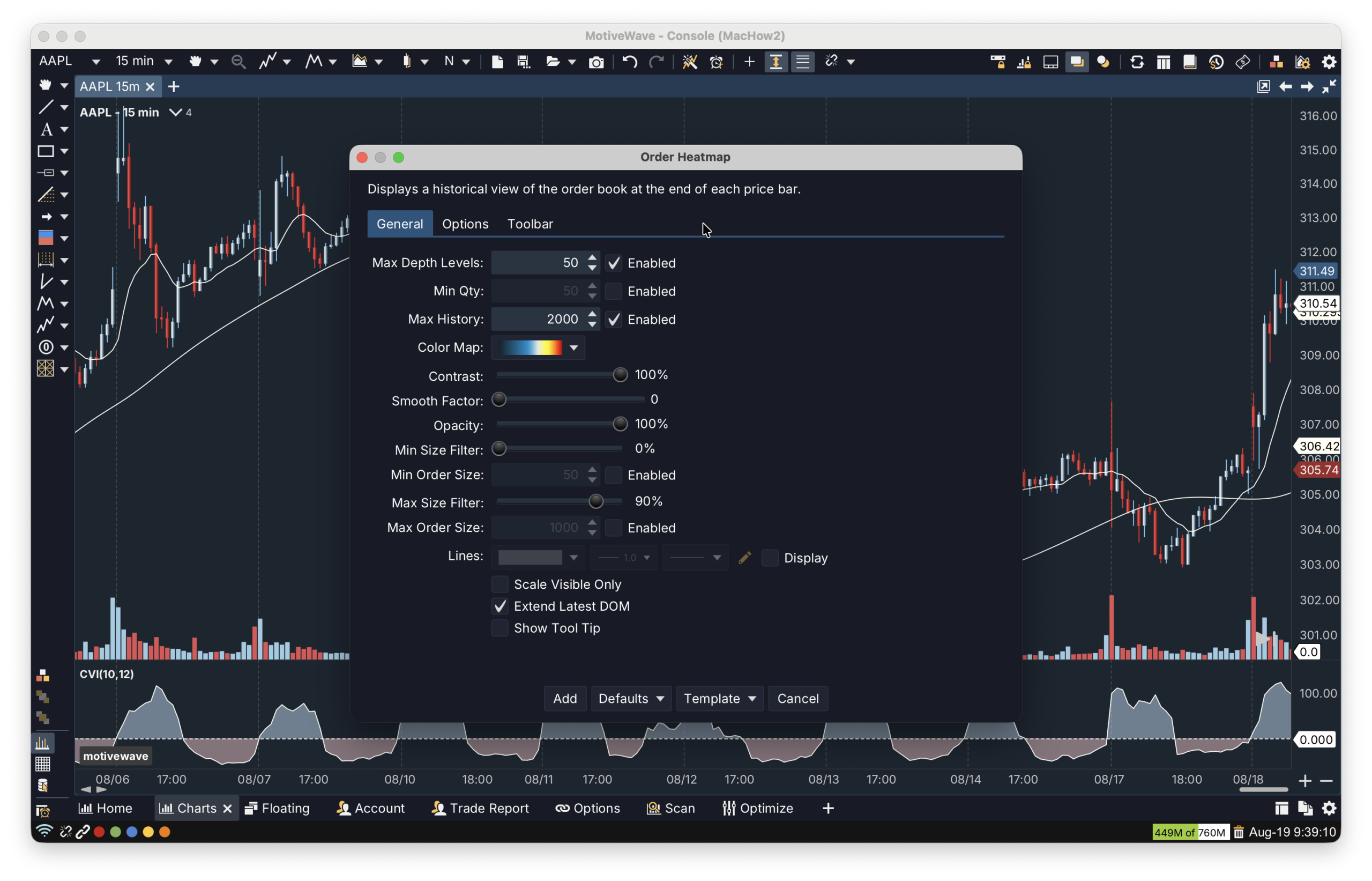
- Order Heatmap
- Big Trades
- DOM Power
- Speed of Tape
- Speed Gauge
- Time and Sales
- Volume Profile, Delta Profile, TPO and VWAP components
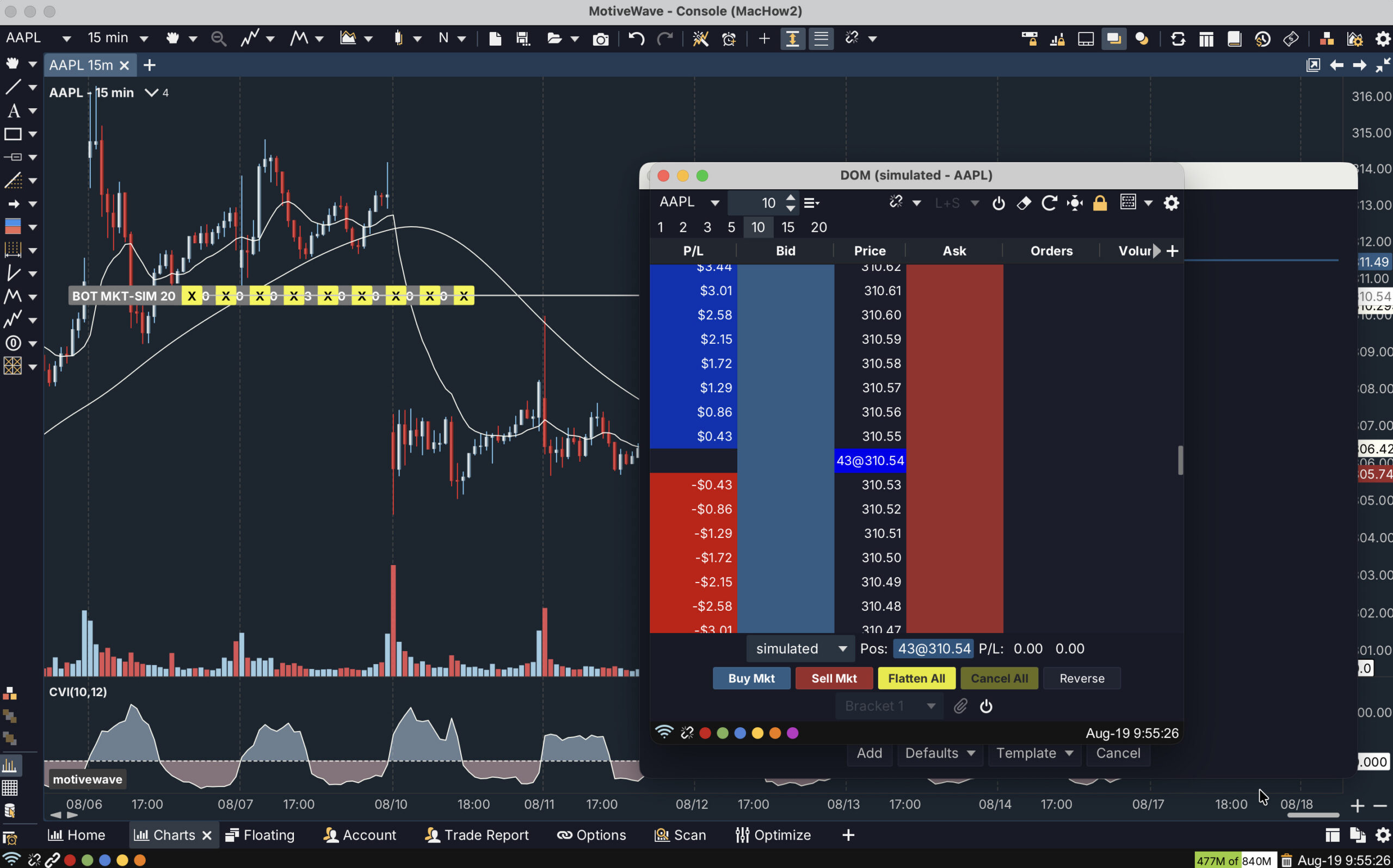
The advanced DOM can display recent trades at the bid and ask, pulling and stacking, separate bid/ask volume profiles, Market by Order data and position in queue.
Some of these features depend on the data provider. Market by Order, full market depth and position-in-queue information are not universally available.
The Order Heatmap also requires a connection that supplies the necessary order-book data. If the heatmap is blank, the problem may be the data connection rather than MotiveWave itself.
Our Order Flow Experience
I tested MotiveWave’s order-flow tools using [insert instrument and data feed].
The Volume Imprint was clear and highly customizable, while the advanced DOM was responsive and clearly readable.
The Order Heatmap showed liquidity clearly and there was no major slowdown or spike in resources used on my Mac however much I customized this.
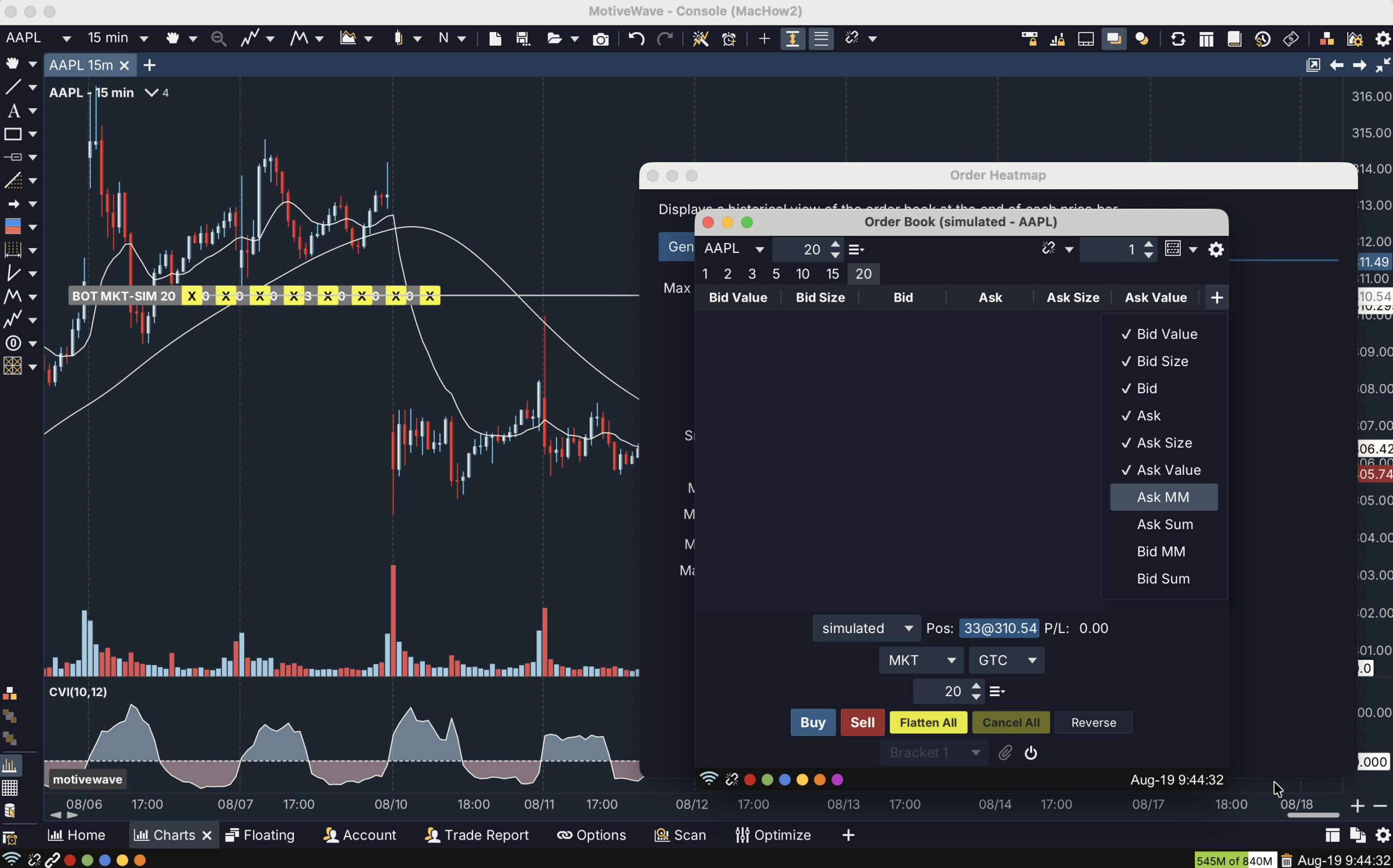
In broker testing, the DOM matched the broker platform in terms of prices, depth and recent trades.
The historical order flow data did seem to only accumulate after the workspace was opened though rather than back-filling.
The heatmap contrast control was also useful and colours remain readable in both light and dark layouts.
Elliott Wave Analysis
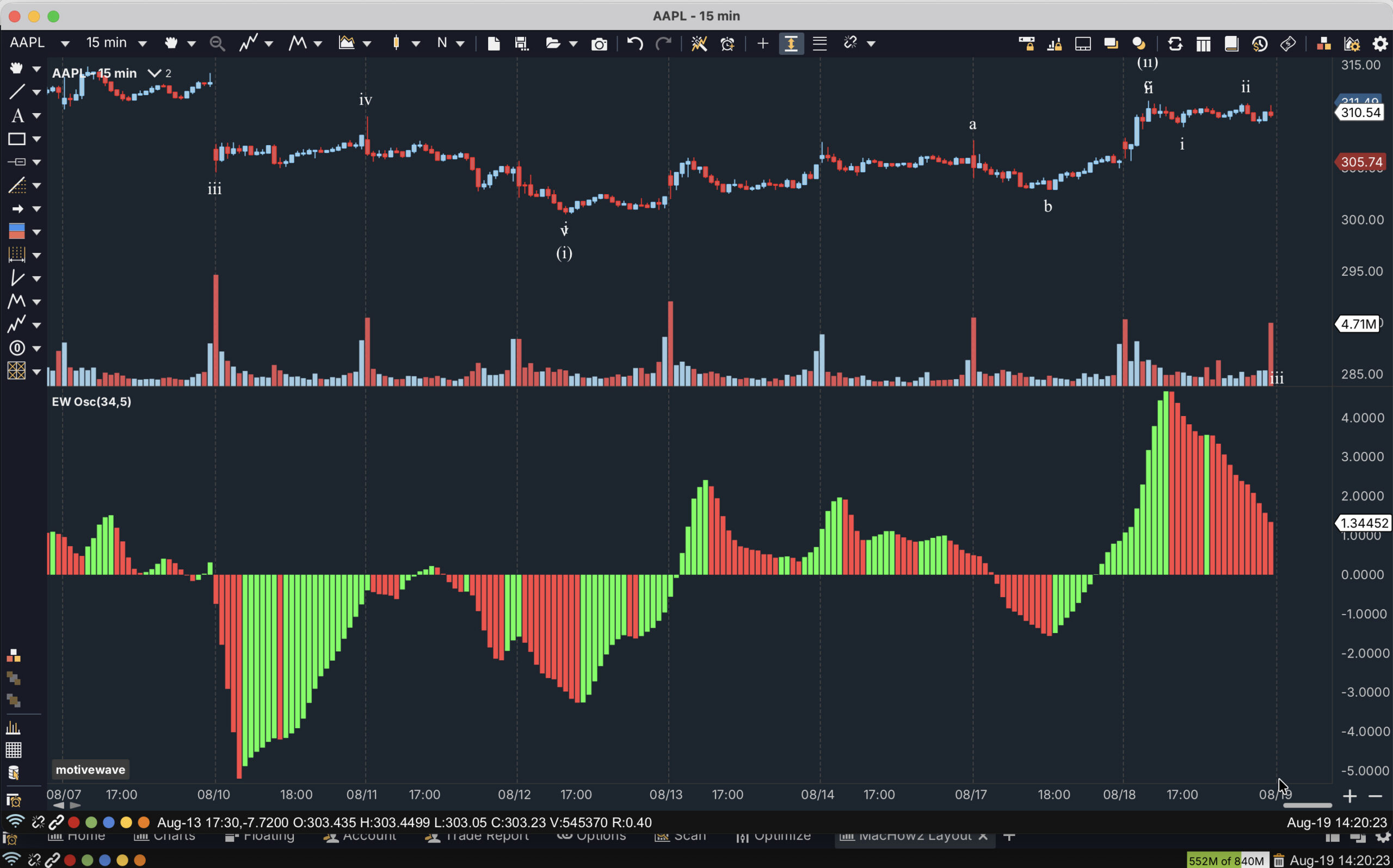
MotiveWave is particularly well known for its Elliott Wave tools.
These are only included in the Elliott Wave Lite and Ultimate editions. Note that the Professional edition does not include the Elliott Wave package.
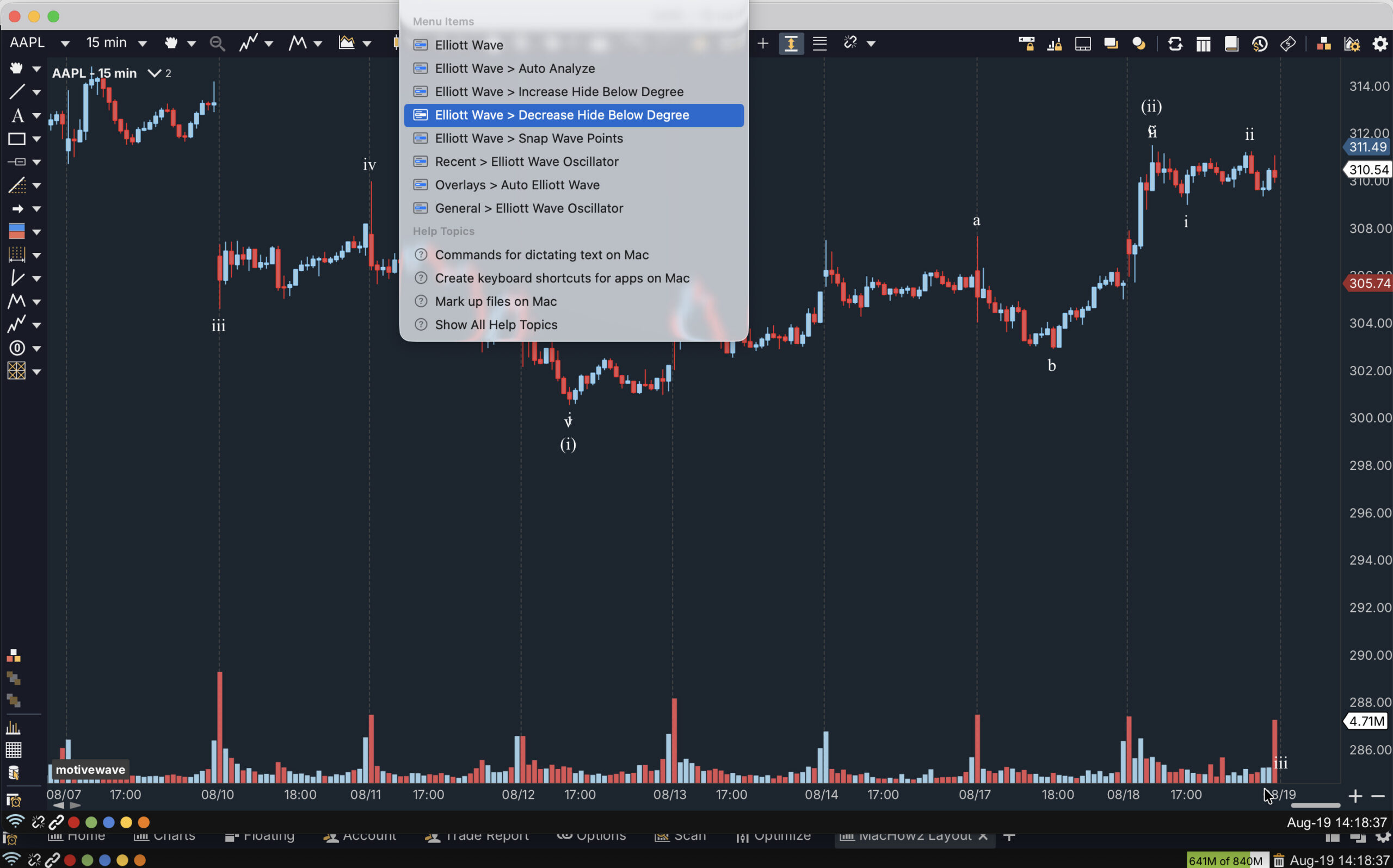
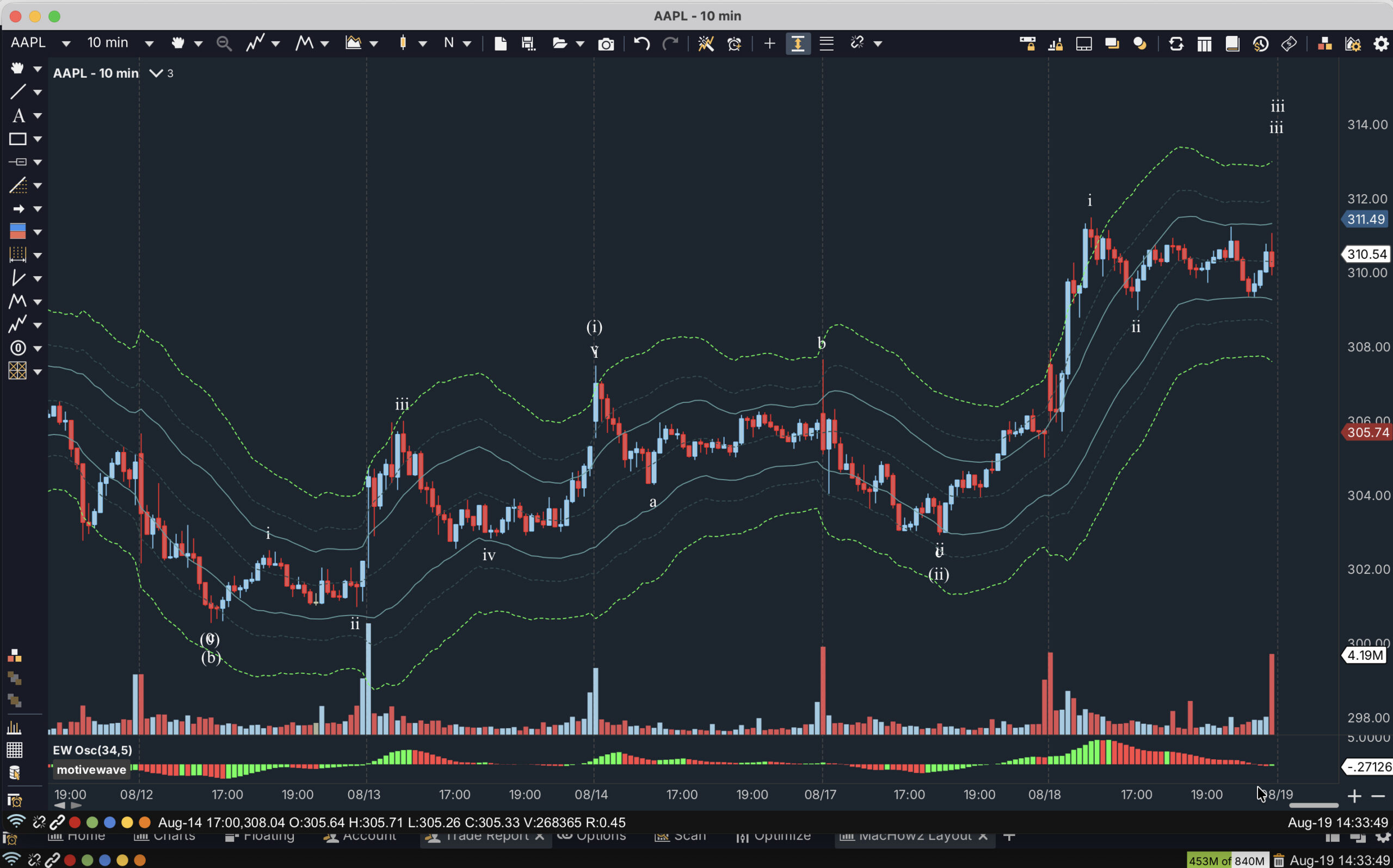
The tools support manual, semi-automatic and automatic Elliott Wave analysis.
When drawing a wave manually, MotiveWave adds the appropriate labels and warns you if the pattern breaks an Elliott Wave rule or guideline.
The Auto Analyze tool can plot an initial wave count over a selected date or data range. The Auto Elliott Wave study can then update the analysis as new bars are created.
Other capabilities include:
- Bullish and bearish wave patterns
- Multiple pattern degrees
- Automatic labels
- Wave composition and decomposition
- Alternative wave counts
- Price and time ratio analysis
- Fibonacci relationships between waves
- Automatic pattern updates
Ultimate also includes the Elliott Wave Scanner, which searches multiple instruments and bar sizes for selected wave patterns.
This is a much more specialized implementation than simply drawing and labelling waves manually on a normal chart.
Our Elliott Wave Experience
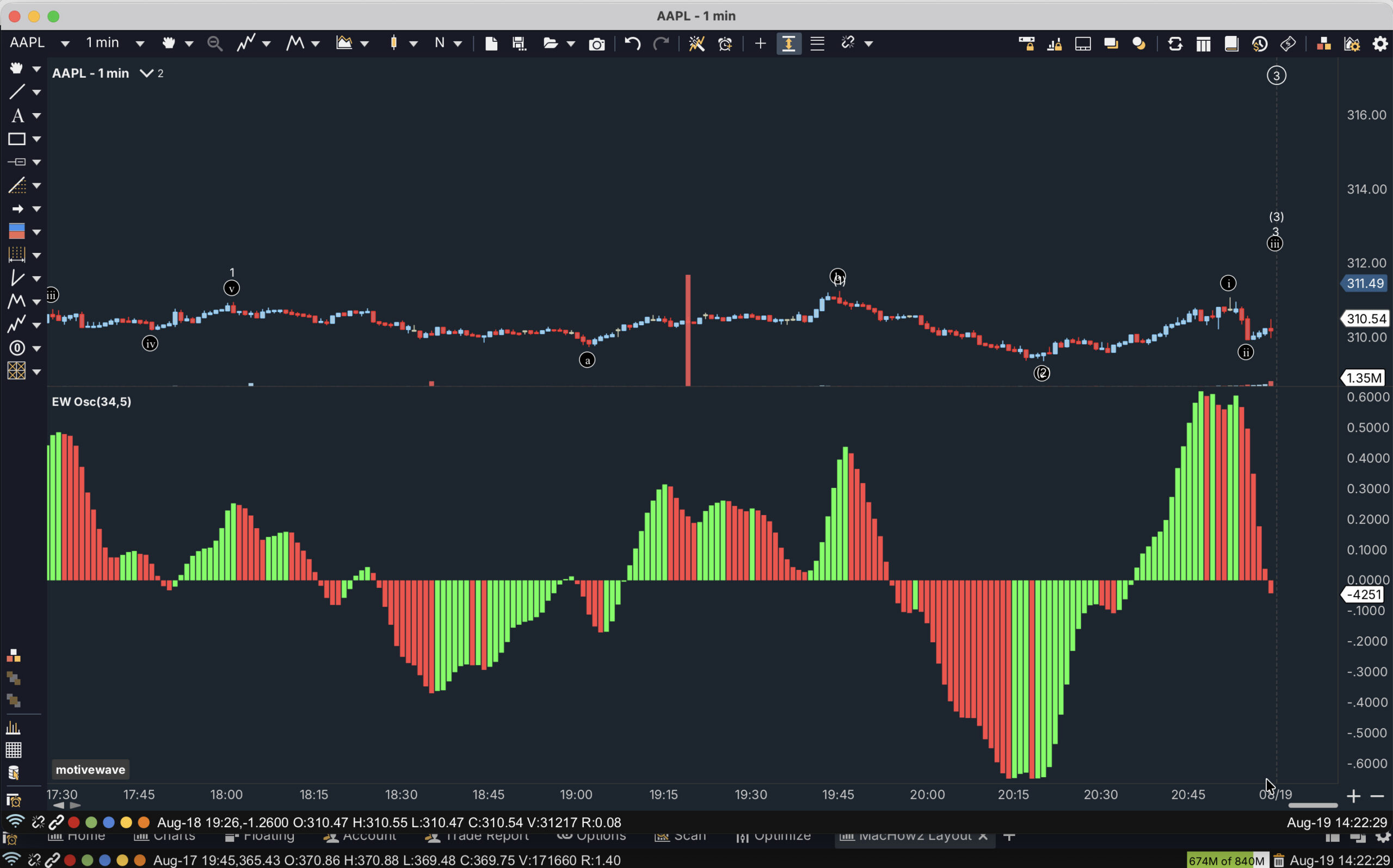
I tested Auto Analyze and configured the exact Bar Size, Start Date, Maximum Bars and Decompose Levels.
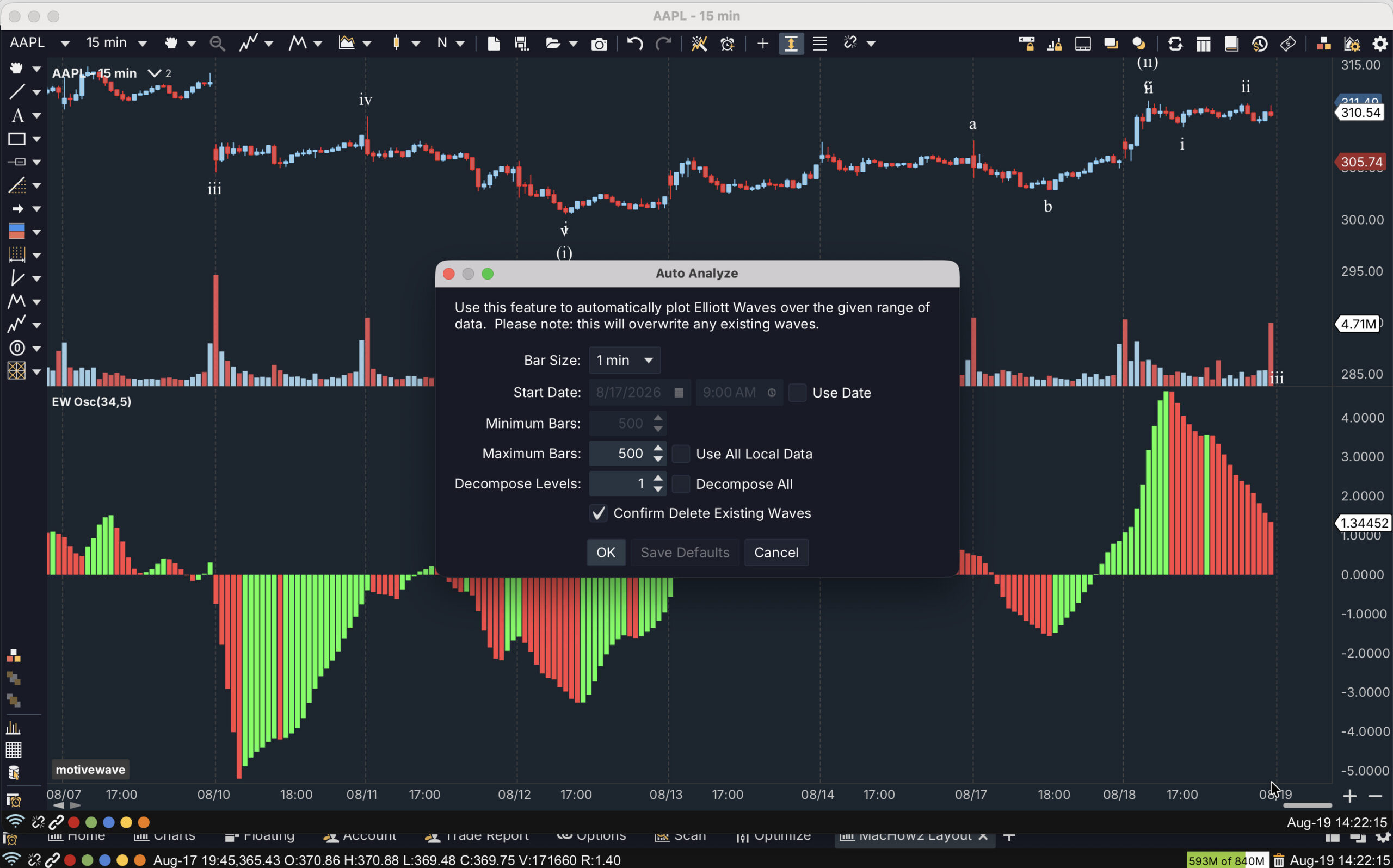
MotiveWave produced the analysis in seconds. Adjusting the start point, data range or date also updates the automated count instantly.
I also tried deliberately to place an invalid pattern and MotiveWave correctly identified it as a rule violation.
Fibonacci, Harmonic, Gann and Hurst Tools
MotiveWave also provides a wide selection of specialist analysis tools.
Its Fibonacci tools include retracements, extensions, expansions, circles, fans, arcs, spirals, wedges, ranges and time ratios.
Manual harmonic tools cover patterns such as:
- Gartley
- Butterfly
- Crab and Deep Crab
- Bat and Alternate Bat
- Shark
- Cypher
- AB=CD
- 5-0
- Three Drives
Professional and Ultimate add automatic harmonic detection and a Harmonic Scanner.
The Gann package includes angles, arcs, circles, wedges, boxes, grids, time ranges, rotatable squares and Pyrapoint tools.
Hurst Cycles analysis is limited to the Ultimate edition.
Trading With MotiveWave
Live trading is available in every paid edition, starting with Standard. The free Community edition does not support live trading.
Once connected to a supported broker, you can place orders from:
- A chart or price axis
- The Trade Panel
- The DOM
- Buy and Sell boxes
- Watchlists
- Alerts
- Accounts and Orders panels
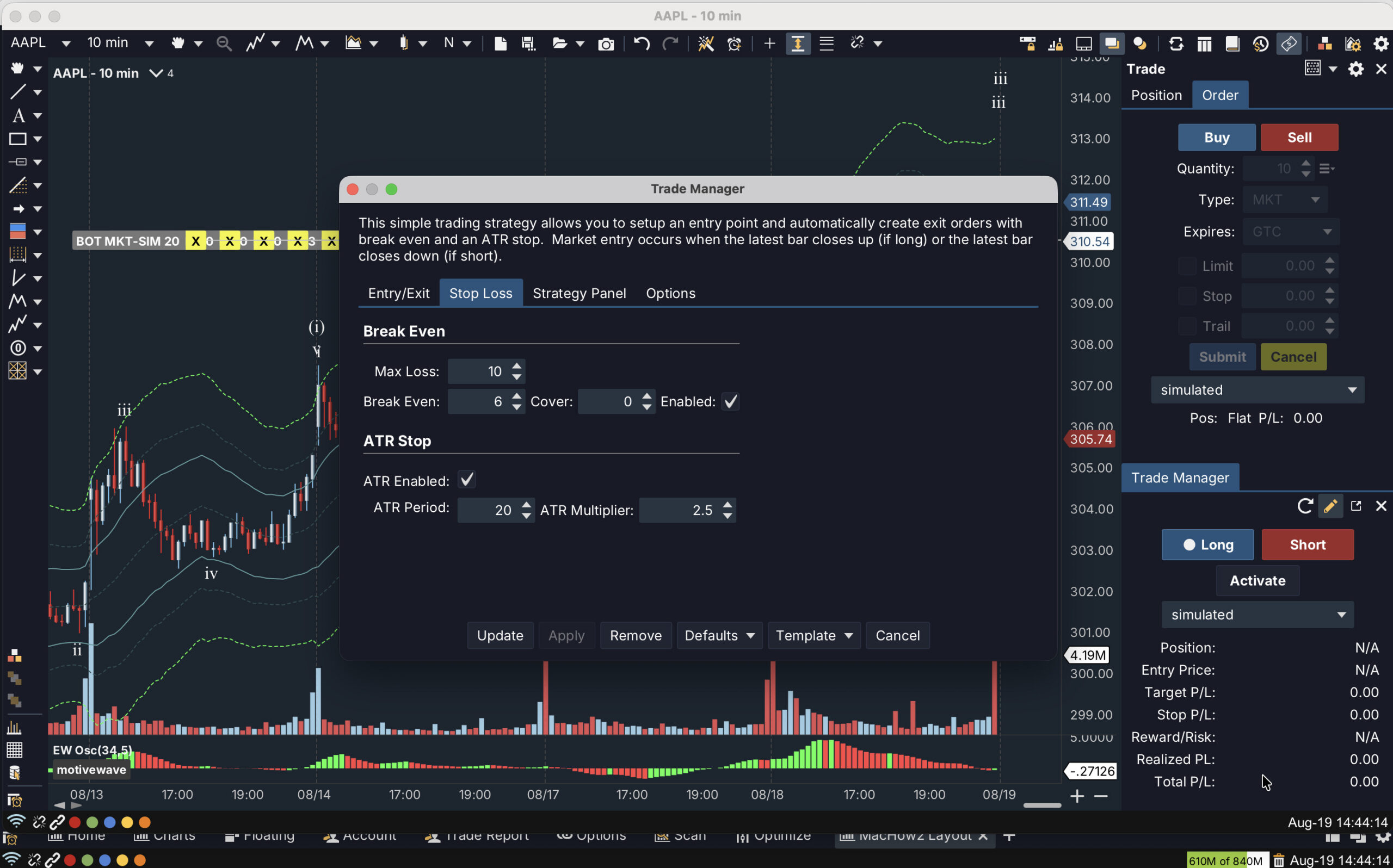
Open orders can be moved or cancelled directly from a chart. MotiveWave also supports order presets, keyboard shortcuts and exit strategies.
The exact order types and whether exit strategies are held at the broker or simulated locally depend on the connection.
MotiveWave sends the orders to your broker; it does not execute or hold them itself.
Trade Copier
The Trade Copier is included with Order Flow, Professional and Ultimate.
Order Flow can copy trades between multiple accounts held under one connection with the same broker. Professional and Ultimate can copy across different brokers because they support multiple connections inside one workspace.
This distinction is important if you manage accounts across several providers.
Our Trading Experience
I tested trading through Interactive Brokers.
Placing an order from the chart was simple and changing or cancelling it took seconds. Account balances, positions and profit/loss figures matched the broker’s platform.
The available order types included Market, Limit, Stop, Stop Limit, MIT (Market-if-Touched), and Trail (Trailing Stop).
Replay and Simulated Trading
MotiveWave includes both replay and live simulation modes.
Replay Mode allows you to return to a previous date and play market data forward tick by tick, bar by bar or continuously.
You can:
- Select a specific date and time
- Step through individual ticks
- Advance to the next bar
- Reproduce the original delay between ticks
- Increase or reduce replay speed
- Link several charts to the same replay session
- Place simulated orders using a replay account
The Community edition includes Basic Replay, while the paid editions include Advanced Replay.
There is also a simulated account for practising with live data. This is useful for testing layouts, order presets and trading ideas before connecting a live account.
Alerts
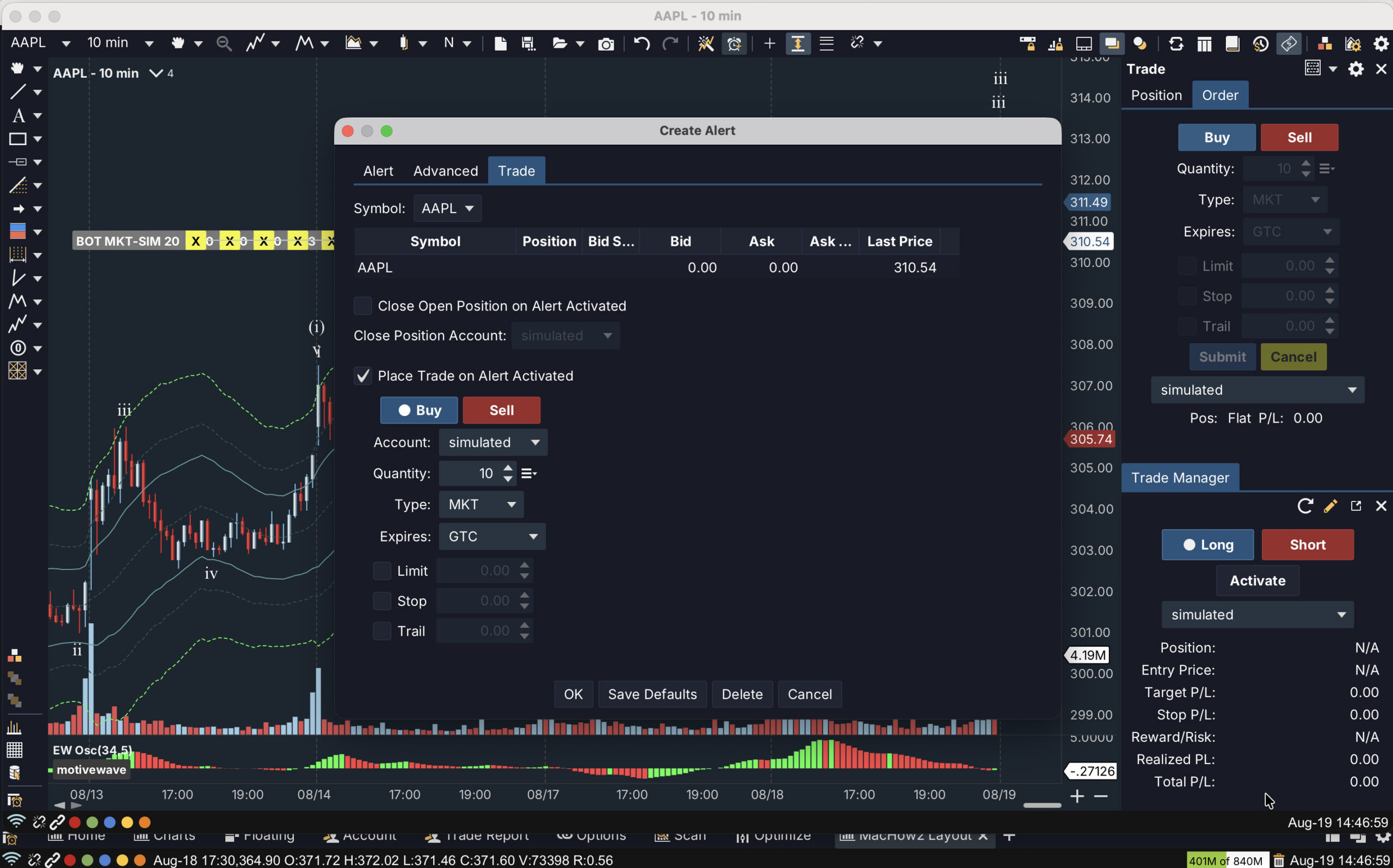
MotiveWave supports price, study and component alerts.
Price alerts can trigger when an instrument reaches a specified bid, ask or last price. Study alerts compare indicator values, while component alerts can react to events such as price or a moving average crossing a trend line.
Version 7 changed how some study and component alerts load. They may not initialize until a chart for the relevant instrument has been opened and its historical data has loaded.
If you rely on an alert, leave an active chart open and verify it before assuming it will run unattended.
MotiveWave warns you that the application must be running on your Mac for alerts to be triggered.
Strategies, Backtesting and Scanners
Strategy backtesting is only available in Professional and Ultimate.
These editions include more than 30 built-in strategies, along with:
- Automatic and manually triggered strategy execution
- Historical backtesting
- Exhaustive optimization
- Genetic optimization
- Walk-forward testing
- Trade and execution reports
- Performance metrics
- Charts showing historical entries and exits
- Period-based analysis
The Study Scanner can search lists of instruments and timeframes for conditions based on study values. Professional and Ultimate also include automatic harmonic scanning, while the Elliott Wave Scanner is exclusive to Ultimate.
Backtesting is one of the biggest reasons to choose Professional instead of Order Flow. However, the result is only as useful as the historical data, costs, slippage assumptions and strategy design used.
Java SDK
All editions include MotiveWave’s Java SDK for creating custom indicators, studies and strategies.
Community, Standard, Order Flow and Elliott Wave Lite can run and test custom studies or indicators, but they do not include strategy backtesting.
Professional and Ultimate can test custom SDK strategies as well.
This is powerful, although Java is less accessible to casual users than TradingView’s Pine Script.
Performance on Apple Silicon
MotiveWave offers a dedicated Apple Silicon installer, but performance will still depend on the number of charts, studies, instruments and tick-data streams in your workspace.
A straightforward charting workspace should not challenge a recent M-series Mac. Order Heatmaps, large tick histories, scanners, backtests and multi-monitor layouts are more demanding but MotiveWave used less than 10% of my M3 MacBook Pro CPU even with these active.
Cloud Workspaces and Backups
Paid editions include Cloud Workspaces that store workspace data and settings on MotiveWave’s servers while retaining a local copy for offline access.
Changes made offline are synchronized when the workspace next opens online.
MotiveWave can also back up a workspace to a local file. The Repository feature provides another way to store and transfer selected workspaces using a local database or synchronized folder.
For a trading platform containing extensive layouts, drawings and custom settings, regular backups are essential – especially before installing a major update.
Our Synchronization Experience
I opened the same cloud workspace on another Mac. Charts, drawings and settings synchronized correctly after approximately a few seconds.
However, you can’t use the same licence on both computers simultaneously – you can only use syncing for switching device purposes.
MotiveWave Mobile App
MotiveWave also offers a companion app for iPhone, iPad and Android devices.
The mobile app includes charting, trading, DOM and selected order-flow tools. However, its connection support is currently far more limited than the desktop app and focuses on Rithmic and CQG.
Pricing is handled separately through the Apple App Store and Google Play.
It may be useful for checking positions away from your Mac, but you should confirm that it supports your broker before treating it as part of your trading setup.
MotiveWave Pricing
MotiveWave is available in six current editions.
Prices are in US dollars and regional taxes may be added. The following were correct at the time of writing, but you can find the latest MotiveWave pricing here.
| Edition | Monthly lease | 3-month lease | 6-month lease | One-time licence | Updates after year one |
| Community | Free | – | – | – | Free updates; forum support |
| Standard | $24 | $69 | $135 | $245 | $55/year |
| Order Flow | $49 | $140 | $270 | $595 | $105/year |
| Elliott Wave Lite | $89 | $250 | $475 | $1,395 | $205/year |
| Professional | $99 | $295 | $565 | $1,495 | $225/year |
| Ultimate | $159 | $455 | $875 | $2,295 | $295/year |
Order Flow, Elliott Wave Lite, Professional and Ultimate can also be purchased in four installments, but the total is higher than paying upfront.
A Purchased Licence Is Not the Same as Lifetime Updates
MotiveWave refers to its upfront option as a Purchased Licence, not a lifetime subscription.
It includes one year of software updates and support.
After the first year, you can either:
- Continue using the version available when your update period expired without paying again.
- Buy another year of updates and support.
- Renew later without paying for the missing years in between.
This is more flexible than a compulsory subscription, but the ongoing support cost should still be considered.
Active leases always include access to the latest version and technical support.
Lease Versus Purchase
Compared with paying monthly, the upfront licence becomes cheaper after approximately:
| Edition | Approximate break-even point |
| Standard | 10 months |
| Order Flow | 12 months |
| Elliott Wave Lite | 16 months |
| Professional | 15 months |
| Ultimate | 14–15 months |
These figures compare the one-time price with the monthly lease and exclude tax, discounts and data fees.
If you expect to use MotiveWave for several years, purchasing is usually better value. A monthly or three-month lease makes more sense if you are still evaluating the platform or need it temporarily.
The six-month lease does not automatically renew, whereas shorter auto-renewing leases must be cancelled before the next billing date.
MotiveWave generally treats purchases as final because it provides a free trial, so test your broker, data feed and essential tools before paying.
Which MotiveWave Edition Should You Choose?
Community: Best for Free Charting and Learning the Interface
Community includes 280 studies, basic charting, a basic DOM and Replay Mode.
However, it does not support live trading, non-linear bars, cloud workspaces or advanced order flow.
It is useful for learning MotiveWave, viewing historical data and testing basic chart layouts.
Standard: Best for General Charting and Live Trading
Standard is likely to be sufficient for traders who want advanced charting and the ability to place trades through one broker.
It adds live trading, non-linear and second-based bars, advanced replay, simulated trading, trade reports and cloud workspaces.
For most stock or forex traders who do not require advanced order flow, Elliott Wave or backtesting, Standard offers the best value.
Order Flow: Best for Futures and Order-Flow Traders
Order Flow adds the advanced DOM, Time and Sales, Volume Imprint, TPO, Order Heatmap and the full order-flow study pack.
It also includes the Trade Copier for multiple accounts available under one broker connection.
This is probably the best balance of features and price for discretionary futures traders.
Elliott Wave Lite: Best for Elliott Wave Specialists
Elliott Wave Lite combines Standard with MotiveWave’s Elliott Wave tools.
It does not include the complete order-flow package, strategy backtesting, multiple connections or Professional’s scanners.
Choose it only if Elliott Wave analysis is central to your trading. At $89 per month or $1,395 upfront, it is expensive as a general-purpose platform.
Professional: Best for Backtesting and Multiple Connections
Professional includes everything in Order Flow and adds:
- Multiple broker and data connections per workspace
- Strategy backtesting
- Optimization and walk-forward testing
- Study and harmonic scanners
- Automatic harmonic analysis
- Custom instruments
- Custom watchlist columns
- Additional Desktops
Despite the name and price, Professional does not include Elliott Wave analysis. This is an important and potentially confusing limitation.
Ultimate: Best for Traders Who Need Everything
Ultimate combines Professional’s order flow, backtesting, scanners and multiple connections with the advanced Elliott Wave package, Elliott Wave Scanner and Hurst Cycles.
It is the only edition that includes virtually everything MotiveWave offers.
It is also very expensive, so it makes sense only if you will actively use several of its specialist toolsets.
MotiveWave Free Trial
MotiveWave provides a 14-day free trial without requiring a credit card.
The trial normally unlocks Ultimate, giving you access to every feature. When the trial expires, the account automatically changes to the free Community edition unless you purchase another plan.
Be careful when evaluating the trial because many of the most impressive features will disappear on lower editions.
Make a list of the tools you actually use during testing and compare it with MotiveWave’s edition table before deciding which licence to buy.
The trial starts when you register, not when you first install or open the application, so sign up only when you have time to test it properly.
MotiveWave vs TradingView
TradingView is the most obvious alternative for many Mac traders.
Both provide Mac desktop apps, technical analysis, broker connections and strategy testing, but their priorities are different.
| Feature | MotiveWave | TradingView |
| Main format | Professional desktop workstation | Cloud-first charting platform |
| Mac support | Separate Intel and Apple Silicon packages | Web app and Mac desktop app |
| Best for | Order flow, Elliott Wave, DOM, multi-broker workflows | Accessible charting, screeners, cloud access and community |
| Interface | Extremely configurable but complex | Easier to learn |
| Data | Separate broker or data connection required | Broad integrated coverage; some exchanges cost extra |
| Programming | Java SDK | Pine Script |
| Backtesting | Professional and Ultimate | Pine Script strategies |
| Collaboration | Limited analysis sharing | Strong public and social sharing |
| Offline/local workspace | Yes | Primarily cloud-based |
TradingView is generally better for users who want fast, accessible charting from any browser and want community driven trading.
MotiveWave is better suited to traders who need a customizable desktop workstation, sophisticated DOM and order-flow analysis, or its specialist Elliott Wave tools and are comfortable trading on their own.
My advice it try the free limited version of TradingView to see how it compares for you.
Is MotiveWave Worth It?
MotiveWave is worth considering if you want a serious desktop trading platform that runs directly on a Mac.
Its strongest advantages are its order-flow analysis, customizable workspaces, broker-neutral approach and Elliott Wave tools. Few Mac-compatible platforms combine this level of charting and analysis with direct broker execution.
However, it is easy to pay for far more than you need.
Standard is the sensible starting point for most traders. Order Flow is the strongest option for active futures traders, while Professional is primarily justified by backtesting, scanning and multiple connections.
Elliott Wave Lite and Ultimate are specialist products rather than automatic upgrades.
You must also budget for market data. Depending on the exchanges and depth required, data costs may become as significant as the MotiveWave licence itself.
FAQ
Does MotiveWave work on Apple Silicon Macs?
Yes. MotiveWave provides a separate Apple Silicon installer for M-series Macs, along with another version for Intel Macs.
Is MotiveWave a broker?
No. MotiveWave is a charting, analysis and trading interface. Your brokerage account, funds and order execution remain with the connected broker.
Does MotiveWave include market data?
No. You must connect a supported broker or data service, use a trial feed or import historical data.
Can you trade with the free Community edition?
No. Live trading begins with the Standard edition.
Does MotiveWave support Interactive Brokers?
Yes. Interactive Brokers is included on MotiveWave’s current connection list. The connection may require Trader Workstation or IB Gateway, and the availability of real-time or historical data depends on your Interactive Brokers subscriptions.
Can MotiveWave be used on more than one Mac?
You can install it on multiple computers, but a single licence can only be active on one computer at a time.
Does the Professional edition include Elliott Wave analysis?
No. Elliott Wave tools are available only in Elliott Wave Lite and Ultimate. Professional includes order flow, backtesting, scanners and multiple connections.
Is MotiveWave’s one-time licence a lifetime licence?
You can continue using the eligible version without another payment, but only the first year of updates and support is included. Further updates require an optional annual extension.
What happens when the free trial ends?
The 14-day Ultimate trial automatically changes to the free Community edition. No credit card is required when registering.
Is MotiveWave better than TradingView?
MotiveWave is better for advanced order flow, Elliott Wave and desktop trading workflows. TradingView is generally easier to learn and better for browser access, screeners, sharing and community features.
Is MotiveWave suitable for beginners?
Beginners can use the Community or Standard editions, but the interface is complex. It is better suited to traders who already understand technical analysis and know which tools they need.
Does MotiveWave support automated trading?
Professional and Ultimate include strategy execution, backtesting, optimization and walk-forward testing. Custom strategies can also be developed through the Java SDK.
Can MotiveWave trade cryptocurrency?
MotiveWave supports connections including Binance, Kraken and Bitstamp, along with cryptocurrency data from services such as CryptoCompare. Availability may depend on your country and the connection’s current API support.