

Nero Burning ROM is still a Windows application, so there is no native Nero disc-burning suite for macOS. The good news is that most Mac users do not need a full Nero replacement: Finder can burn data discs and disk images, while the Music app can create audio and MP3 CDs.
The choice becomes narrower if you need to create a DVD-Video disc with menus, copy an unprotected disc, convert old home-video footage or burn Blu-ray. In that case, Toast remains the closest Mac equivalent to Nero, while the free app Burn is the better option for simpler jobs.
One important 2026 caveat: Roxio’s public Toast 20 requirements still only list macOS Mojave through Sonoma. Do not assume it is officially supported on the latest versions of macOS including macOS Sequoia, Tahoe or Golden Gate without checking with Roxio first. For a one-off, important disc, test it out thoroughly before committing your only copy of the media.
| Tool | Best for | CD/DVD | Blu-ray | Price |
|---|---|---|---|---|
| Toast 20 Titanium | DVD authoring, menus and an all-in-one media suite | Yes | Optional plug-in | Paid, one-off licence |
| Toast 20 Pro | Blu-ray authoring and burning | Yes | Yes | Paid, one-off licence |
| Burn | Free data, audio and simple video discs | Yes | No | Free and open source |
| Finder and Music | Data discs, disk images and audio CDs | Yes | No | Included with macOS |
1. Toast 20 Titanium: Best For DVD Authoring
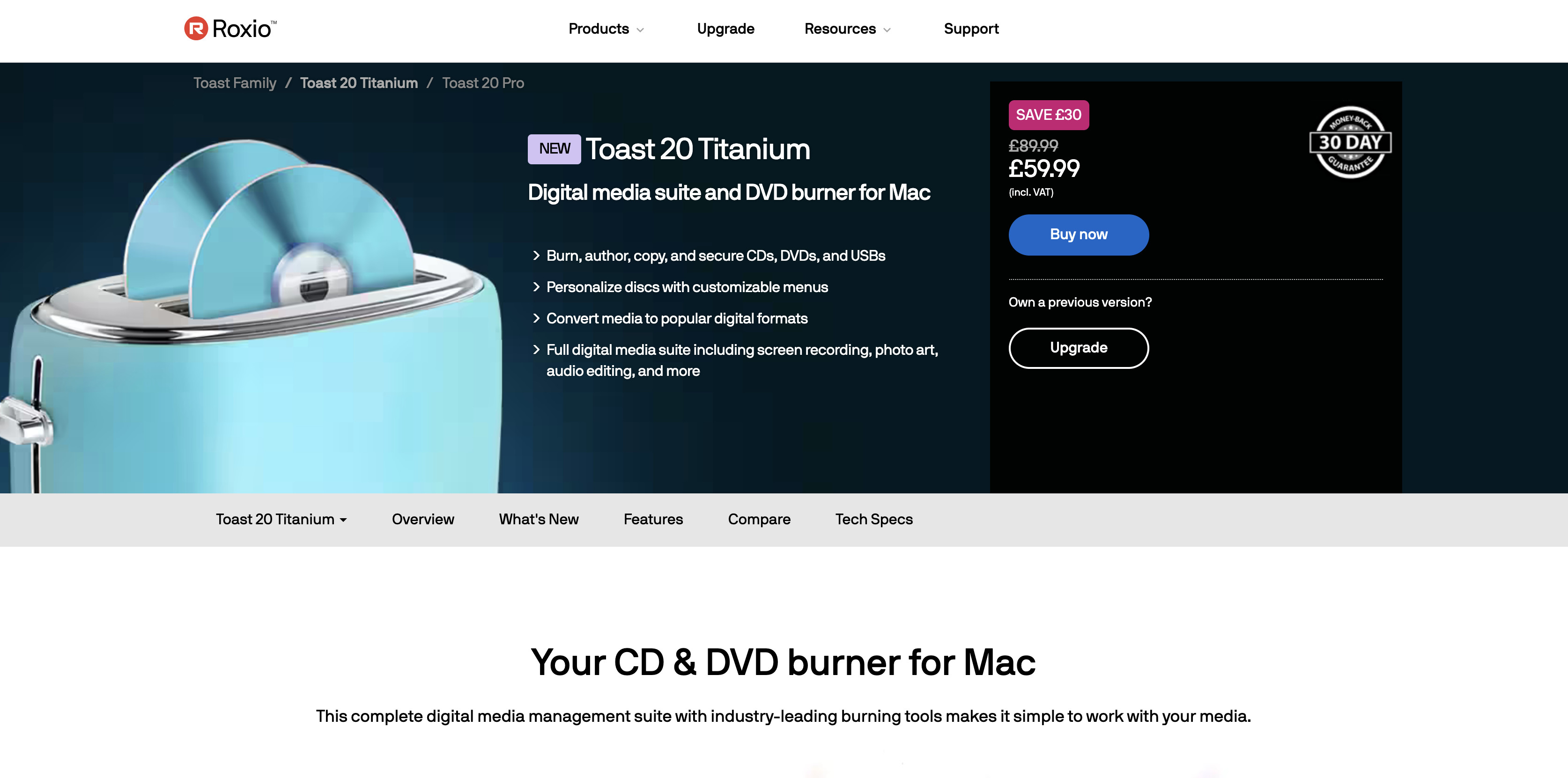
Toast 20 Titanium is still the closest functional replacement for Nero on a Mac. It can burn data CDs and DVDs, create audio discs, copy unprotected discs, convert media files and author DVD-Video discs with chapters and custom menus.
That last point is what separates Toast from the free options. A DVD player cannot simply play any video file dragged onto a disc. To make a DVD that works in a conventional DVD player, the video must be encoded and authored as a DVD-Video project. Toast’s MyDVD tools handle that process and let you add a menu, title screen, background music and chapter points.
Toast also includes useful extras if you are digitising old family media: basic video trimming, screen and webcam capture, audio tools, file conversion, disc-image support and encrypted data discs. It does not copy, rip or convert encrypted or copy-protected DVDs or Blu-rays.
The reason we cannot give Toast an unconditional recommendation for every new Mac in 2026 is support status. Toast 20 is a 64-bit application and Roxio explicitly lists Intel Macs and M1 Macs, but its published compatibility list stops at macOS Sonoma. If your Mac is on Sequoia, Tahoe or Golden Gate, confirm support with Roxio or use its direct-purchase refund policy as a last-resort compatibility check before relying on it for an important project.
Toast Titanium is sold as a one-off purchase rather than a subscription, although the price changes regularly with promotions and region. It is worth paying for if you regularly author home-movie DVDs and your macOS version is officially supported.
2. Toast 20 Pro: Best For Blu-ray Burning
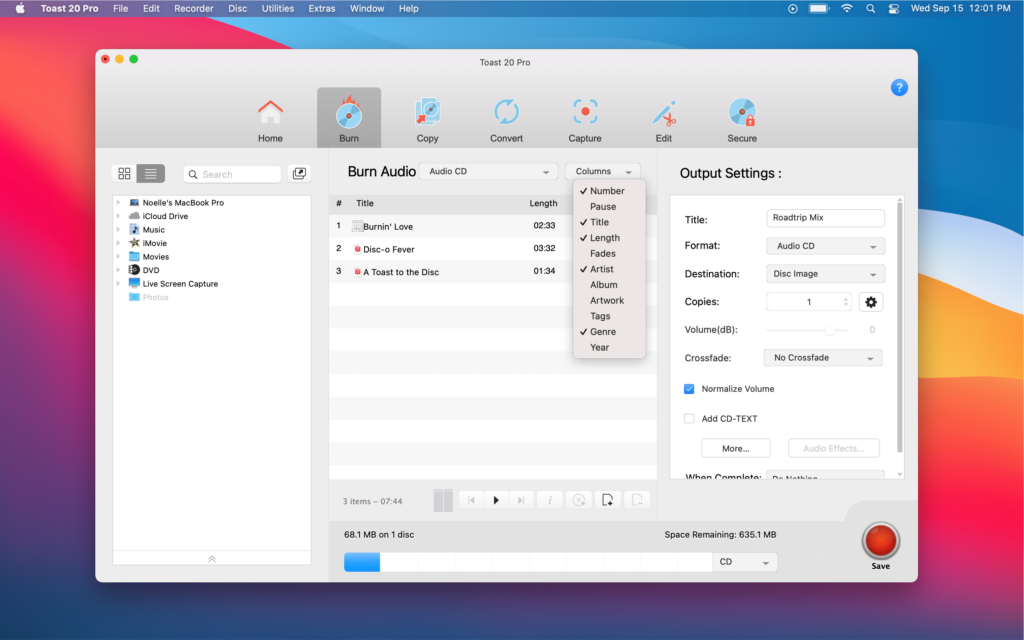
Toast 20 Pro is the version to choose only if you specifically need to burn Blu-ray discs. It includes the Blu-ray plug-in that is an extra purchase with Toast Titanium, as well as a larger collection of DVD menu templates and extra photo, painting and compression apps.
For ordinary CD, DVD and DVD-Video jobs, Titanium is the more sensible purchase. The Pro upgrade makes sense when you need Blu-ray capacity for long HD video projects or archive discs and already have a compatible external Blu-ray writer.
Bear in mind that a Blu-ray writer is different from a standard external DVD writer. A CD/DVD drive cannot burn Blu-ray media, and a disc that plays in one Blu-ray player may not necessarily work in every older player. Use good-quality media and burn a test disc before making multiple copies.
Toast Pro has the same public macOS support caveat as Titanium: Roxio’s current product page formally lists compatibility only through Sonoma. Do not buy it on the assumption that Blu-ray authoring will be supported on a newer macOS release without checking first.
3. Burn: Best Free Nero Alternative for Mac
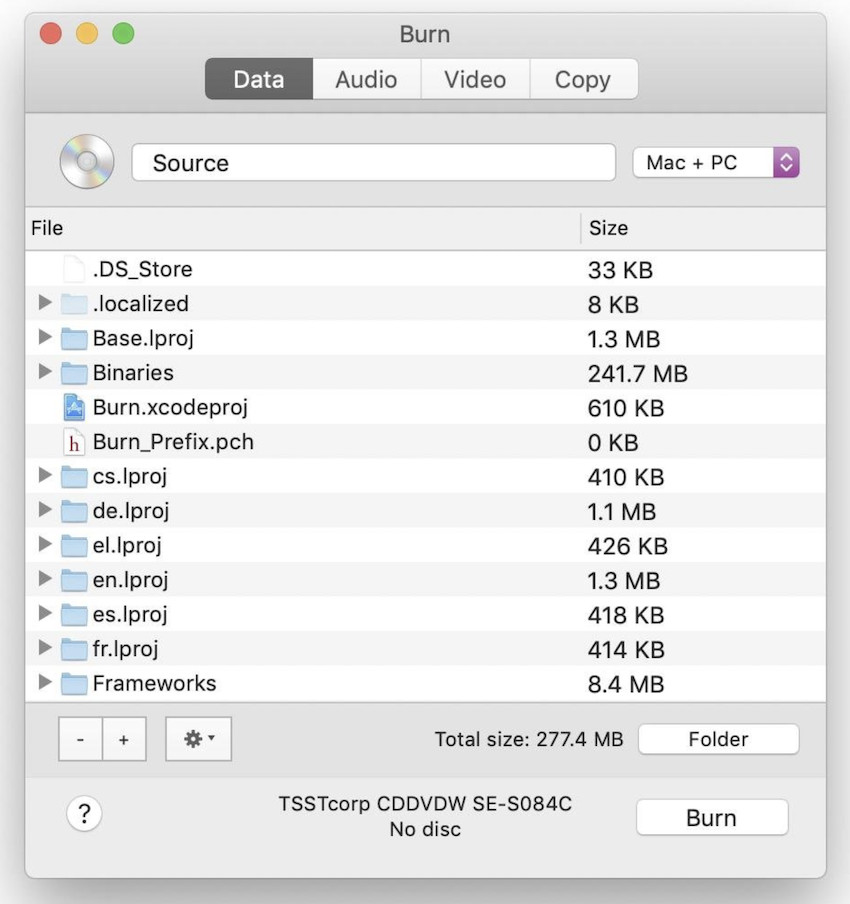
Burn is the best free option if you want a conventional disc-burning app rather than Finder’s basic built-in tool. It can create data, audio and video discs, including DVD-Video projects, and it is considerably more current than many old Mac burning utilities still recommended elsewhere.
The project added Apple Silicon support in version 3.0, received a specific fix for macOS Tahoe in version 3.1.8, and received a further maintenance release in February 2026. That makes it a much safer free recommendation than legacy tools such as SimplyBurns or NTI Dragon Burn.
Burn is deliberately straightforward. It is a good fit for:
- burning a data CD or DVD;
- creating an audio CD from music files;
- making a basic DVD-Video disc from compatible home videos;
- making a copy of an unprotected disc; and
- recreating a disc from an image or existing project.
It is not a replacement for Toast’s polished menu authoring, broader conversion tools, encryption features or Blu-ray burning needs. You should also download it only from the project’s SourceForge page or a trusted package manager, then make a test burn before using it for valuable footage.
4. Finder and Music: Best If You Only Need the Basics
Before installing anything, check whether macOS already does the job you need.
Burn data discs and disk images in Finder
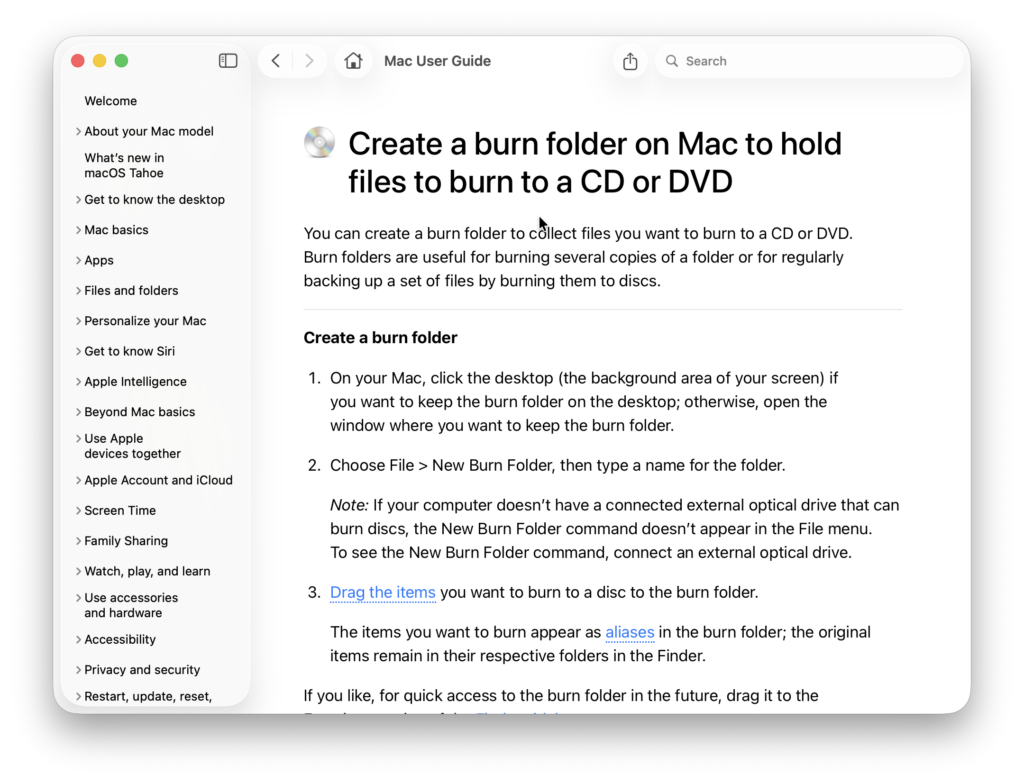
Finder can burn a folder of files to a CD or DVD. Create a burn folder, drag in the files you want, open it and choose Burn. You can also burn an ISO, DMG or other supported disk image by Control-clicking it in Finder and choosing Burn Disk Image to Disc.
This is the simplest choice for moving files between computers or making a physical copy of a small archive. It does not create a menu-driven DVD movie, convert a video into DVD-Video format, burn Blu-ray or give you the disc-copying tools found in Toast.
Create audio and MP3 CDs in Music
The Music app can still create audio CDs, MP3 CDs and data CDs/DVDs from a playlist. Create the playlist, insert a blank disc, then choose File > Burn Playlist to Disc. It includes options such as CD Text, gaps between tracks and Sound Check.
Music can also import an unprotected audio CD into your library. That is normally all you need if you are digitising a personal CD collection; there is no need to install a separate CD-ripping application.
What You Need to Burn CDs, DVDs or Blu-ray on a Mac
No current Mac has a built-in optical drive, so you will need an external one.
- Buy a CD/DVD writer for CDs and DVDs.
- Buy a Blu-ray writer if you need to burn Blu-ray discs; a standard DVD writer cannot do it.
- A USB-C drive is the tidiest option for a recent MacBook, Mac mini, iMac or Mac Studio. A USB-A drive can work through a suitable USB-C adapter.
- If you use Apple’s USB SuperDrive, connect it directly to the Mac or through one of Apple’s supported adapters rather than a display or USB hub.
For backups, do not make an optical disc your only copy. Keep the original files on an external drive or in a properly configured backup system as well. CDs and DVDs are useful for sharing or an extra archive copy, but they are not a substitute for Time Machine or another current backup strategy.
Why iDVD, SimplyBurns and Dragon Burn Are Not Included
iDVD was discontinued long ago. Apple still hosts its final 7.1.2 updater for existing users, but the app belongs to the iLife ’11 era and is not a practical choice for a current version of macOS.
SimplyBurns and NTI Dragon Burn have also fallen behind modern macOS compatibility and are not worth troubleshooting when Burn and macOS’s built-in tools cover the same basic jobs.
There is also no reason to install Windows solely to use Nero. Even if you can pass an external drive through to a virtual machine, you add a Windows licence, hardware-connection and troubleshooting layer for work that native Mac tools can usually handle more simply.
FAQ
Can you run Nero on a Mac?
Not directly. Nero’s main disc-burning software is designed for Windows, not macOS. Nero does offer some separate Mac-compatible apps, but they are not a native Mac version of Nero Burning ROM.
What is the closest Nero equivalent for Mac?
Toast 20 Titanium is the closest match because it combines disc burning, copying unprotected discs, conversion, encrypted data discs and DVD authoring. However, check its current macOS compatibility before buying it for a Mac running Sequoia, Tahoe or Golden Gate.
What is the best free DVD burner for Mac?
Burn is the best free app to try when you need more control than Finder offers. For a data disc or disk image, Finder is simpler. For an audio CD or MP3 CD, use Music.
Can an Apple Silicon Mac burn CDs and DVDs?
Yes. Connect a compatible external optical writer and use Finder, Music or a compatible third-party app. Burn has Apple Silicon support, while Toast’s published requirements explicitly list M1 Macs.
Can I copy or rip a commercial DVD or Blu-ray?
This guide covers your own unprotected discs and media you have the right to use. Commercial DVDs and Blu-rays are commonly protected by encryption, and the apps above do not support copying or converting protected content. Copyright rules also vary by country, so check the rules that apply where you live.
Is a DVD video disc the same as copying an MP4 to a DVD?
No. A data DVD containing an MP4 may play on a computer or a compatible smart player, but a traditional DVD player normally needs a properly authored DVD-Video disc. Use Toast for that, or Burn for a simpler free alternative.
The Bottom Line
For most people, the best Nero alternative is the software already on the Mac: Finder for data discs and images, and Music for audio CDs. If you need a free standalone burner, Burn is the clear choice in 2026 thanks to its current maintenance and Tahoe fix.
For DVD menus, chapters, media conversion and a broader Nero-style toolkit, Toast 20 Titanium remains the strongest Mac option. Choose Toast 20 Pro only when Blu-ray burning is essential. In both cases, check Roxio’s support position first if you are running a post-Sonoma version of macOS.