

Since the release of macOS Catalina, Macs have no longer been able to run old 32-bit Mac applications or games directly.
The last version of macOS capable of running them was macOS Mojave 10.14. From macOS Catalina 10.15 onwards, macOS only supports 64-bit applications.
However, there are still ways to access some older apps and games on a Mac. The best method depends on whether you are trying to run:
- A 32-bit Mac application
- A 32-bit Windows application
- A 32-bit Steam game
These are three different compatibility problems and the same solution will not work for all of them.
Can You Run 32-Bit Apps on a Mac?
Here is the short answer:
| What You Want To Run | Apple Silicon Mac | Intel Mac |
|---|---|---|
| 32-bit Mac app | Not directly supported. Use an updated alternative or remotely access an Intel Mac running Mojave | Run Mojave from another volume, external drive or virtual machine |
| 32-bit Windows app | Use Windows 11 ARM in a virtual machine or try CrossOver | Use a Windows virtual machine, CrossOver or Boot Camp |
| 32-bit Windows Steam game | Try Pixel Port, CrossOver or Windows 11 ARM | Try CrossOver, Windows or Boot Camp |
| 32-bit Mac Steam game | No supported direct method | May run in Mojave, but the Steam client no longer supports Mojave |
The important distinction is that compatibility layers such as CrossOver, Pixel Port, Sikarugir and Porting Kit run Windows software. They cannot open an old 32-bit Mac .app.
Why Did Apple Stop Supporting 32-Bit Apps?
Apple began warning developers about the end of 32-bit application support several years before macOS Catalina was released.
macOS Mojave was the final version capable of running 32-bit applications. According to Apple’s 32-bit compatibility guidance, 32-bit apps are no longer compatible with macOS Catalina or any later release.
Moving entirely to 64-bit software allowed Apple to remove old system components and focus macOS development on newer security, performance and memory-management technologies.
However, it also meant that abandoned applications, games, plug-ins and hardware utilities stopped working.
Office for Mac 2011 is one well-known example. Some older Adobe applications, Aperture, iPhoto, audio plug-ins and games also stopped working, although not all of these were entirely 32-bit. Some were 64-bit applications that still relied on obsolete 32-bit components or frameworks.
If you try to run any of these apps you’ll get an “App is not optimized for your Mac and needs to be updated” error message.
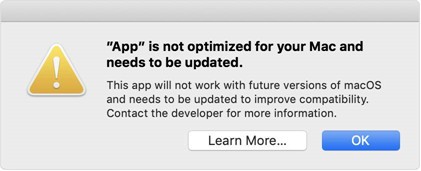
Note that Rosetta does not solve this problem. Rosetta allows Apple Silicon Macs to translate many 64-bit Intel applications, but it does not restore support for 32-bit Mac software.
Here then are 8 ways to use or access 32-bit apps on a Mac in 2026.
1. Look For an Updated Version or Alternative
Before setting up a virtual machine or an old Mac, check whether the developer released a 64-bit replacement.
This is the best long-term solution because it allows you to continue using a fully supported version of macOS without exposing your Mac to the security risks associated with Mojave.
You may find that:
- The original app now has a 64-bit version.
- Another developer has created a modern alternative.
- The service has moved to a web-based application.
- A newer app can import or convert files created by the old one.
- The Windows version of the application still works in a virtual machine.
If you still have access to the old application, export your work into standard formats before upgrading. Proprietary project files can become extremely difficult to recover once the original software no longer opens.
2. Use an Intel Mac Running macOS Mojave
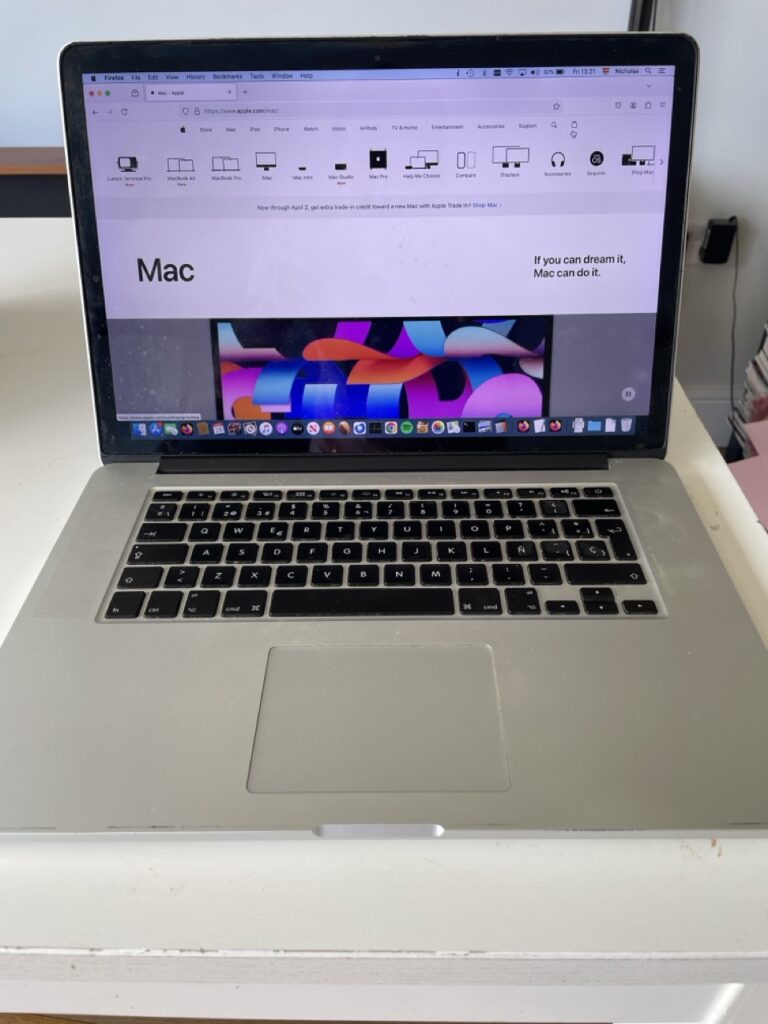
For a genuine 32-bit Mac application, the most reliable solution is still an Intel Mac running macOS Mojave 10.14.6 or earlier.
This can be an old Mac you already own or an inexpensive used model that officially supports Mojave. Apple lists compatible models including many MacBook Air, MacBook Pro, Mac mini and iMac models released from 2012 onwards, as well as the 2013 Mac Pro.
Before buying one, check the official macOS Mojave system requirements. A Mac cannot normally install a version of macOS older than the version it originally shipped with.
You can either use Mojave as the Mac’s main operating system or install it on:
- A separate APFS volume
- A partition
- An external SSD
You can then hold the Option key while starting the Mac to choose between Mojave and your newer macOS installation.
You do not use Boot Camp to create a second macOS installation. Boot Camp is designed for installing Windows on Intel Macs. Use Disk Utility to create another APFS volume or install Mojave on an external drive instead.
Apple provides instructions for using more than one version of macOS and for downloading older macOS installers.
Is It Safe To Use macOS Mojave?
Mojave no longer receives normal security updates and should not be treated as a secure everyday operating system.
If possible:
- Keep the Mojave installation offline.
- Avoid using it for email, banking or general web browsing.
- Do not store sensitive information on it.
- Transfer files using an external drive or a restricted local network.
- Maintain regular backups of the Mac and the application’s data.
It is best to think of a Mojave Mac as a dedicated legacy workstation rather than your main computer.
3. Run macOS Mojave in a Virtual Machine
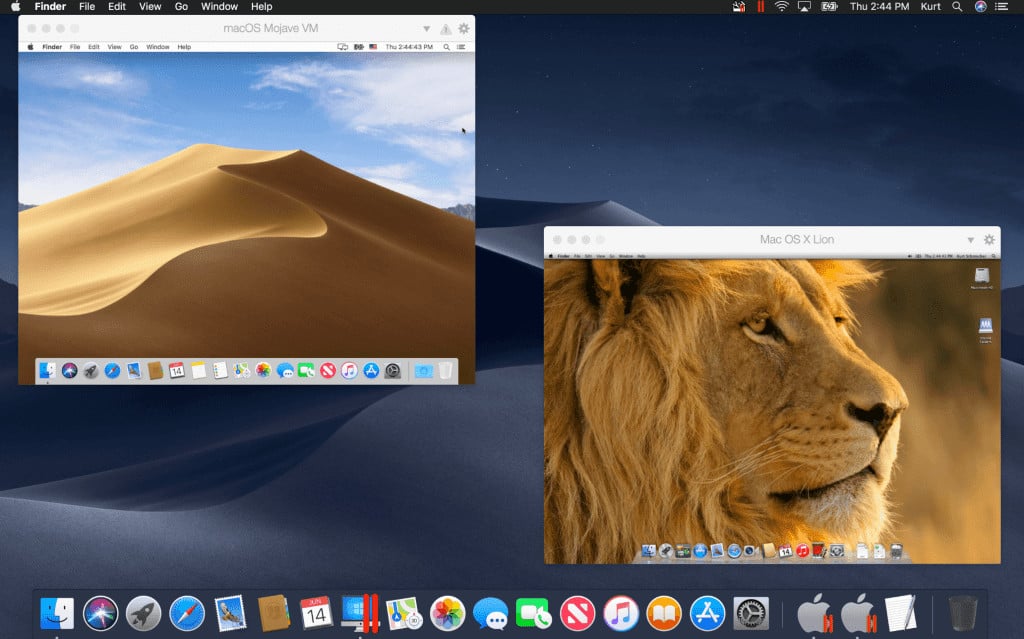
If you have an Intel Mac, you may be able to install Mojave in a virtual machine and run the old application without rebooting.
Older compatible versions of Parallels Desktop and VMware Fusion can run Mojave as a guest operating system on an Intel Mac. You can then switch between your current macOS desktop and Mojave whenever you need the old application.
However, there are several limitations:
- You still need an Intel Mac.
- Current virtualization releases may no longer officially support Mojave.
- Graphics acceleration may be limited, making this unsuitable for some games or demanding creative software.
- Old hardware devices and specialist USB peripherals may not connect correctly.
- You may need an older version of Parallels or VMware Fusion.
You cannot use this method to run Mojave on an Apple Silicon Mac. Parallels states that its Apple Silicon macOS virtualization uses technology introduced with macOS Monterey, so versions earlier than Monterey cannot be virtualized.
VMware Fusion also cannot virtualize an Intel operating system on Apple Silicon. Apple Silicon versions of Fusion can only virtualize ARM-based operating systems.
VMWare Fusion is however free although Parallels is better and currently offers discounts of up to 50% off.
For more information, see our guide to the best virtual machines for Mac.
4. Remotely Access an Old Mac
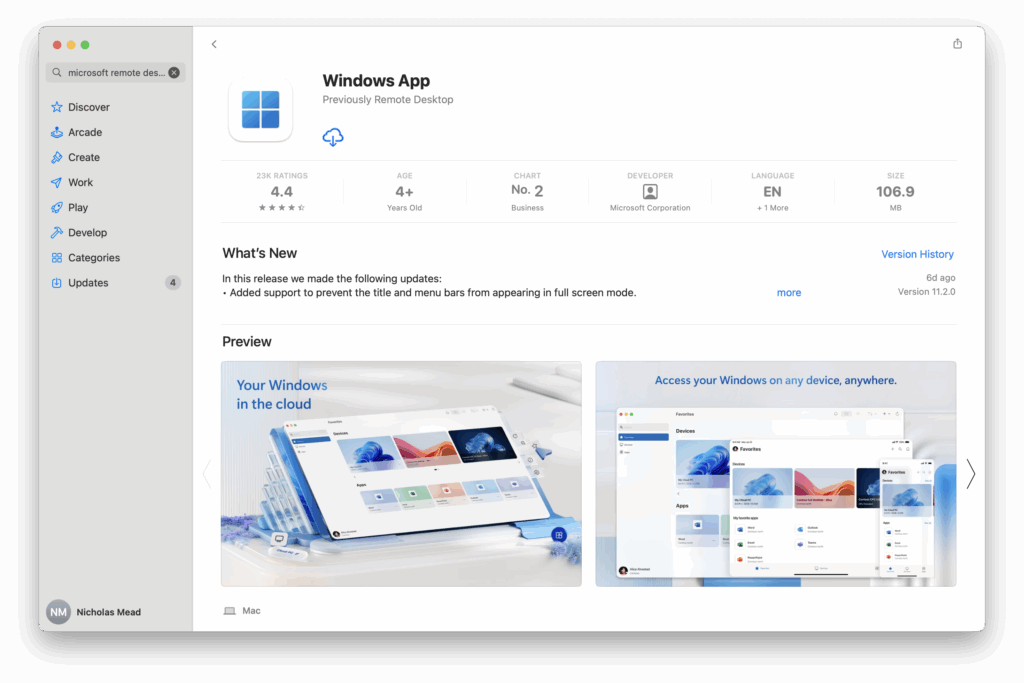
If you already have an Intel Mac running Mojave, you can leave it set up as a legacy computer and remotely control it from your newer Mac using remote desktop software.
This works from both Intel and Apple Silicon Macs because the old application runs on the remote Intel Mac. Your current Mac only displays and controls its desktop.
On a local network, you can use macOS Screen Sharing. For access over the internet, a dedicated remote desktop service is usually easier and more secure than exposing the Mac’s VNC port directly.
This is useful if you only need the old application occasionally and do not want an old Mac permanently connected to another keyboard, mouse and monitor.
Our guide to the best remote desktop software for Mac covers both free and paid options.
5. Run a 32-Bit Windows App in a Virtual Machine
If the program is a 32-bit Windows application rather than a Mac application, the situation is considerably easier.
On Apple Silicon Macs
You can install Windows 11 ARM using Parallels Desktop or VMware Fusion.
Although Windows 11 ARM is a 64-bit operating system, it includes built-in emulation for both x86 and x64 Windows applications. Microsoft confirms that Windows 11 ARM can emulate 32-bit x86 applications.
In many cases, you simply open the old .exe on a Mac inside Windows as you would on a PC.
However, compatibility is not guaranteed. Problems are more likely with software that requires:
- Old Windows drivers
- Specialist USB hardware
- Copy-protection dongles
- Kernel-level components
- Antivirus or system utilities
- Very old 16-bit installers
Windows can translate application code, but drivers must be compiled specifically for ARM64. This is often the reason why an old application runs but cannot communicate with its scanner, printer, audio interface or other hardware.
Parallels is the easiest option to set up, while VMware Fusion is free for personal, educational and commercial use.
On Intel Macs
An Intel Mac can run the standard x64 version of Windows in Parallels, VMware Fusion or another virtual machine. A 64-bit Windows installation normally runs 32-bit Windows software through Microsoft’s built-in WOW64 compatibility system.
Intel Macs can also install Windows using Boot Camp, although Apple only officially supports Windows 10 through Boot Camp. Windows 10 has now reached the end of normal support, so this is no longer the best choice for a computer that will regularly connect to the internet.
6. Use CrossOver For 32-Bit Windows Apps and Games
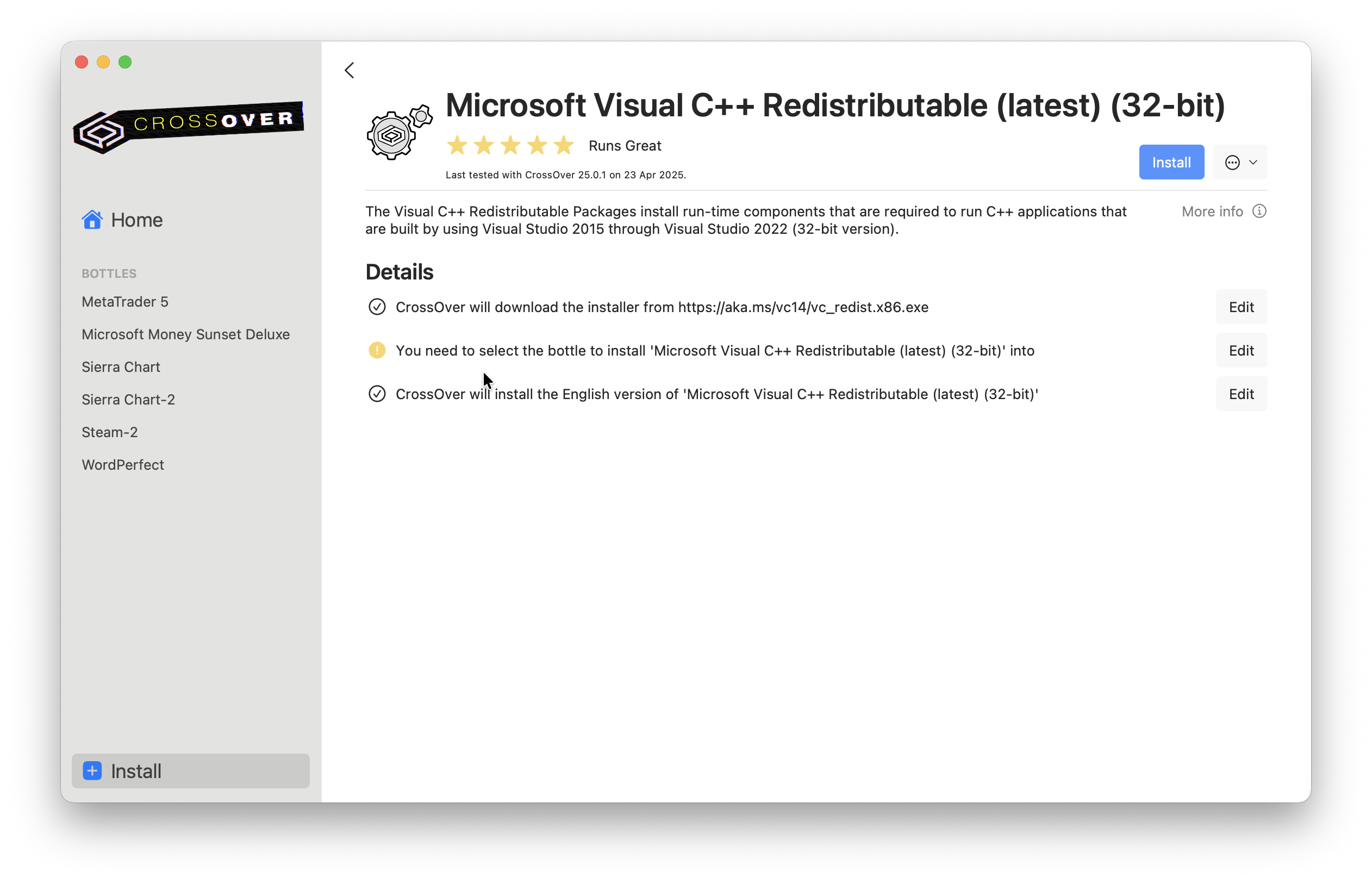
CrossOver allows Windows apps and games to run in macOS without installing Windows.
It does this by installing each application into a self-contained Windows-style environment known as a bottle.
It is important to understand that the bitness of the bottle and the bitness of the application are not necessarily the same. A 32-bit Windows application can often run inside a 64-bit CrossOver bottle.
What Is Changing in CrossOver 27?
CrossOver 26 creates 64-bit bottles by default, but it still has a setting called Enable deprecated 32-bit bottles for software that will not work in a 64-bit bottle.
CodeWeavers has confirmed that CrossOver 27 will completely remove support for 32-bit bottles.
However, this does not mean CrossOver 27 will stop running all 32-bit Windows applications.
CodeWeavers says that almost all 32-bit applications run inside a 64-bit bottle. It is the old 32-bit bottle environment that is being removed, not necessarily the ability to execute 32-bit Windows software.
If you currently have a 32-bit CrossOver bottle:
- Create a new 64-bit bottle in CrossOver 26.
- Reinstall the application in the new bottle.
- Transfer your documents and settings.
- Test everything before upgrading to CrossOver 27.
There is no direct conversion process that can reliably turn every 32-bit bottle into a 64-bit one.
If the application only works in a 32-bit bottle, keep CrossOver 26 installed and do not upgrade it. CodeWeavers says existing CrossOver purchases continue working after the update and support period expires.
CrossOver 27 will also require an Apple Silicon Mac running macOS Sonoma or later. Intel Mac users and anyone who needs a 32-bit bottle will need to remain on CrossOver 26 or use another method.
CrossOver only runs Windows applications. It cannot run Office for Mac 2011, Aperture or another old Mac application.
Crossover isn’t free but you can get 15% off.
7. Use Pixel Port For 32-Bit Windows Steam Games
For older Windows Steam games, Pixel Port is one of the easiest free options on an Apple Silicon Mac – although it is still in beta and prone to bugs.
Pixel Port installs the Windows version of a supported Steam game and automatically configures its compatibility settings. It does not attempt to run the abandoned 32-bit Mac version.
Pixel Port 0.4.2 added DXVK support for 32-bit games, including older titles based on DirectX 8 and DirectX 9.
The main limitations are that Pixel Port:
- Only supports Apple Silicon Macs.
- Requires macOS Sonoma 14 or later.
- Is designed for Steam games rather than general Windows software.
- Does not work with every game.
- May be blocked by anti-cheat or copy-protection systems.
- Is still in beta so may not be stable at times.
Check the game in Pixel Port’s compatibility catalogue before installing it.
8. Try Sikarugir or Porting Kit
Sikarugir is a free, open-source Wine wrapper for running Windows apps and games on macOS.
It is the successor to Kegworks and Wineskin and is actively maintained. It supports macOS Sonoma 14 or later and offers a range of Wine engines and graphics backends.
Sikarugir requires more manual configuration than CrossOver or Pixel Port, but it can be a useful free option for older Windows games.
Porting Kit is another free Wine-based option. It includes preconfigured wrappers for a selection of Windows games and applications and is generally easier to use when the software you want is already included in its database.
Compatibility varies significantly between applications, so neither should be considered a guaranteed way to run every 32-bit program.
What About Whisky?
We no longer recommend Whisky as a long-term solution.
The Whisky project was archived in May 2025 and is no longer actively maintained. Its Wine components will not receive major compatibility updates and apps or games may stop working after future macOS or Steam updates.
An existing Whisky installation may continue working for a particular game, but new users should use CrossOver, Pixel Port, Sikarugir or Porting Kit instead.
Do These Methods Work With 32-Bit Steam Games?
It depends on whether you mean the Mac or Windows version of the game.
32-Bit Mac Steam Games
Steam officially stopped supporting macOS High Sierra and Mojave in February 2024.
Existing Steam installations on Mojave may continue working temporarily, but they no longer receive updates or security fixes and Valve does not guarantee continued access.
This makes an old Mojave installation an unreliable long-term solution for Steam games, even though Mojave itself can run 32-bit Mac software.
If you own a DRM-free standalone version of the game, it may still work directly in Mojave.
32-Bit Windows Steam Games
The Windows version may work through:
- Pixel Port
- CrossOver in a 64-bit bottle
- Sikarugir
- Porting Kit
- Windows 11 ARM in Parallels or VMware Fusion
- Windows on an Intel Mac
Steam stopped supporting 32-bit versions of Windows in January 2026, but Valve confirms that 32-bit games still run on 64-bit Windows.
This means you do not need a 32-bit version of Windows or a 32-bit CrossOver bottle simply because the game itself is 32-bit.
FAQ
Can Apple Silicon Macs Run 32-Bit Mac Apps?
No. Apple Silicon Macs cannot directly run 32-bit Mac applications.
Rosetta only translates supported 64-bit Intel applications. To use a genuine 32-bit Mac app, you need an Intel Mac running Mojave or earlier, either locally or through remote access.
Can CrossOver 27 Run 32-Bit Windows Apps?
In many cases, yes.
CrossOver 27 will remove 32-bit bottles, but CodeWeavers says most 32-bit Windows applications will continue working in 64-bit bottles.
Applications that specifically require a 32-bit bottle will need CrossOver 26, a Windows virtual machine or another compatibility tool.
Can CrossOver Run 32-Bit Mac Apps?
No. CrossOver only runs Windows software.
A Mac application such as Office for Mac 2011 cannot be installed in CrossOver. You would need to use the Windows version of Office or run the original Mac application on an Intel Mac with Mojave.
Is There a Free Way To Run 32-Bit Windows Apps?
Yes. VMware Fusion is free and can run Windows 11 ARM on Apple Silicon Macs or standard Windows on Intel Macs.
Sikarugir and Porting Kit are also free, although compatibility layers are generally less reliable for productivity applications than a full Windows virtual machine.
Is It Safe To Keep Using Mojave?
Mojave is no longer a secure everyday operating system because it does not receive regular security updates.
It is safest to keep it offline and use it only for the specific legacy application you need. Avoid email, general browsing, cloud accounts and sensitive information.
What Is the Best Overall Solution?
For a 32-bit Mac application, use an Intel Mac running Mojave or replace the application with a modern alternative.
For a 32-bit Windows productivity app, Windows 11 ARM in Parallels or VMware Fusion is generally the most reliable option.
For a 32-bit Windows Steam game on Apple Silicon, try Pixel Port first and CrossOver if you need more control or broader compatibility.