

If you’re looking for a better way to brainstorm ideas, plan projects, create roadmaps or organize research, mind mapping software can turn a collection of disconnected thoughts into a clear visual structure.
We tested the best mind mapping software for Mac in 2026, including native Mac apps that work offline and cloud-based platforms designed for collaboration.
Mind mapping tools have also changed significantly because of AI. Many can now generate an entire mind map from a prompt, expand individual branches, summarize documents and convert PDFs, websites, meeting recordings or videos into editable maps.
However, AI is not equally useful in every app. Some products merely generate a basic starting structure, while others can analyze source material, suggest connections and turn completed maps into outlines, tasks or presentations.
After comparing the latest Mac apps and online tools, we found MindNode the best overall mind mapping software for Mac. XMind is the strongest alternative if you want more extensive AI tools, while Miro remains our top choice for collaborative brainstorming.
Quick Recommendations
If you don’t want to read every review, these are our top choices:
- Best Overall Mac App: MindNode
- Best AI and Offline Combination: XMind
- Best Professional Diagramming Tool: SmartDraw
- Best for Team Collaboration: Miro
- Best Simple AI Mind Mapper: Whimsical
- Best Free Mac App: Apple Freeform
- Best for Designers: FigJam
- Best for Project Planning: Ayoa
- Best One-Time Purchase: SimpleMind
- Best for Converting Documents into Maps: GitMind
How We Chose These Apps
Here are some of the things we looked for in shortlisting these tools.
- Mac Desktop App: We gave preference to those brainstorming apps that have a solid Mac desktop app. While many of the best mind mapping solutions are Cloud based nowadays, some still offer a Mac desktop app for brainstorming offline.
- Support for Apple Silicon: While most Cloud based mind mapping software work on any type of Mac, we also looked at mind mapping software that work natively on Apple Silicon Macs with M-series chips.
- AI Assistance: We compared whether each app could generate a mind map from a prompt, expand individual branches, summarize source material or turn documents, recordings and webpages into editable maps. We also considered privacy, usage limits and whether AI features required a more expensive subscription.
- Team Collaboration Support: One of the most important features of any mind mapping software for a company or organization is the ability of all members to contribute to it in real time. This includes the ability to comment, tag and add notes to mind maps.
- Attachment Support: We looked at mind mapping software that allows you to support the reasoning behind steps and processes with added attachments such as PDFs, videos, images and other supporting data.
- Presentation Support: Mind maps are often used in presentations to illustrate new ideas or plans. We looked at tools that allow you to easily present ideas in meetings or are integrated with presentation software.
- Organic Mind Mapping: Although templates are a useful way to speed things up, we also looked at mind mapping software allow you to draw mind maps freeehand from scratch like you would on a white board or on paper.
- Keyboard Shortcuts: Keyboard shortcuts help increase your productivity and workflow by reducing the amount of work you have to do with the mouse or trackpad. We looked at mind mapping software that support keyboard shortcuts for faster, smoother workflows.
1. MindNode – Best Overall Mac App
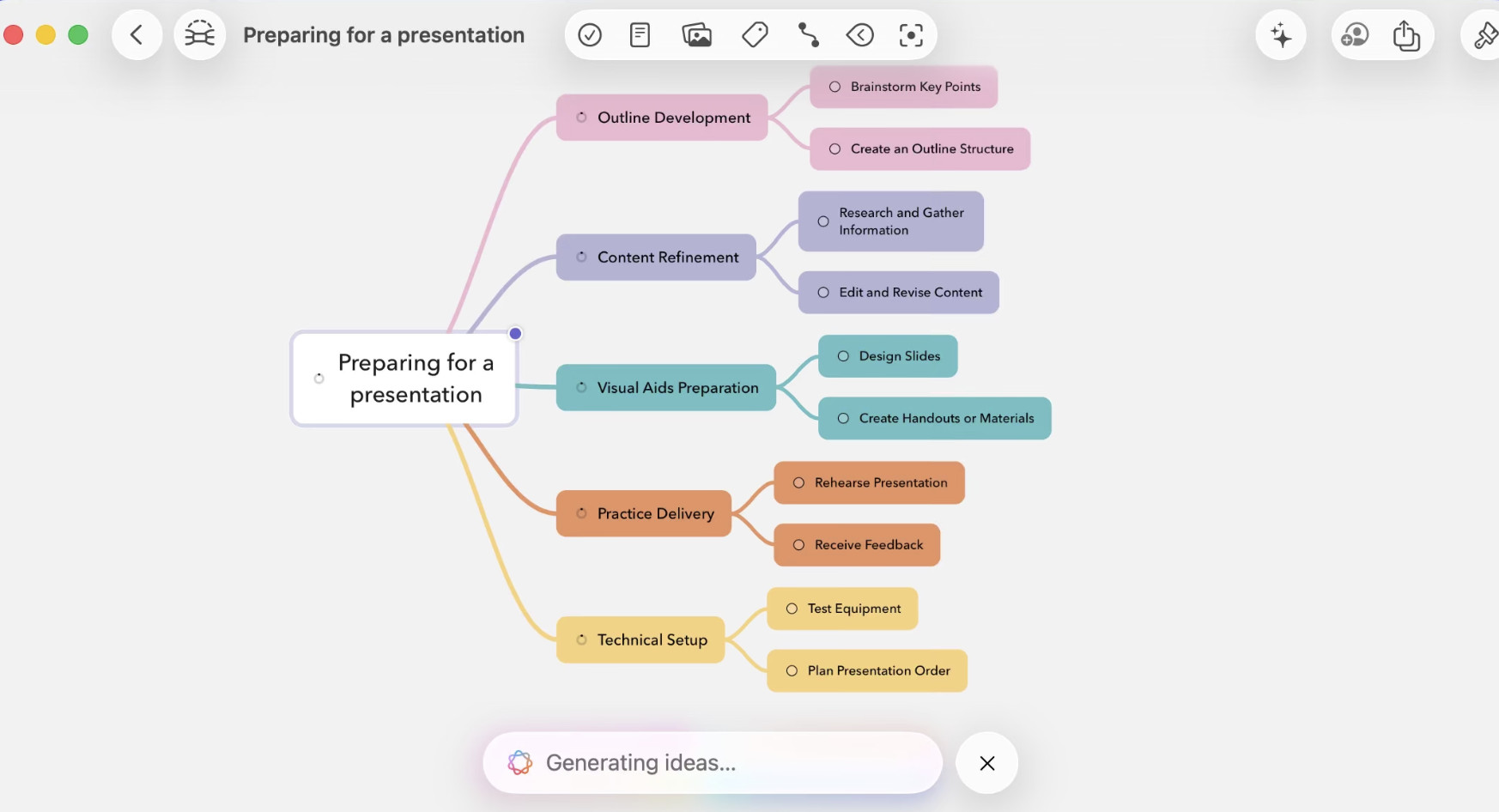
MindNode is our top choice for Mac users because it combines an excellent native Mac app with a clean interface, offline access, iCloud syncing and increasingly useful AI features.
Unlike many mind mapping platforms, MindNode is designed specifically for Apple devices. It works on Mac, iPhone, iPad, Apple Watch and Apple Vision Pro, with automatic syncing through iCloud.
MindNode has undergone a significant transition since the previous version of this article. The current MindNode uses a new document and syncing system that supports conflict-free syncing and real-time collaboration. The older file-based version is now called MindNode Classic and remains available to existing users.
The new version can switch between a visual mind map and a structured outline. You can add notes, visual tags, connections, images and tasks, with completed actions synced to Apple Reminders.
MindNode also now integrates with Apple Intelligence. Its AI tools can suggest a starting structure, expand a selected branch, summarize longer material and turn a completed mind map into a written draft. Because it uses Apple Intelligence where available, its AI features are more privacy-focused than most cloud-based alternatives.
The free editor is generous enough for basic mind mapping, including creating, editing, rearranging and folding branches. MindNode Plus unlocks AI, notes, tasks, advanced styling, connections, document linking and other premium features.
The main limitation is that MindNode remains an Apple-only product. Although real-time collaboration is now supported, it is less suitable for teams whose members use Windows or Android.
You can start using MindNode for free now.
Pricing: Generous free version with most features included. Pricing Plans start at $2.99/month or $24.99 per year. Also available in the Mac App Store.
2. XMind – Best for AI and Offline Use
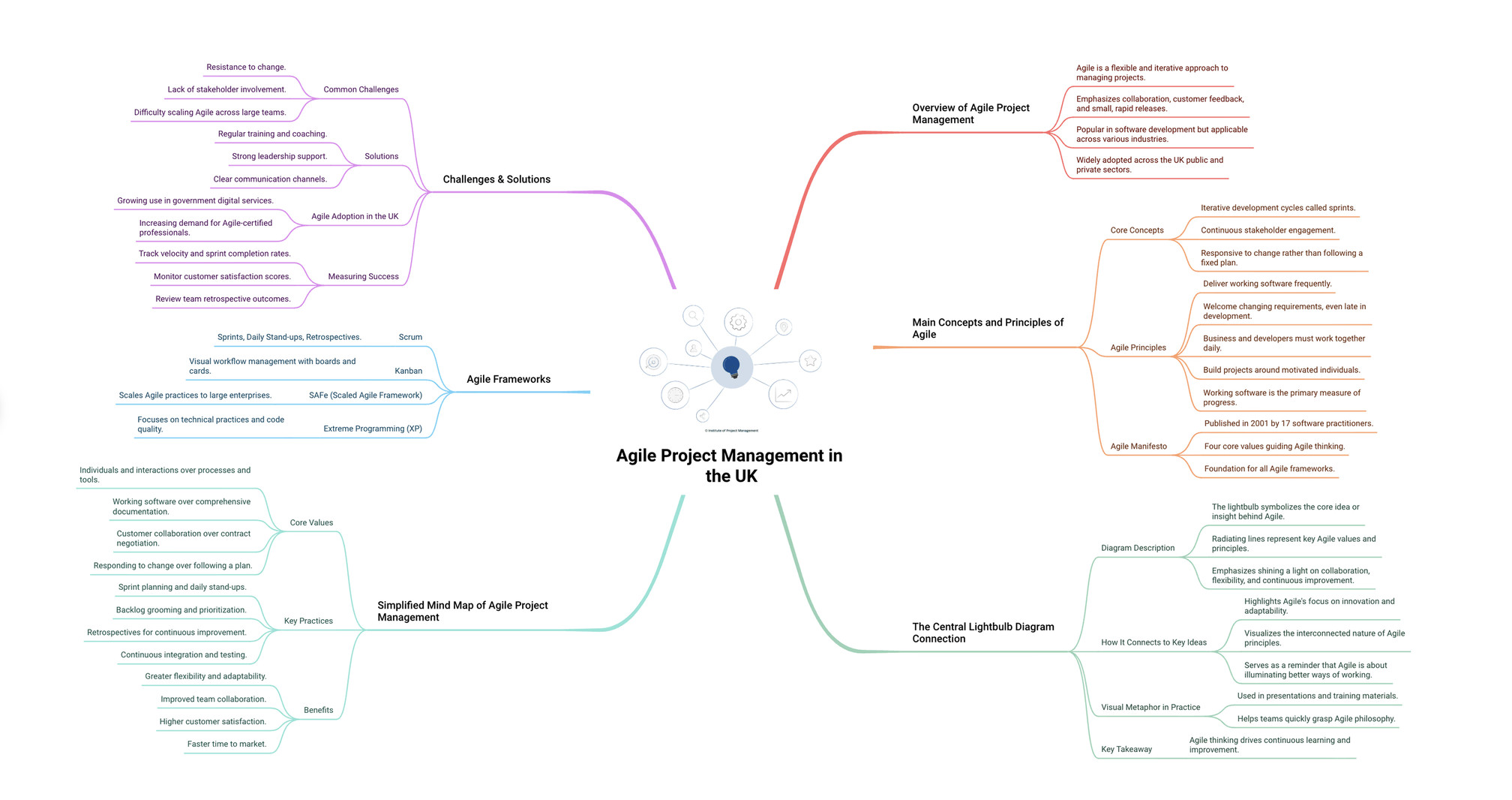
XMind is one of the best alternatives to MindNode if you want a dedicated mind mapping tool that works on Macs, Windows PCs, mobile devices and in a browser.
It combines a polished Mac desktop app with online collaboration, presentation tools and some of the most extensive AI features available in a traditional mind mapper.
XMind Copilot can generate a map from a prompt, expand existing branches and convert text, webpages, PDFs, documents and video links into structured mind maps. It can also extract action items and turn a completed map into a presentation or written outline.
This makes XMind particularly useful for research. Instead of manually summarizing a long PDF or webpage, you can import it and use AI to identify the main topics and supporting points.
The desktop app still works well as a conventional offline mind mapper, so you are not forced to rely entirely on cloud storage or an internet connection. XMind also offers multiple structures, including logic charts, tree tables, timelines, fishbone diagrams and organizational charts.
The free plan is useful but limited to 10 manually created online maps and only a small number of AI credits. The Pro plan removes export watermarks and adds attachments, custom themes, Office exports and more online maps. Premium is required for heavier AI use.
Pricing: Free. Pro costs $4.92/month and Premium costs $8.25/month when billed annually. See the current XMind pricing.
Pros:
- Mac desktop app and browser version
- Works offline
- Converts documents, webpages and videos into maps
- Strong AI Copilot
- Excellent presentation mode
- Wide selection of map structures
- Cross-platform support
Cons:
- Free AI allowance is small
- Online map limits apply
- Full AI functionality requires Premium
3. SmartDraw – Best for Professional Mind Maps
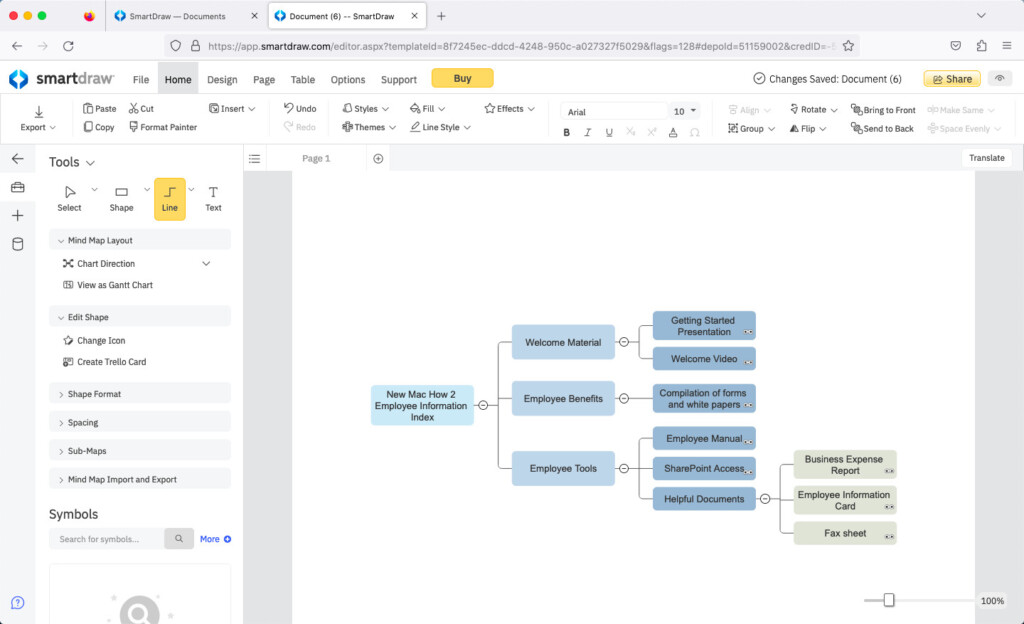
SmartDraw is the best choice if mind mapping is only one part of the professional diagramming work you need to do.
Alongside mind maps, it can create flowcharts, organizational charts, network diagrams, floor plans, Gantt charts and many other business diagrams.
SmartDraw automatically formats branches as you add, move or remove ideas. This prevents maps from becoming cluttered and allows you to concentrate on the content rather than manually arranging every element.
SmartDraw can also use AI to generate a mind map from a text prompt. The result is fully editable, making it useful for creating an initial structure that you can develop manually.
Its other major advantage is Microsoft Visio compatibility. SmartDraw can import and export Visio VSDX files, which is useful in organizations that exchange diagrams with Windows users.
There is a native Mac desktop app although it is effectively a web wrapper and Mac users can also access it through a browser. It nevertheless works well in Safari, Chrome and Firefox.
You can also check out our review of SmartDraw.
Pricing: Free to start / $8.95 per month for teams of 3+ / $9.95 per month individuals / Enterprise plans on request.
Pros:
- AI mind-map generation
- Automatic formatting
- Excellent professional templates
- Imports and exports Visio files
- Supports many other diagram types
- Microsoft 365 and Google Workspace integrations
Cons:
- Excessive for occasional personal mind maps
4. Miro – Best for Team Collaboration
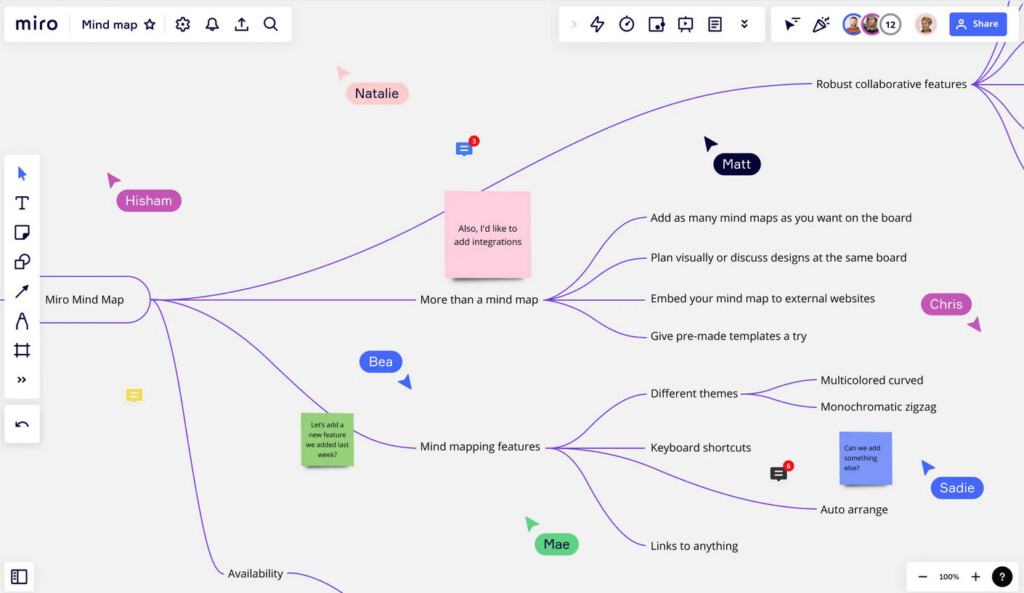
Miro is the best mind mapping and brainstorming platform for teams that need to work together remotely.
Its infinite canvas provides plenty of space for mind maps, sticky notes, diagrams, documents, prototypes, Kanban boards and project-planning material. Multiple users can edit the same board while adding comments, reactions and votes.
Miro AI can generate a mind map from a prompt, expand branches, summarize board content and group related sticky notes. It can also create diagrams, tables and documents, making it much more capable than the version previously described in this article.
Miro now connects to AI development tools through its MCP integration and supports workflows involving Claude, GitHub Copilot and Codex. That will not matter to every mind mapper, but it makes Miro increasingly useful for product and software-development teams.
Mac users can use Miro in a browser or install its desktop app. However, the app still depends heavily on Miro’s online service and should not be described as a fully offline mind mapping solution.
The free plan allows unlimited boards, but only the three most recent remain editable. The Starter plan adds unlimited private boards, high-resolution exports, visitor editing and additional AI credits.
You also check out our full Miro review for more.
Pricing: Free. Starter costs $8/user/month when billed annually. See Miro’s current plans.
Pros:
- Excellent real-time collaboration
- Infinite canvas
- AI generation and summarization
- Thousands of templates
- Desktop and browser access
- Voting, timer and workshop tools
- Extensive integrations
Cons:
- Only three editable boards on the free plan
- Limited AI credits on lower plans
- More complex than a dedicated personal mind mapper
- Not designed for fully offline use
5. Whimsical – Best Simple AI Mind Mapper
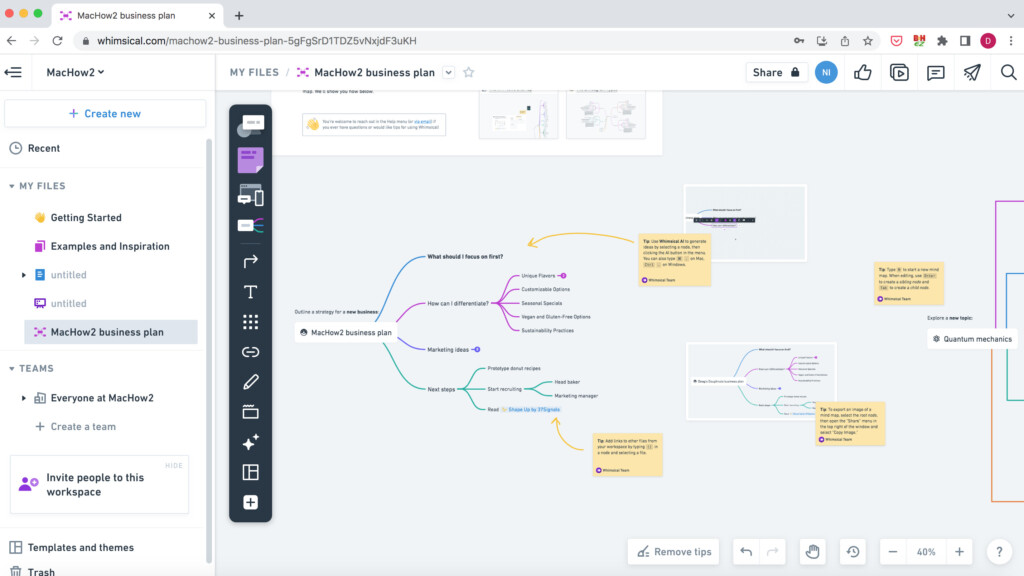
Whimsical is one of the fastest ways to turn a prompt into an attractive, editable mind map.
Its AI mind-map generator uses Claude to create a complete branching structure from a short description. You can then add, remove or reorganize the suggested ideas manually.
Whimsical is less complicated than Miro and better suited to people who want to start mapping immediately without configuring a large collaborative workspace. Automatic layouts and colour choices keep maps tidy as they grow.
It also supports real-time editing, comments, version history and links between Whimsical files. The same workspace can be used for flowcharts, wireframes and sequence diagrams.
The original article incorrectly states that Whimsical has no desktop app. There is now a desktop app for macOS and Windows, although Whimsical remains primarily cloud-based.
The free plan currently includes three team boards and 20 AI credits for the workspace. Pro adds unlimited team boards, larger uploads, additional guests and longer version history.
Pricing: Free. Pro costs $10/editor/month with annual billing. See Whimsical’s current pricing.
Pros:
- Excellent AI mind-map generator
- Very easy to use
- Clean automatic formatting
- Mac desktop app
- Real-time collaboration
- Also creates flowcharts and wireframes
Cons:
- Free plan limited to three team boards
- Only 20 total AI credits on the free plan
- Fewer advanced project-management features than Miro or Ayoa
6. Apple Freeform – Best Free Mac App
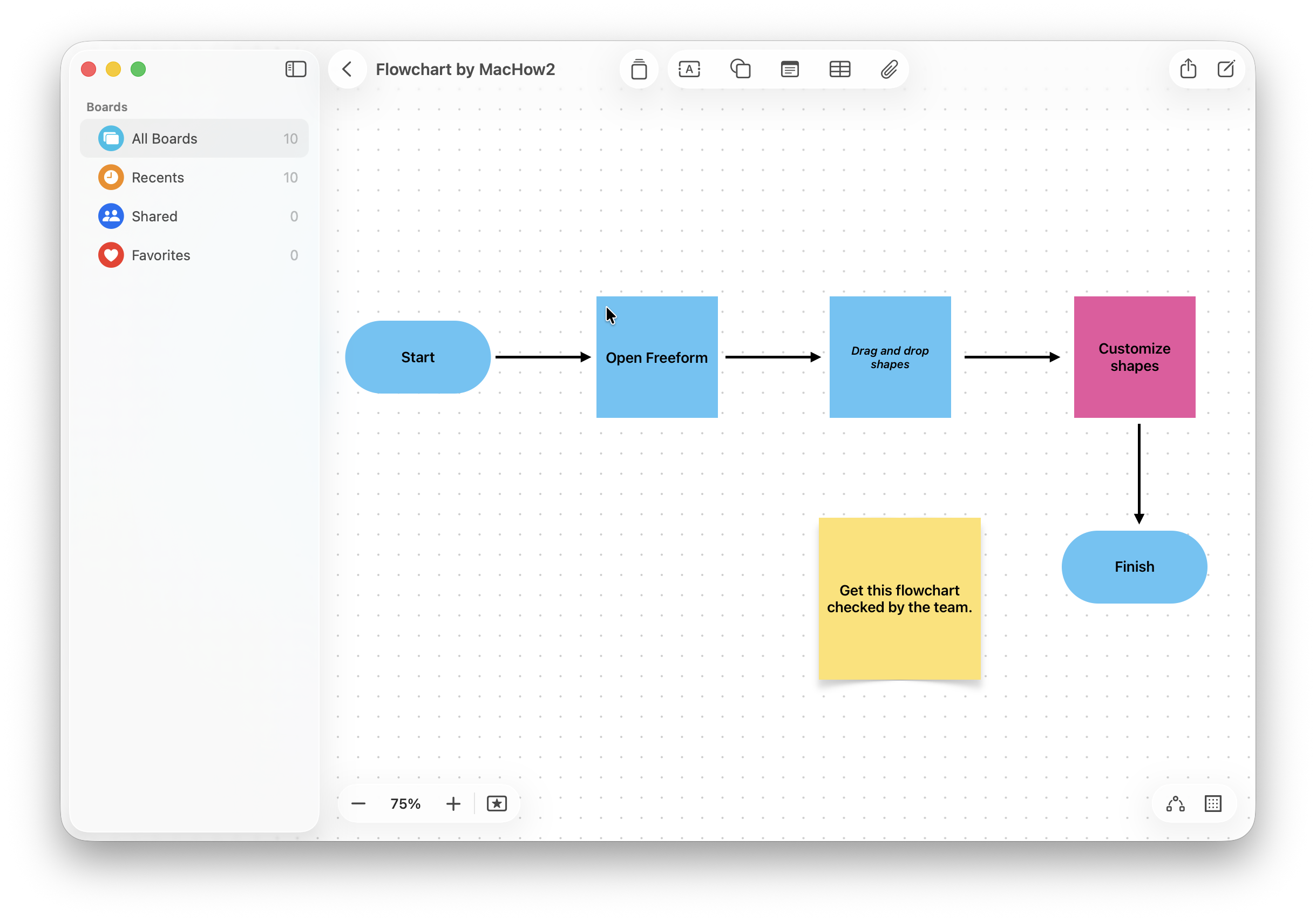
Freeform is Apple’s free infinite-canvas app for Mac, iPhone and iPad.
It is not a traditional mind mapper because it does not automatically create and rearrange hierarchical branches. However, it is excellent for free-form brainstorming, mood boards, research collections and loosely structured visual planning.
You can add text, sticky notes, shapes, links, photos, videos, audio, PDFs and other documents. Apple currently provides more than 700 shapes and alignment guides, making Freeform far more useful for diagrams than it was when first released.
Boards sync through iCloud and support real-time collaboration with up to 100 people. Messages and FaceTime are also integrated for discussing a shared board.
Freeform has gained AI-powered image creation and automatic cropping through Apple Creator Studio. These features can help illustrate a board, but they do not automatically generate or expand a conventional mind map. The core Freeform app remains free, while some advanced creative assets and image tools require an Apple Creator Studio subscription. Apple’s Freeform guide explains the distinction.
Remove the existing claim that Freeform does not work with drawing tablets. A Mac drawing tablet can be used as a pointer and drawing input device, although the best drawing experience remains Freeform on an iPad with Apple Pencil.
You can check out more on Apple Freeform for Mac here.
Pricing: Free. Some advanced image features require Apple Creator Studio.
Pros:
- Included free with Apple devices
- Flexible infinite canvas
- Supports many file types
- Up to 100 collaborators
- Excellent iCloud integration
- More than 700 shapes
- AI-assisted image tools available
Cons:
- No automatic mind-map layout
- No prompt-to-mind-map generator
- Apple devices only
- Less structured than dedicated mind mapping apps
7. FigJam – Best for Designers
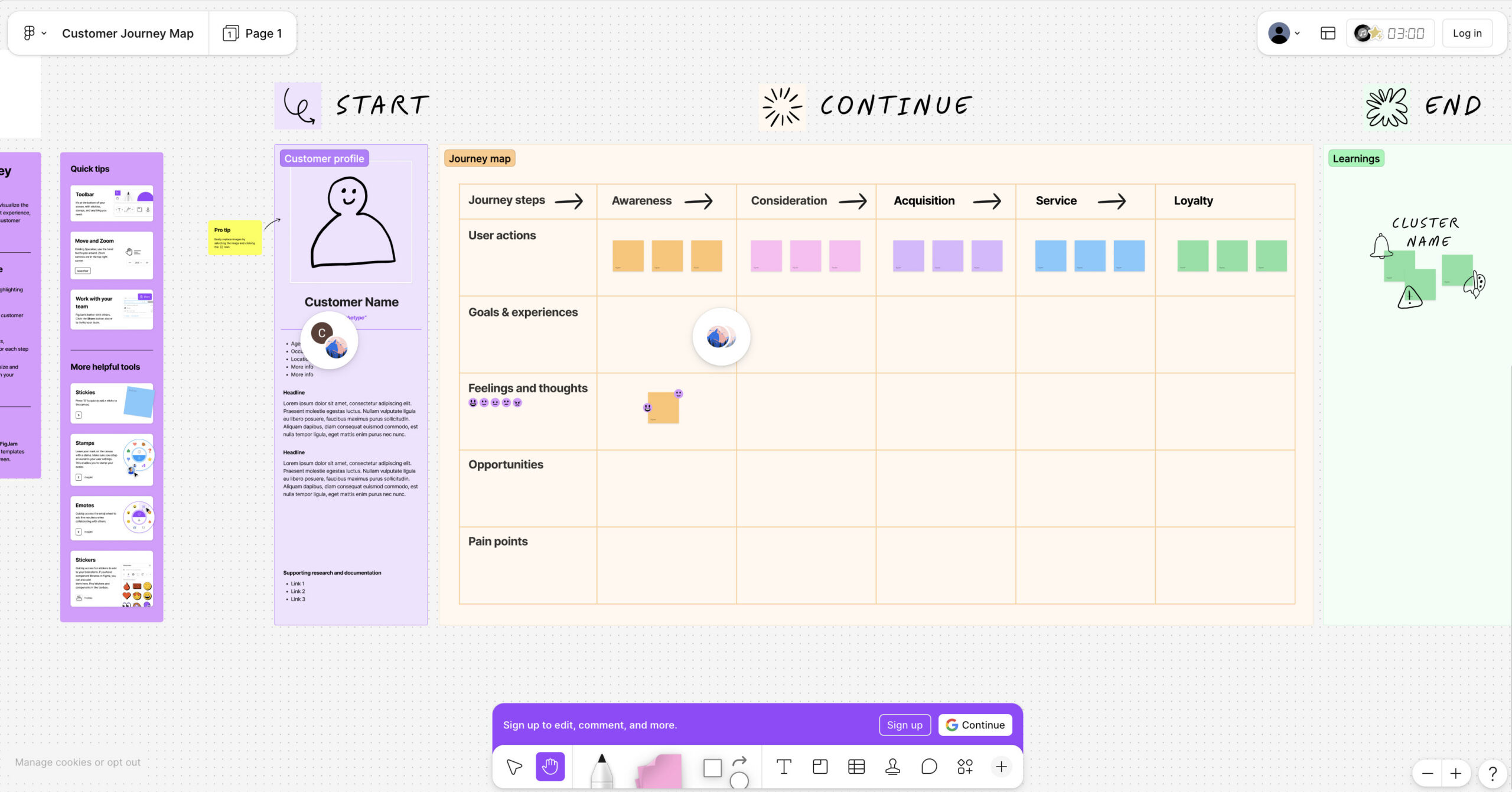
FigJam is Figma’s collaborative whiteboard and is the correct product to recommend for mind mapping—not the main Figma Design app.
FigJam includes purpose-built mind-map connectors that automatically create new branches from existing text. Teams can add sticky notes, diagrams, stamps, comments and reactions while working together in real time.
FigJam AI can generate a mind map from a prompt using its “Make templates and diagrams” tool. It can also produce brainstorming templates, timelines, organizational charts and meeting structures.
Its strongest advantage is integration with Figma. A product or UX team can begin with research and a mind map in FigJam before moving into interface design and prototyping in Figma Design.
The free Starter plan includes unlimited personal drafts and a monthly allocation of AI credits. Paid Figma seats add shared files, projects and higher AI allowances.
Pricing: Free Starter plan. Professional Collab seats start at $3/user/month; Full seats cost more. See Figma’s current pricing.
Pros:
- Dedicated mind-map tools
- AI map generation
- Excellent real-time collaboration
- Ideal for UX and product teams
- Integrates with Figma Design
- Useful free plan
Cons:
- Primarily designed for online collaboration
- Unnecessary for people outside design and product teams
- Figma’s seat-based pricing can be confusing
8. Ayoa – Best for Turning Ideas into Tasks
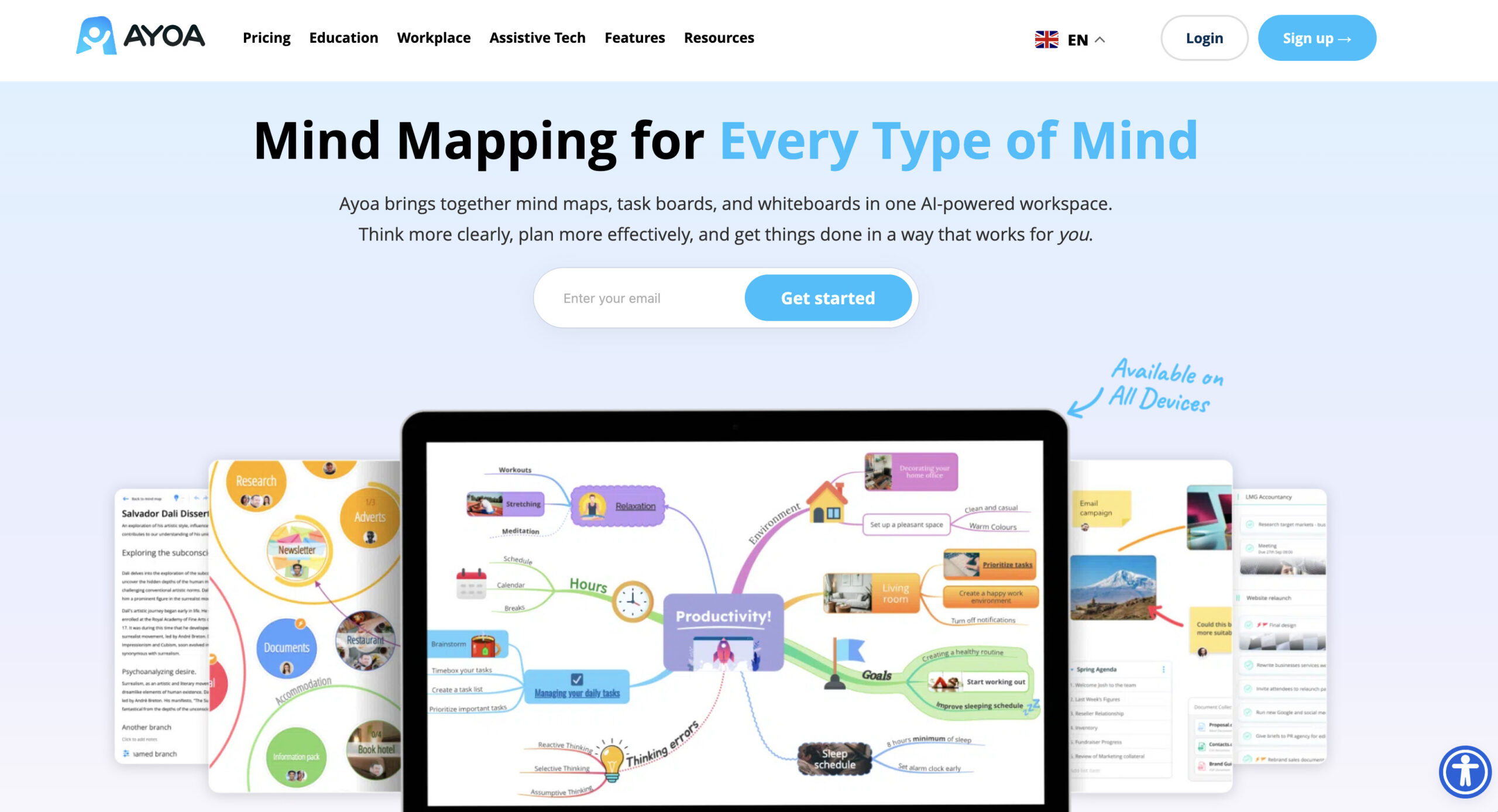
Ayoa combines mind mapping with task management, whiteboards, Gantt charts and team collaboration.
It offers several types of mind map, including organic, speed and radial maps. Ideas can be converted into tasks, assigned to team members and tracked using deadlines, progress indicators and project boards.
Ayoa’s AI can generate a map from a topic, expand ideas and summarize imported material. It can also convert audio recordings of up to 60 minutes into structured mind maps, which is useful for lectures, interviews and meetings.
Ayoa is also notable for its accessibility and neurodiversity features. The company positions it as assistive technology for people with dyslexia, ADHD and autism, and it can be obtained through the UK Access to Work scheme in some circumstances.
The free version allows up to 10 mind maps. AI, editable task boards, whiteboards and the more advanced productivity features require Ayoa Ultimate.
Pricing: Free for up to 10 mind maps. Ayoa Ultimate starts at approximately $13/user/month when billed annually. See Ayoa’s pricing.
Pros:
- AI-powered mind mapping
- Converts audio into maps
- Multiple mind-map styles
- Integrated task and Gantt views
- Strong accessibility features
- Real-time collaboration
Cons:
- AI requires Ayoa Ultimate
- More expensive than dedicated personal apps
- Interface can feel busy
9. SimpleMind – Best One-Time Purchase
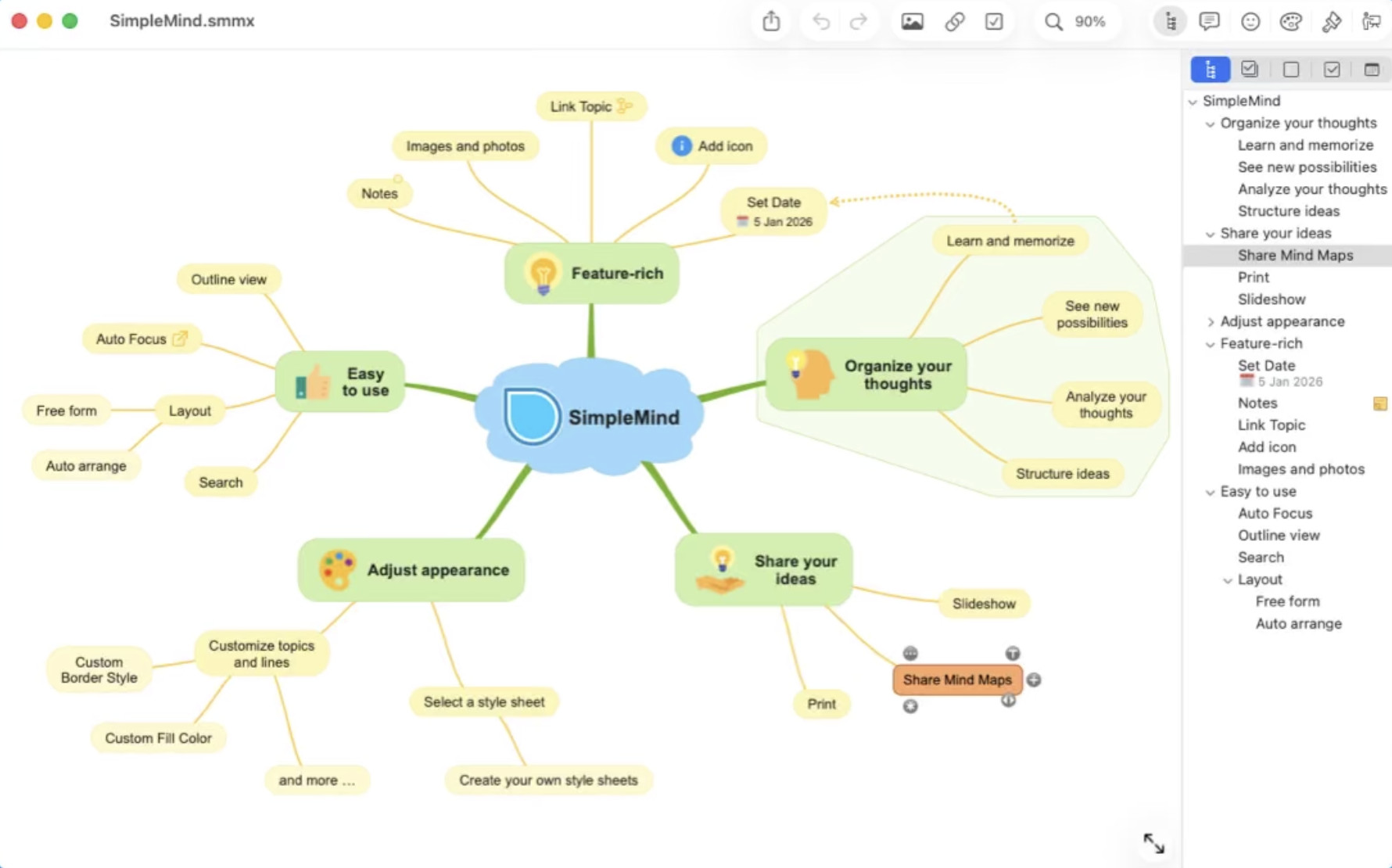
SimpleMind is a good choice for anyone who wants a private, offline Mac mind mapper without another subscription.
The Mac version supports free-form and automatic layouts, images, icons, notes, links, checkboxes, dates and more than 15 stylesheets. Maps can be exported to PDF or images and synced using services such as iCloud, Dropbox, OneDrive and Google Drive.
SimpleMind does not have its own generative AI assistant. Instead, it allows structured text generated by ChatGPT or another AI service to be copied into SimpleMind and converted into a visual map.
That is less convenient than the integrated AI in XMind or MindNode, but it may appeal to users who do not want the contents of their maps processed by an additional cloud AI service.
The original article incorrectly describes the Mac version as having a free Lite edition. SimpleMind Free is available for mobile devices, while Mac users receive a 30-day trial of SimpleMind Pro.
Pricing: 30-day Mac trial followed by a one-time purchase. Licences are purchased separately for each platform. See SimpleMind’s feature comparison.
Pros:
- One-time purchase
- Works offline
- No registration required
- Flexible automatic and free-form layouts
- Good cloud-sync options
- Useful for privacy-conscious users
Cons:
- No built-in generative AI
- Separate licence required for each platform
- No free Mac edition
- Limited real-time collaboration
10. GitMind – Best for Converting Content into Maps
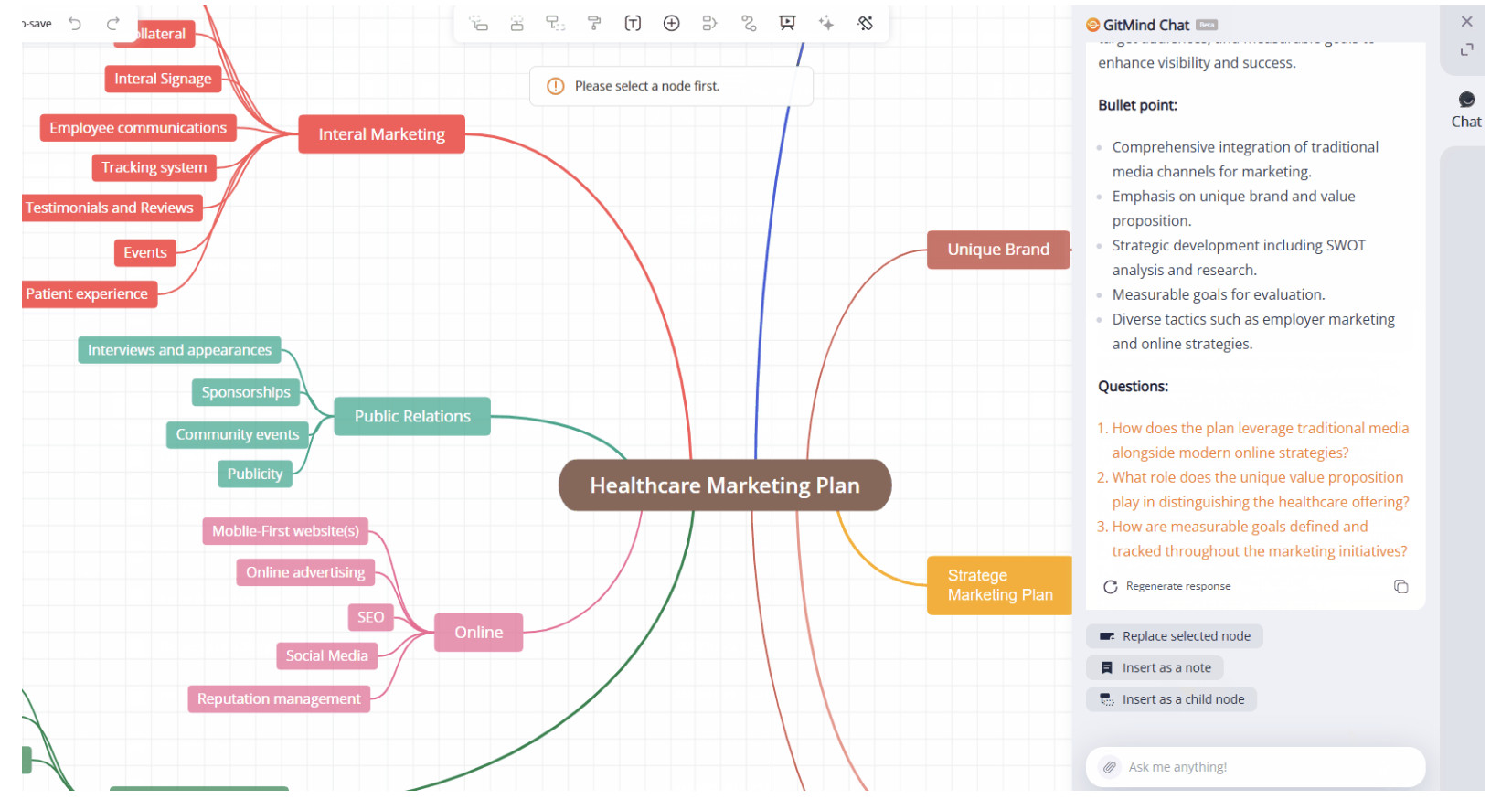
GitMind has evolved from a basic online mind mapper into an AI workspace capable of turning many different content types into visual maps.
It can convert text, webpages, PDFs, Word documents, PowerPoint presentations, spreadsheets, images, audio recordings and videos into editable mind maps. It can also summarize YouTube videos and extract text from images using OCR.
Unlike the old description, GitMind is no longer browser-only. It now provides desktop apps for Mac and Windows, along with iPhone, iPad and Android apps.
GitMind remains useful for students, but it should not be described as completely free with unlimited functionality. Free users receive limited trials or AI credits depending on the feature. Paid plans unlock unlimited conventional mind maps and larger allowances, while intensive AI processing may consume additional credits.
Pricing: Limited free access. Paid plans cost $9/month or the equivalent of $4.08/month when billed annually. See GitMind’s current pricing.
Pros:
- Converts PDFs, documents and websites into maps
- Audio, video and YouTube summarization
- OCR and image-to-map tools
- Mac desktop and mobile apps
- Real-time collaboration
- Conventional and AI-generated maps
Cons:
- Free AI use is limited
- Pricing and AI credits can be confusing
- Cloud processing may not suit confidential material
- Less polished than MindNode or XMind
Is FreeMind Available For Mac?
FreeMind was once one of the best-known open-source mind mapping applications, but it has not received a stable release since 2014.
Because it is an old Java application, it is not a practical choice for modern versions of macOS or Apple Silicon Macs. Even if it can be made to launch using additional Java components, compatibility and security concerns mean we no longer recommend it.
For a free alternative, use MindNode’s free editor, Apple Freeform or the free version of XMind. SimpleMind is a better option if you want a private desktop application with a one-time purchase.
Can OneNote Be Used For Mind Maps?
Microsoft OneNote is one of the best note taking software out there and in theory, should be ideal for making mind maps as it supports attachments and notes of all kinds.
However, OneNote has no specific tools for mind maps and isn’t self organizing meaning you’ll spend a lot of time formatting your mind maps.
Note taking software like OneNote in general are great for capturing snippets for inspiring mind maps later but not for actual mind mapping.
Why Use Mind Mapping Software?
Mind maps can be effective because they combine hierarchy, spatial arrangement, color and visual connections. This can make complicated information easier to organize, review and remember than a long linear document.
Mind maps can bring out creative thinking in a way that a lot of business planning or brainstorming can’t.
They are effective for a variety of reasons but some of the most important are:
- Mind maps help you to see the bigger picture
- Use time more efficiently by focusing on the most important tasks or issues
- Improve the ability to remember key information
- Mind maps help to clarify thinking on topics
- Mind maps are an excellent way to present ideas and information in meetings and presentations
Digital mind mappers make the process much easier than using a pen and paper or because they are far more flexible when it comes to making changes, edits, enriching and sharing mind maps.
You’re also much less likely to lose mind maps created on your Mac than on a piece of paper or a white board.
Mind mapping is particularly important in project management to understand the strategy behind a project, streamline processes and delegate tasks to the right teams.
Mind mapping software can also be used alongside flowchart software to make workflows and process flows more efficient.
Mind maps aren’t just exclusively useful for just businesses though.
They’re also useful in non-business fields too such as helping to map out anything from an idea for a book, writing an essay or in medical fields by helping patients with ADHD organize thought processes.
Seven Tips for Creating a Better Mind Map
There is no single correct way to create a mind map, but the following principles can make one easier to understand and develop:
- Try to start in the center of a blank page and work out. You’ll have more space for ideas if you turn the page sideways.
- Use an image to illustrate the core theme for the mind map. This helps stimulate your thinking and keeps you focused each time you look at the mind map.
- Illustrate your mind map with colors which will bring your mind map to life and help highlight important ideas and strands.
- All main branches should link to the central image with sub-branches of those but don’t create too many sub-branches otherwise your mind map will lose its focus.
- Curved lines are more aesthetically pleasing than straight lines and easier to digest visually than lots of straight lines.
- Try to use one keyword per line rather than sentences or phrases which helps trigger off sub-ideas and branches.
- Images are more effective at conveying a message than words so where possible, use images throughout your mind map.