

If you want to use macOS Dictation without an internet connection, whether you can do so depends on your Mac, chosen language and where you’re dictating.
On supported Macs and languages, macOS can process general text Dictation entirely on the device. Your voice input and transcript are therefore not sent to Apple’s servers.
However, Apple does not provide a simple rule based solely on whether you have an Intel or Apple silicon Mac. Instead, macOS tells you how Dictation is processed on your particular setup.
To check:
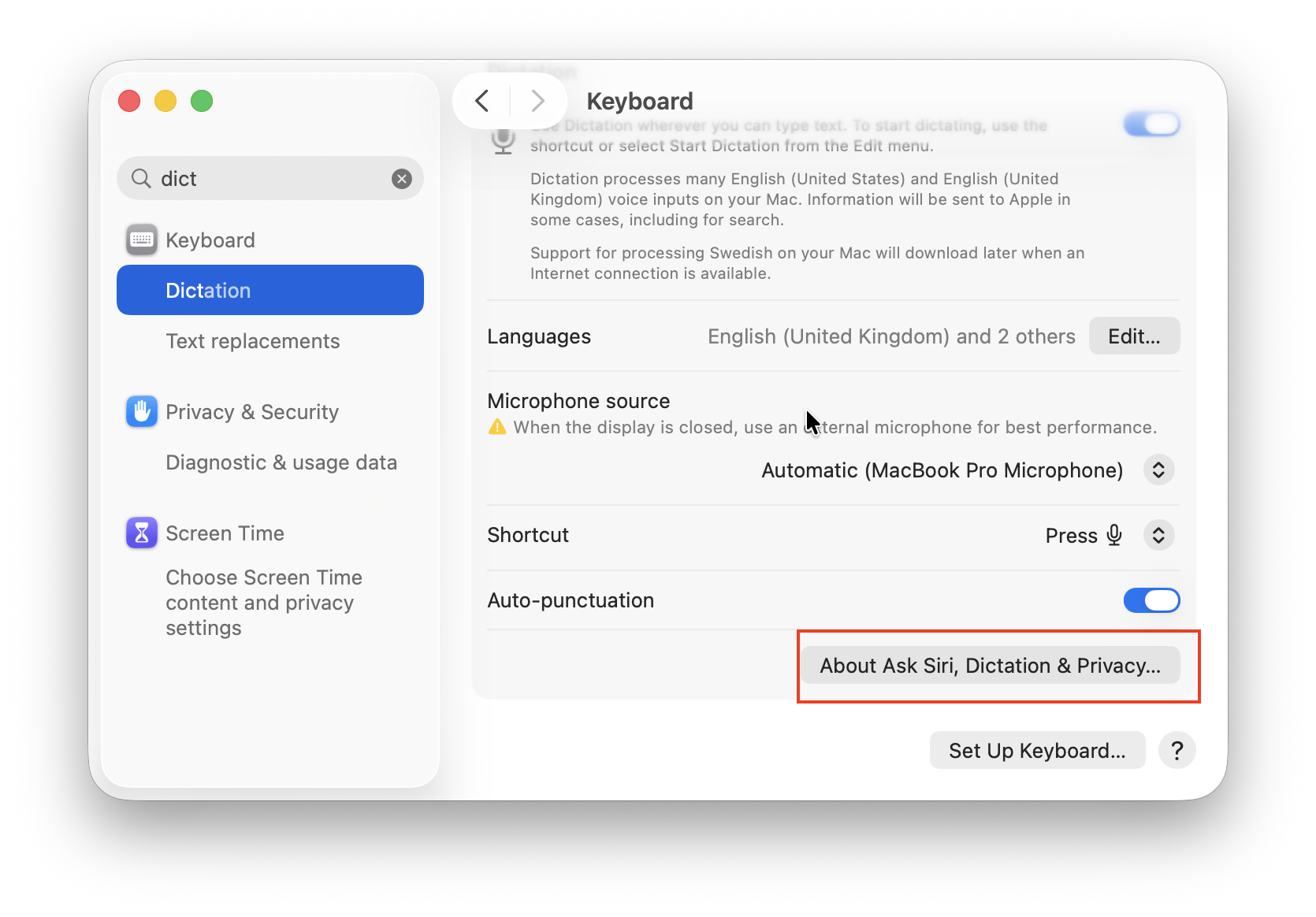
- Open System Settings > Keyboard.
- Make sure Dictation is enabled.
- Read the message displayed when you click on About Ask Siri, Dictation and Privacy…
This message will tell you whether your voice input and transcripts are processed on your Mac or whether Dictation requires an internet connection.
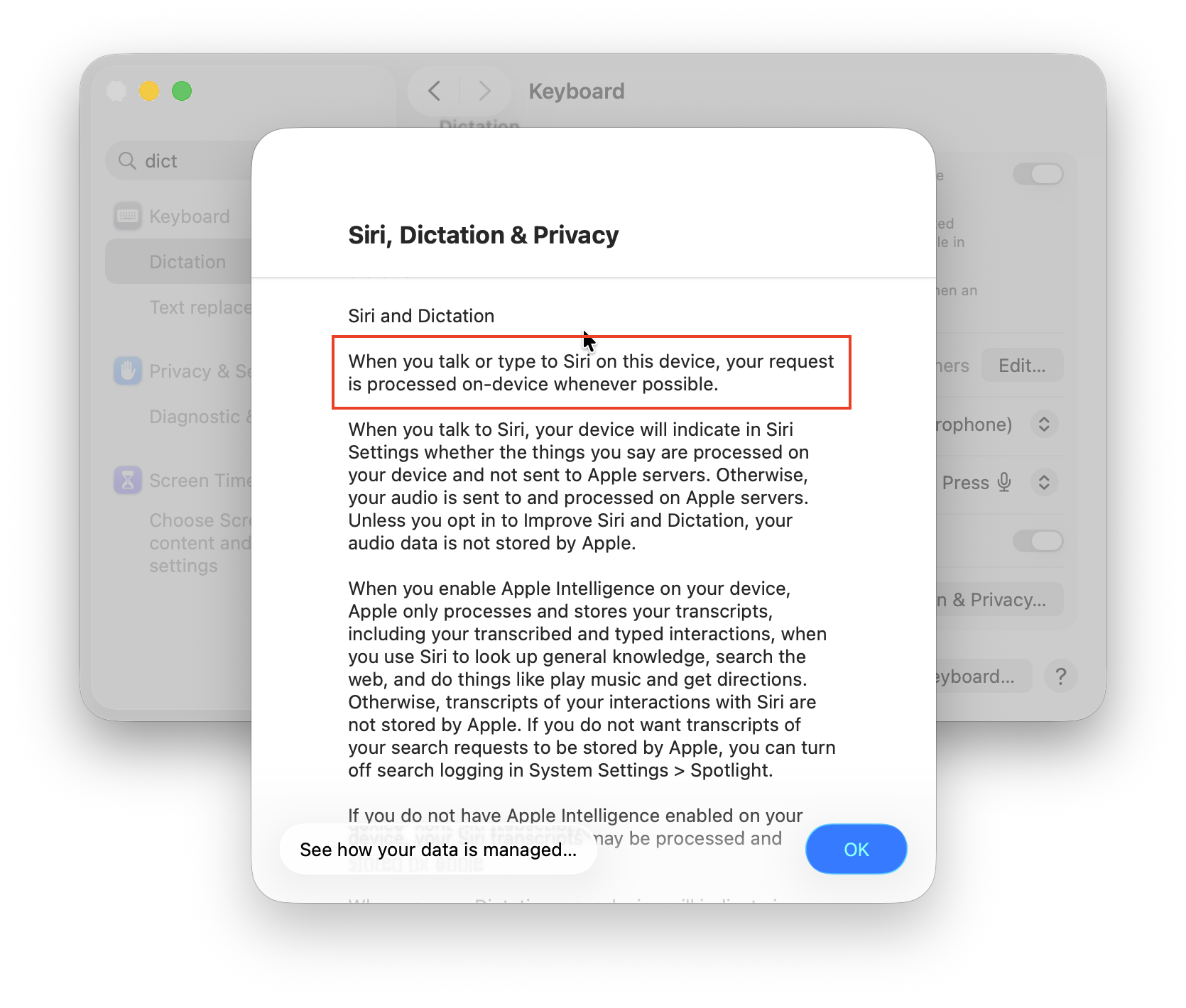
If you see the message:
When you talk or type to Siri on this device, your request is processed on-device whenever possible.
then Dictation works offline on your Mac. If you don’t, then it means that it’s probably using Apple’s servers to process dictations.
You can confirm this by disconnecting your Mac from Wi-Fi and dictating into Notes or Pages (see our demo below). If the text continues appearing, Dictation is being processed locally for that language and text field.
You can also check whether your language is included in Apple’s list of supported Dictation languages.
Instructions for changing the Dictation language on a Mac are available separately.
Apple silicon Macs also allow you to type while continuing to dictate.
There is no fixed limit on the length of a Dictation session, although Dictation stops automatically when no speech is detected for 30 seconds.
Does Clicking “Not Now” Enable Offline Dictation?
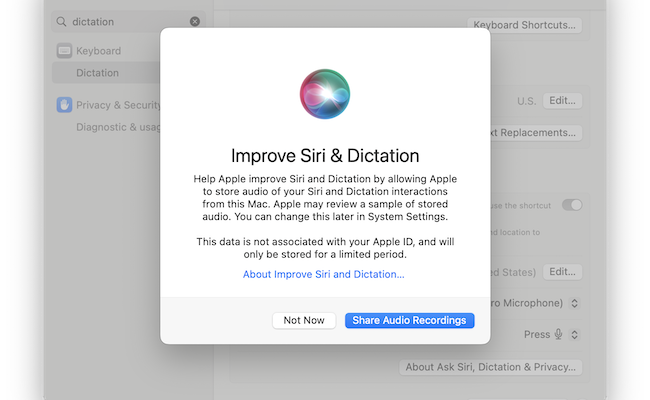
When you activate Dictation, Apple may ask whether you want to share audio recordings to improve Siri and Dictation.
Selecting Not Now does not enable offline Dictation.
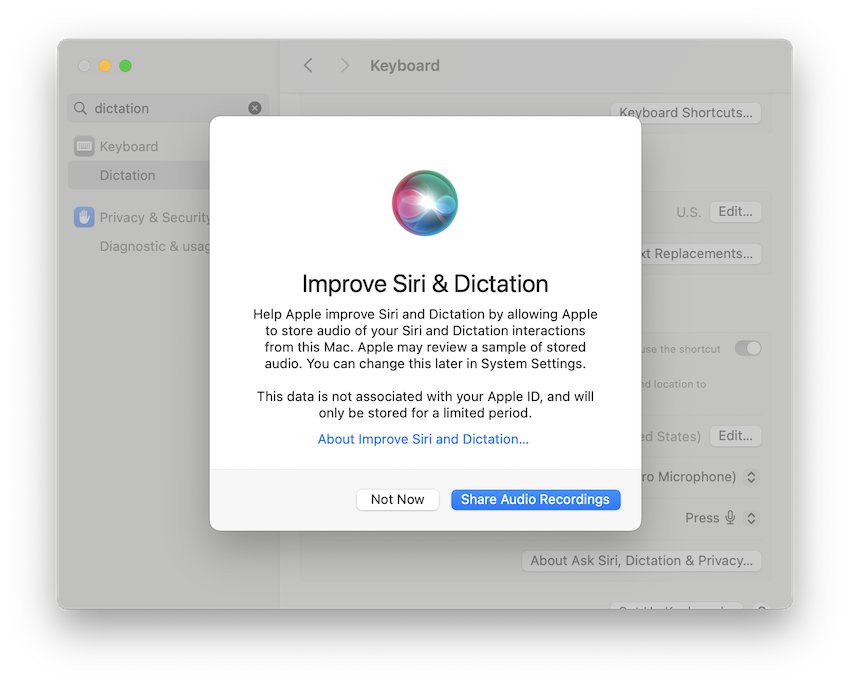
Likewise, selecting Share Audio Recordings does not necessarily mean all your dictation will be processed on Apple’s servers.
This prompt controls a separate privacy setting called Improve Siri & Dictation. If you opt in, Apple can store and potentially review samples of your Siri and Dictation audio to improve its speech-recognition services.
If you select Not Now, Dictation will still work, but Apple will not store your Dictation audio for this improvement programme.
You can change the setting at any time by going to:
System Settings > Privacy & Security > Analytics & Improvements > Improve Siri & Dictation
Whether the actual transcription happens locally or on Apple’s servers is shown separately underneath System Settings > Keyboard > Dictation.
What Happens If Dictation Uses Apple’s Servers?
If on-device Dictation isn’t supported by your Mac or selected language, your speech and transcript are sent to Apple’s servers for processing.
Apple says that the things you dictate are not stored unless you have opted in to Improve Siri & Dictation.
However, Apple may retain related request data, including:
- The category of request
- Whether the request was completed successfully
- Device specifications and configuration
- Performance information
- Your approximate location if applicable Location Services are enabled
Apple associates this information with a random, device-generated identifier rather than your Apple Account or email address.
You can read more in Apple’s Siri and Dictation privacy policy.
Can You Dictate Offline on an Intel Mac?
Offline Dictation on an Intel Mac is less straightforward.
On Intel Macs running macOS Mojave or earlier, Apple offered a feature called Enhanced Dictation. This downloaded the required language files and allowed supported languages to be transcribed without sending the recording to Apple.
To activate it in macOS Mojave:
- Go to System Preferences > Keyboard > Dictation.
- Turn Dictation on.
- Select Use Enhanced Dictation.
- Wait for macOS to download the required language files.
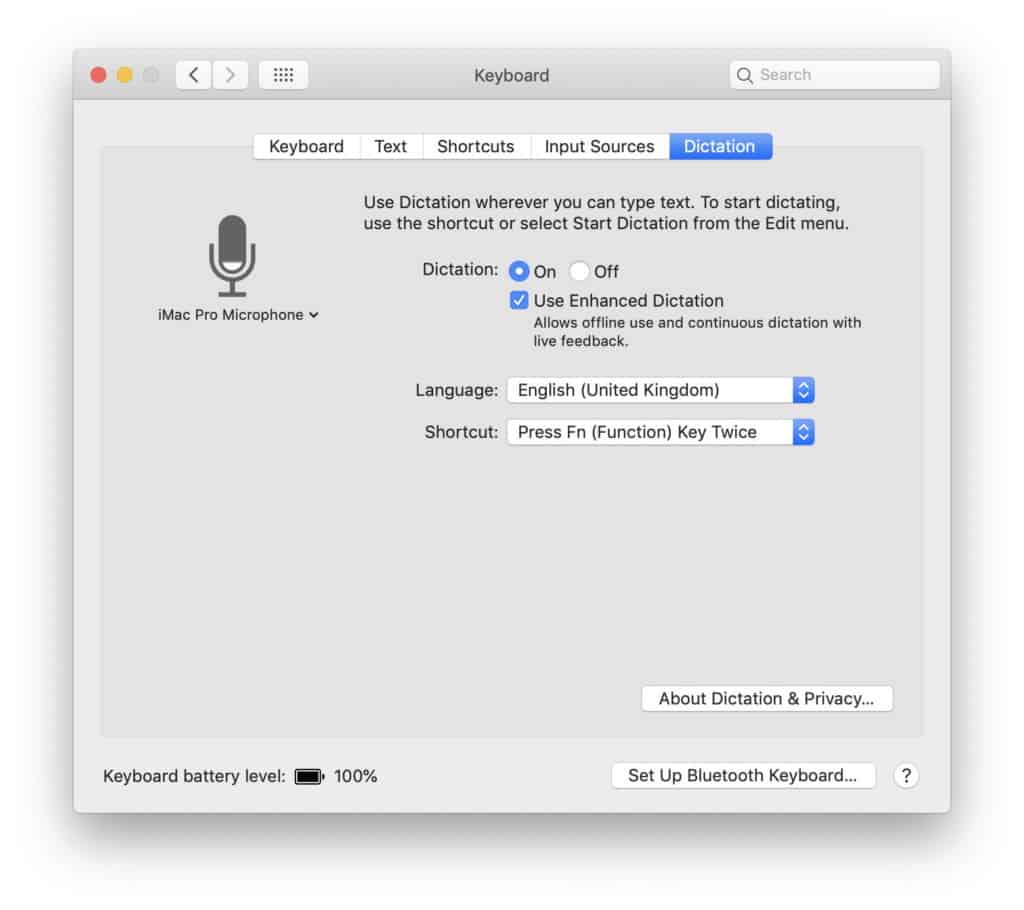
The size of the download varies according to the language. Make sure your Mac has enough free storage space before downloading it.
Apple removed the Enhanced Dictation option in macOS Catalina. This means you will not see the Use Enhanced Dictation box on an Intel Mac running Catalina or later.
Dictation on these Macs will usually require an internet connection, but you should check the message underneath System Settings > Keyboard > Dictation for a definitive answer for your Mac and language.
Using Voice Control for Offline Dictation
Voice Control is another option if standard Dictation requires an internet connection.
Apple introduced the current Voice Control feature in macOS Catalina. It is primarily an accessibility tool for controlling your Mac by voice, but it also allows you to dictate text.
Voice Control is different from standard macOS Dictation. When Voice Control is enabled, it takes over speech input and normal Dictation is unavailable.
To activate it in current versions of macOS:
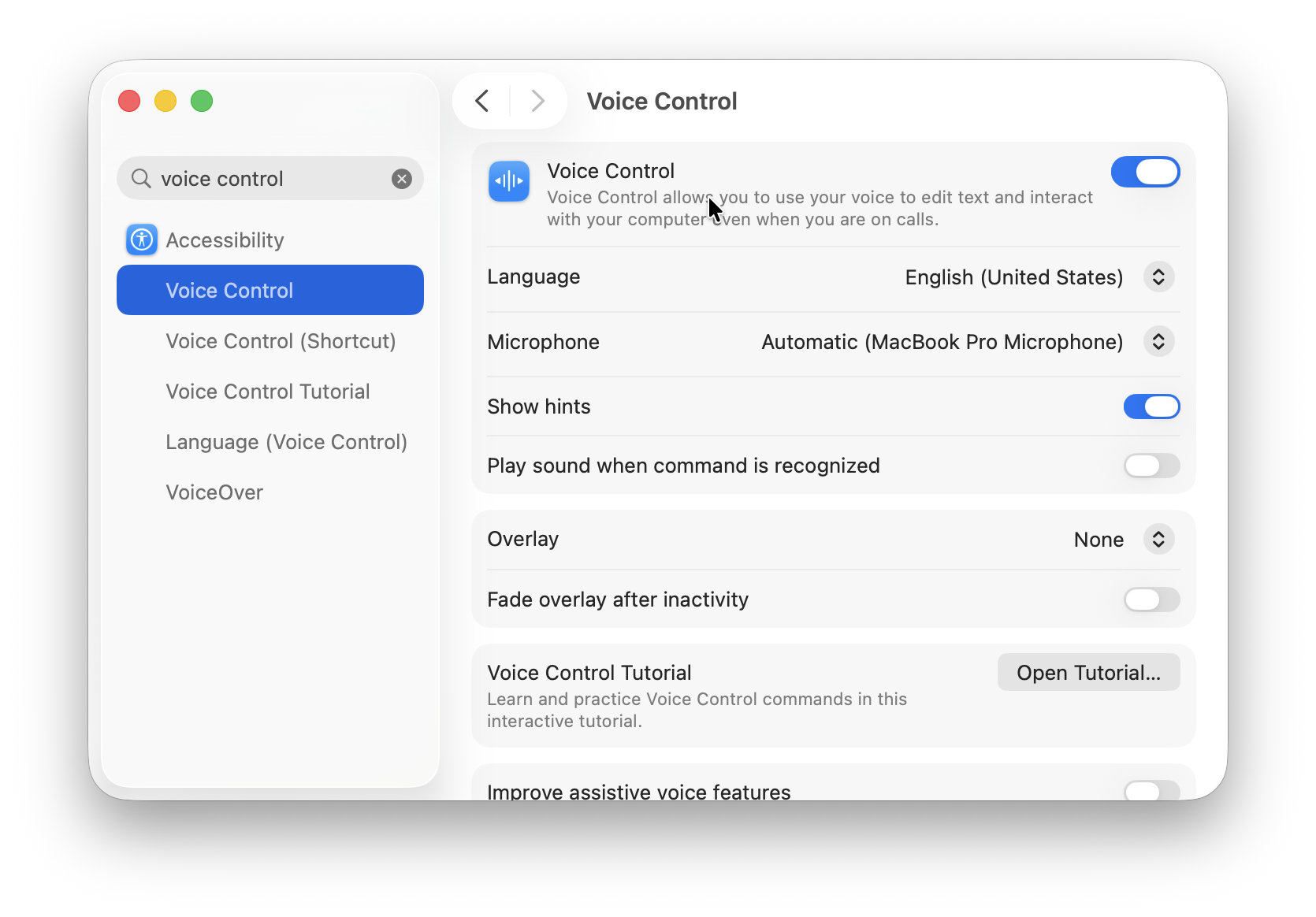
- Open System Settings.
- Select Accessibility.
- Click Voice Control.
- Turn on Voice Control.
- Select a language and allow macOS to download any required files.
In older versions of macOS, go to:
System Preferences > Accessibility > Voice Control
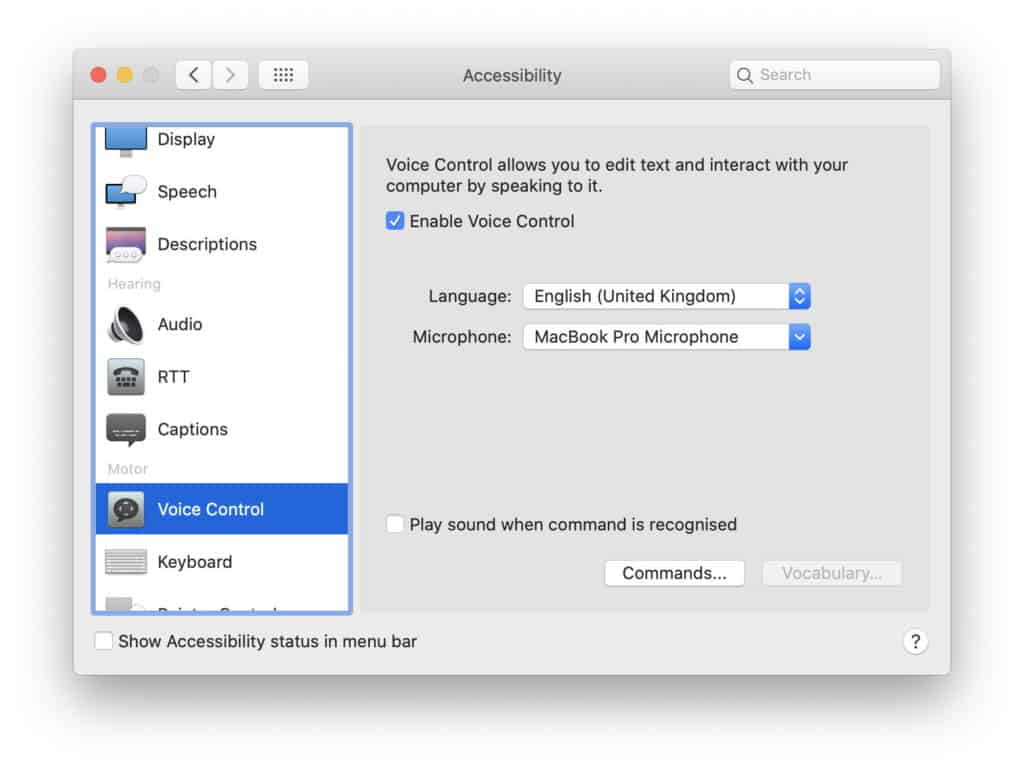
Once the required language files have been downloaded, Voice Control can provide on-device speech recognition for supported languages. You can then dictate text and control your Mac without relying on the standard Dictation feature.
Voice Control includes commands for navigating macOS, selecting text and formatting documents. Click Commands in the Voice Control settings to see the available instructions.
You can also pause or resume Voice Control by clicking its floating microphone window or saying:
- “Go to sleep” to pause Voice Control
- “Wake up” to resume it
For specialist words and names, Voice Control also supports a custom vocabulary in selected languages. You can add terms under:
System Settings > Accessibility > Voice Control > Vocabulary
This makes Voice Control potentially more useful than standard Dictation for users who regularly dictate technical names or unusual terminology.
macOS Dictation vs Voice Control
Although both features can enter text, they are designed for different purposes.
macOS Dictation is the simplest option when you just want to speak instead of type. It works in most text fields and requires very little setup.
Voice Control is designed to operate the entire Mac with spoken commands. It provides more control over navigation, text selection, editing and formatting, but its interface is more intrusive if you only want occasional dictation.
You cannot use both simultaneously. When Voice Control is active, it handles dictation as well as spoken commands, and standard macOS Dictation is disabled.
How Accurate Is macOS Dictation?
The accuracy of macOS Dictation has improved significantly, particularly on recent Apple silicon Macs using supported languages.
Results depend on several factors, including:
- Your microphone quality
- Background noise
- How clearly you speak
- Your chosen language and regional dialect
- Whether macOS supports on-device recognition for that language
- The number of specialist or unusual words you use
In supported languages, Dictation can automatically insert commas, full stops and question marks. You can control this under:
System Settings > Keyboard > Dictation > Auto-punctuation
You can also speak punctuation and formatting instructions such as “comma”, “question mark”, “new line” and “new paragraph”.
However, standard macOS Dictation offers few tools for creating a specialised vocabulary or training it to recognise your individual speech patterns.
Some professional dictation software for Mac provides custom vocabulary, voice profiles, document formatting and more advanced correction features. These tools may be more suitable if you dictate lengthy documents or frequently use technical, medical or legal terminology.
Voice Control also allows you to add custom vocabulary in supported languages, which can help it recognise names and specialist terms.
Is Offline Dictation More Private?
On-device Dictation provides greater privacy because your voice input and transcript remain on your Mac rather than being sent to Apple for processing.
For the most private setup:
- Check that System Settings > Keyboard > Dictation confirms on-device processing.
- Turn off Improve Siri & Dictation under Privacy & Security > Analytics & Improvements.
- Test Dictation without Wi-Fi in an ordinary document or note.
- Check the privacy policy of any third-party app that uses speech recognition.
Bear in mind that the document itself could still be uploaded if you save it in iCloud Drive, Google Drive, OneDrive or another cloud service. Offline speech processing does not automatically mean that the resulting document remains stored only on your Mac.
The safest conclusion is not to assume that Dictation is offline simply because you have an Apple silicon Mac. Check the message in System Settings > Keyboard > Dictation, as this reflects your specific Mac, language and configuration.