

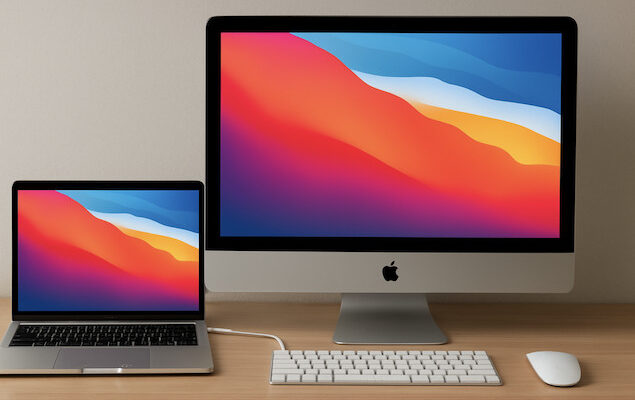
If you want to use an iMac as an external display with another Mac or MacBook, then AirPlay in macOS offers a free and easy way to do so.
Apple’s older Target Display Mode (TDM) only works with certain 2009 – 2014 Intel iMacs and Intel Macs running macOS Catalina or earlier.
Modern Macs – including all Apple Silicon (M-series) models – cannot use TDM. Instead, you can use AirPlay to Mac to turn a compatible iMac into a wireless (or wired) secondary display.
AirPlay is built into any version of macOS Monterey and later, letting you mirror or extend one Mac’s screen to another Mac (including an iMac).
Requirements To Use AirPlay With an iMac
You’ll need the following models of Macs, software and network setup to use an iMac an an external display with AirPlay.
1. Hardware
- Source Mac (Primary Mac)
- MacBook Pro/Air: 2018 or later
- Mac mini: 2020 or later
- iMac: 2019 or later
- Mac Pro: 2019 or later
- iMac Pro: 2017
- Receiving iMac (Display)
- iMac 2019 or later running macOS Monterey or newer officially
- iMac Pro 2017 also supported
⚠️ Earlier iMacs cannot “officially” receive AirPlay video but iMacs as far back as 2011 can work if you upgrade or “patch” macOS using OpenCore Legacy Patcher (OCLP).
2. Software
- Receiving iMac: macOS Monterey (12) or later.
- Source Mac: macOS Mountain Lion (10.8) or later for mirroring,
Mavericks (10.9) or later for extended desktop mode.
3. Network
- Wi-Fi and Bluetooth enabled on both Macs.
- Both must be on the same Wi-Fi network (or connected directly via Thunderbolt/USB-C cable for lower latency).
AirPlay Performance & Limitations
- Resolution: AirPlay to Mac maxes out at 1080p (Full HD) at a 16:9 aspect ratio.
- It does not support Retina or 5K resolution, even if your iMac has a 4K/5K screen.
- Compression & Lag: Because the signal is compressed by AirPlay, text and fine details are softer and there may be slight input lag when typing and gaming. It is particularly noticeable when drawing on a Mac or using graphic design software for example.
- Best Use: AirPlay is fine for extra screen real estate, presentations, or media playback, but not for pixel-perfect design or fast gaming.
Instructions: Using AirPlay to Turn an iMac into a Display
1. Prepare the iMac (Display Mac)
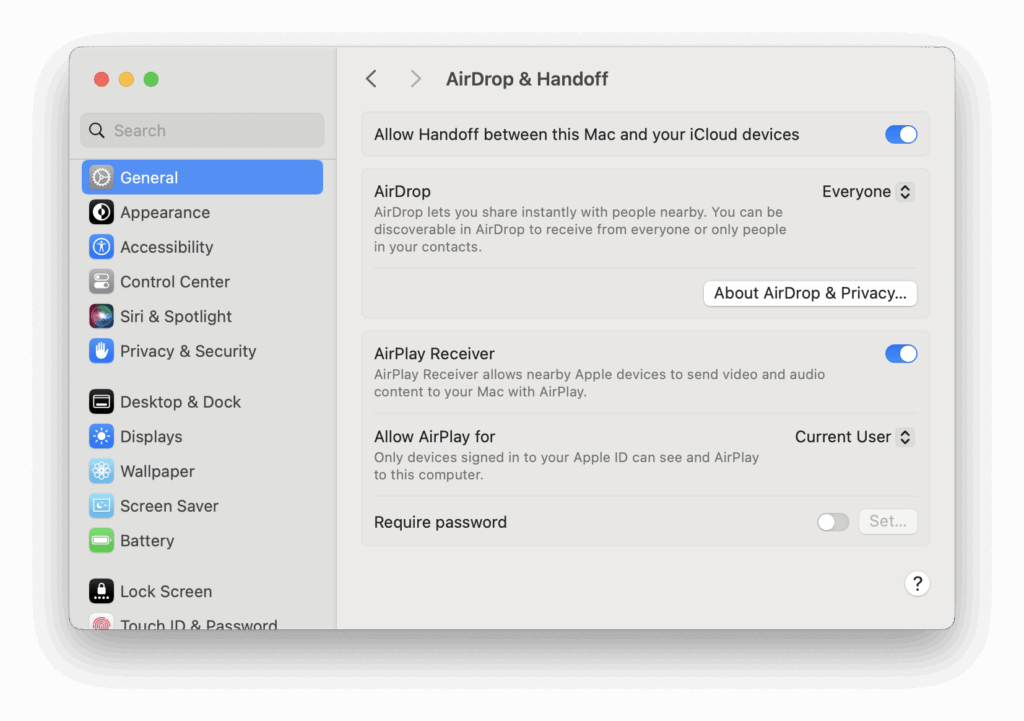
- Enable AirPlay Receiver
- macOS Monterey:
Apple Menu → System Preferences → Sharing → AirPlay Receiver - macOS Ventura or later:
Apple Menu → System Settings → General → AirDrop & Handoff → AirPlay Receiver
- macOS Monterey:
- Allow Connections
- Under “Allow AirPlay for”, choose Current User (recommended for security).
- Optional: set a password if others share your network.
2. Prepare the Source Mac
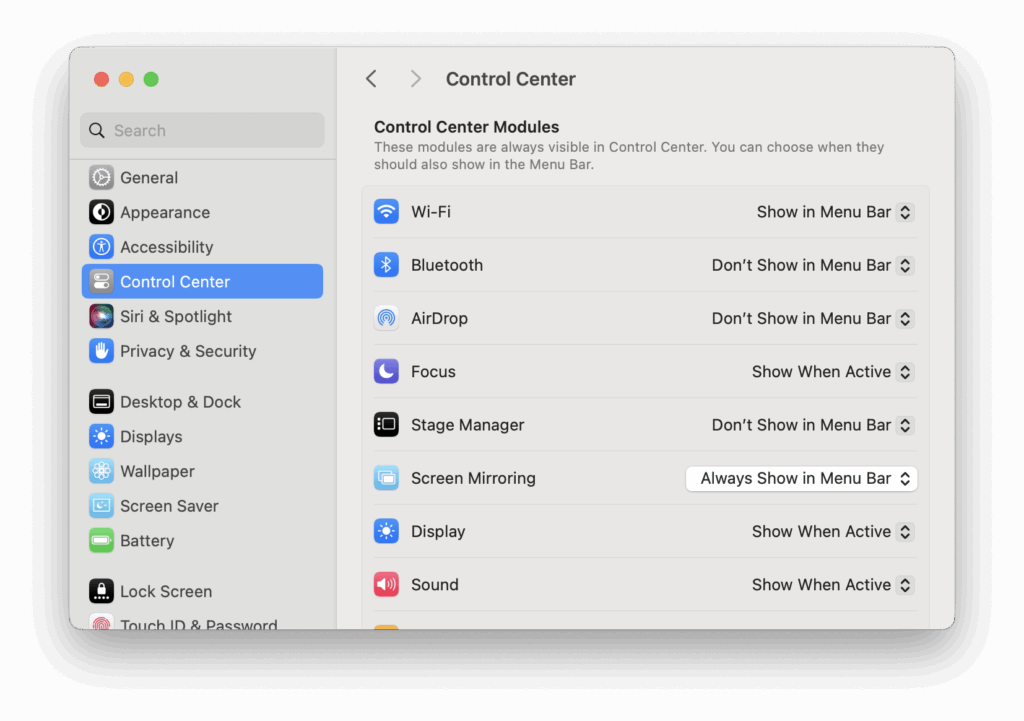
- Enable Screen Mirroring Icon
- Go to
Apple Menu → System Settings/Preferences → Control Center(or Dock & Menu Bar in Monterey). - Enable Screen Mirroring to appear in the menu bar for quick access.
- Go to
- (Optional) Use a Cable For Less Lag
- Connect the Macs with a Thunderbolt 3/4 (USB-C) cable for a faster, lower-latency connection. With older Macs, we found that a plain USB cable or a USB-C to USB-A cable with Apple Silicon Macs gives far less lag than Wi-Fi, often making the iMac feel like a near-native display. Thunderbolt cables also sometimes offer lower resolutions than a simple USB 3 cable.
- AirPlay does of course work over Wi-Fi, but a wired connection reduces lag. If you can’t use a cable, put both Macs on the same 5 GHz Wi-Fi network and keep other network to a minimum.
3. Connect & Extend
- On the source Mac, click the Screen Mirroring icon in the menu bar.
- Select your iMac from the list of available devices.
- Choose one of two options:
- Mirror Display – The iMac shows the same screen as your source Mac.
- Use as Separate Display – The iMac acts as an extended desktop (recommended for workspace).
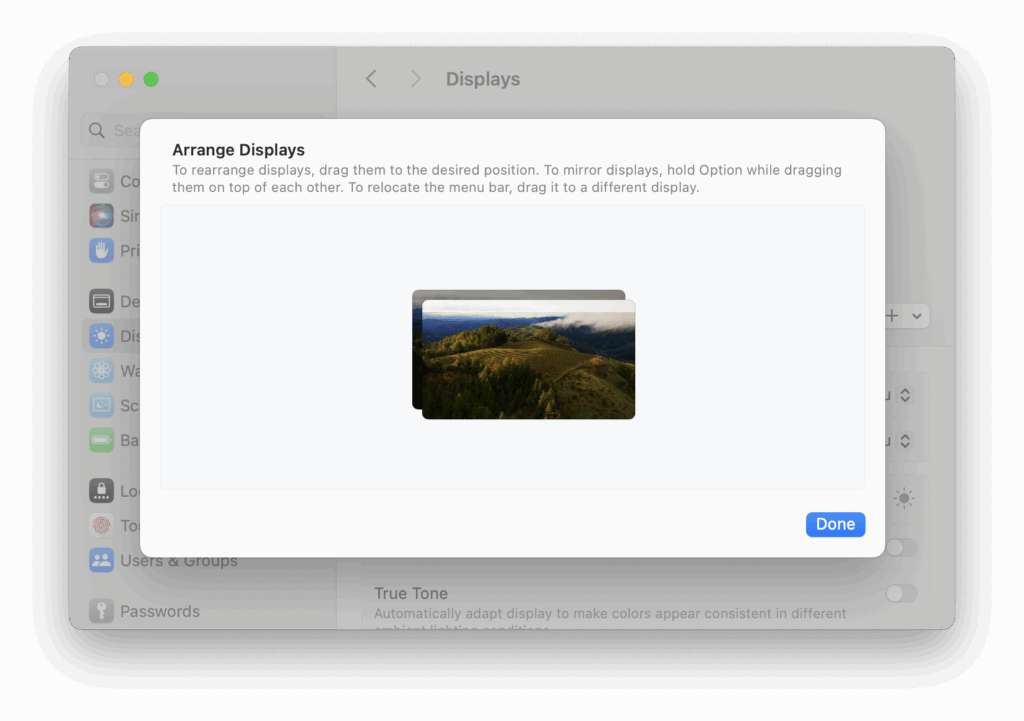
- To arrange displays:
- Go to System Settings → Displays → Arrangement.
- Drag the blue rectangles to match the physical layout of your screens.
4. Adjust Quality (Optional)
- For slightly sharper output, ensure both Macs are on Wi-Fi 6 or use a wired connection.
- Turn off other network-intensive tasks for smoother streaming.
5. Disconnect
- Click the Screen Mirroring icon in the menu bar again.
- Select Turn AirPlay Off to stop using the iMac as an external display.
Tips for Best Results
There’s a few things we recommend for better performance:
- Use Ethernet or Wi-Fi 6: A wired connection dramatically reduces lag and increases clarity.
- Adjust Resolution: Lower the iMac’s display resolution temporarily to reduce bandwidth demands and improve responsiveness. With USB,selectable modes are up to 2560×1440, 2880×1620, or even 3840×2160 (4K) on some 5K iMacs. The actual choices vary by Mac model and macOS version.Apps like BetterDisplay can unlock HiDPI scaling for crisper text.
- Enable “Full Quality”: If you have a fast network, select this option for sharper visuals.
- Mouse & Bluetooth Lag: Bluetooth peripherals can slow down when AirPlay is active. Switch to a wired or USB wireless mouse/keyboard if you notice stutter.
- Network Tips: If using Wi-Fi, disable internet access on the target iMac to reduce bandwidth competition.
- Audio sync can drift slightly; use the source Mac for audio output if lip-sync is critical.
Troubleshooting
If you’re having trouble connecting your iMac and Mac, try the following fixes:
- iMac not appearing:
Make sure AirPlay Receiver is toggled on the iMac and both Macs are on the same Apple ID or network. Reboot if needed. - Soft text:
Use “Use as Separate Display,” enable HiDPI scaling (BetterDisplay), and experiment with different cables. - No high-res option:
Some USB ports on older iMacs are only USB 2.0; try the high-speed ports or another cable.
Alternative Methods
If you don’t have the necessary models of Macs, software or network availability to do the above, there are other options.
Suggestions include:
- Luna Display: A third-party dongle/software combo that can push higher resolutions (up to 5K) between Macs with less compression than AirPlay.
- Wired AirPlay: Even though it uses a cable, it’s still limited to 1080p.
For more on these and other options, check out our guide to using an iMac as an external display with a Mac.
Summary
While AirPlay won’t give you the pixel-perfect sharpness of a native 5K Target Display Mode connection, it’s the only Apple-supported way to use a modern iMac as an external display for Apple Silicon or Intel Macs in 2025.
With the right cable and a patched OS if needed, AirPlay can transform even a decade-old iMac into a usable secondary display for a modern Mac – often at 1440p–4K – and with minimal lag when wired.
It won’t match a native 5K Thunderbolt display, but it’s a free and surprisingly practical way to extend the life of your iMac’s beautiful panel.
However, for those that want higher resolutions and performance, other options may be better.